
5.56x45mm NATO
Introduced 1980NATO standard
Also known as SS109, M855, 5.56 NATO: the same cartridge under different names, all of which find this page.
Dimensions and pressure
Generated from the schema, like every specification table on this site, so a figure recorded on this entry cannot be missing from the table.
Identity
- Designed by
- not recorded
- Introduced
- 1980
- Production
- not recorded
- Standards body
- NATO
- Case type
- Rimless
- Case shape
- Bottleneck
Dimensions
- Bullet diameter
No free NATO dimensional standard is published. The C.I.P. datasheet for the .223 Remington, which shares this bullet, gives a cartridge-maximum bullet diameter of 5.70 mm.
- Bore diameter
- not recorded
- Case length
- not recorded
STANAG 4172 is not published free of charge, and C.I.P. standardises only the commercial .223 Remington. No case length is recorded here rather than one borrowed from a different cartridge.
- Overall length
- 57.4 mm2.260 insource
Length of the M855 cartridge: 2.26 in (57.4 mm).
- Rim diameter
- not recorded
- Neck diameter
- not recorded
- Base diameter
- not recorded
Pressure
- Maximum pressure
- 379.2 MPa54,998 psisource
Chamber pressure of the M855 cartridge, 55,000 psi. The manual states this as the cartridge's pressure, not as a standard ceiling.
- Pressure standard
- NATO
SAAMI and C.I.P. measure pressure differently and their figures are not interchangeable, which is why the body is always named beside the figure.
Loads
Velocity is recorded per barrel length as published. A gun page interpolates between these points and never projects beyond them.
M855 ball (SS109)
US Government
- Bullet mass
- 4.018 g62.01 grsource
62 gr as published, converted to grams.
- Cartridge mass
- 12.31 g190.0 grsource
Complete round, 190 gr as published, converted to grams.
- Bullet type
- FMJ with hardened steel penetrator
- G1 BC
- not recorded
- G7 BC
- not recorded
| Barrel | Velocity |
|---|---|
| 508 mm20.00 in | 944.9 m/s3,100 fps |
| 368.3 mm14.50 in | 905.3 m/s2,970 fps |
Chambered in
Computed from every entry that lists this cartridge. Nothing here is hand-maintained.
- AK-102
Kalashnikov Concern
- AR-15 platform
- ArmaLite AR-18
ArmaLite
- B&T APC556
Brügger & Thomet
- CAR-15 XM177 Commando
Colt's Manufacturing Company
- Colt Canada C7
Diemaco
- Colt M4 Carbine
Colt's Manufacturing Company
- Daewoo Precision Industries K1A
SNT Motiv
- Daewoo Precision Industries K2
SNT Motiv
- FAMAS
Manufacture d'armes de Saint-Étienne
- FN CAL
FN Herstal
- FN SCAR
FN Herstal
- FX-05 Xiuhcoatl
Dirección General de Industria Militar
- Heckler & Koch G36
Heckler & Koch
- Heckler & Koch HK33
Heckler & Koch
- Heckler & Koch HK416
Heckler & Koch
- Howa Type 89
Howa Machinery, Ltd.
- IWI Galil
Israel Weapon Industries
- IWI Tavor X95
Israel Weapon Industries
- La France M16K
La France Specialties
- M16 rifle
Colt's Manufacturing Company
- M27 Infantry Automatic Rifle
Heckler & Koch
- Pindad SS2
Pindad
- S&T Daewoo K11
SNT Motiv
- SA80
Royal Small Arms Factory
- SIG SG 540
SIG Sauer AG
- SIG SG 550
SIG Sauer AG
- Smith & Wesson M&P15 Sport III
Smith & Wesson
- Steyr AUG
Steyr Arms
- Stoner 63
Cadillac Gage
- Vektor R4
Denel Land Systems
Gallery
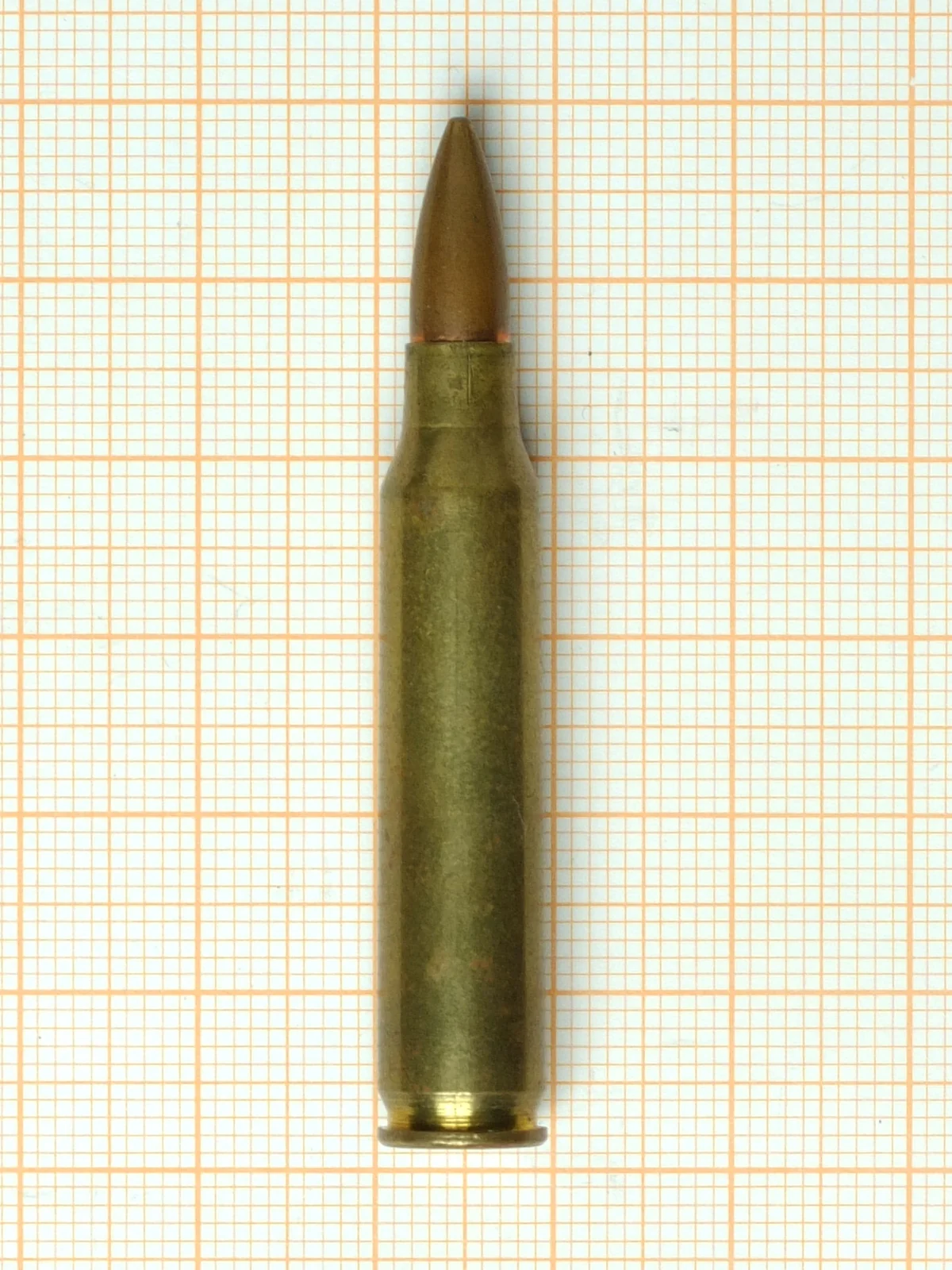
Image credit
- Title
- Cartridge 5.56x45mm NATO CC BY-SA 4.0 by Grasyl
- Author
- Grasyl(attribution required)
- Licence
- CC BY-SA 4.0
- Source
- https://commons.wikimedia.org/wiki/File:Cartridge_5.56x45mm_NATO_CC_BY-SA_4.0_by_Grasyl.jpg

Detail
The cartridge NATO adopted in 1980 is not the one the United States fielded in Vietnam. It keeps the case of the 1963 M193 loading and replaces the projectile with the Belgian SS109, a heavier bullet with a hardened steel penetrator in its nose, which needs a faster rifling twist to stabilise. That is the whole reason a 1970s rifle with a one-turn-in-twelve-inch barrel should not be fed this round: the chamber accepts it and the barrel will not steady it.
Sourcing this entry is harder than sourcing a commercial cartridge, and the gaps below are the honest result. STANAG 4172 is not published free of charge and C.I.P. standardises only the civil .223 Remington, so there is no free dimensional drawing to transcribe. What can be cited is the United States Army’s own ammunition data sheet for the M855 and the marksmanship manual’s velocity table, which is why the two velocity points here belong to a rifle and a carbine rather than to a laboratory test barrel.
References
- TM 43-0001-27, Army Ammunition Data Sheets: Small Caliber Ammunition · TM 43-0001-27, 29 April 1994 · read 2026-08-27
- FM 3-22.9, Rifle Marksmanship M16A1, M16A2/3, M16A4 and M4 Carbine · FM 3-22.9 (FM 23-9), Change 1 · read 2026-08-27
- C.I.P. TDCC datasheet, 223 Rem. · Tab. I, dated 1984-06-14, revision 2017-05-17 · read 2026-08-27
- M16 rifle · 1371381489 · read 2026-08-27
- Colt Military and Law Enforcement Catalog, Q2 2026 · read 2026-08-27
Last verified 2026-08-27 · review status: spot-checked