
M27 Infantry Automatic Rifle
Heckler & Koch2010–presentContemporary
Also known as M38 Squad Designated Marksman Rifle, Infantry Automatic Rifle
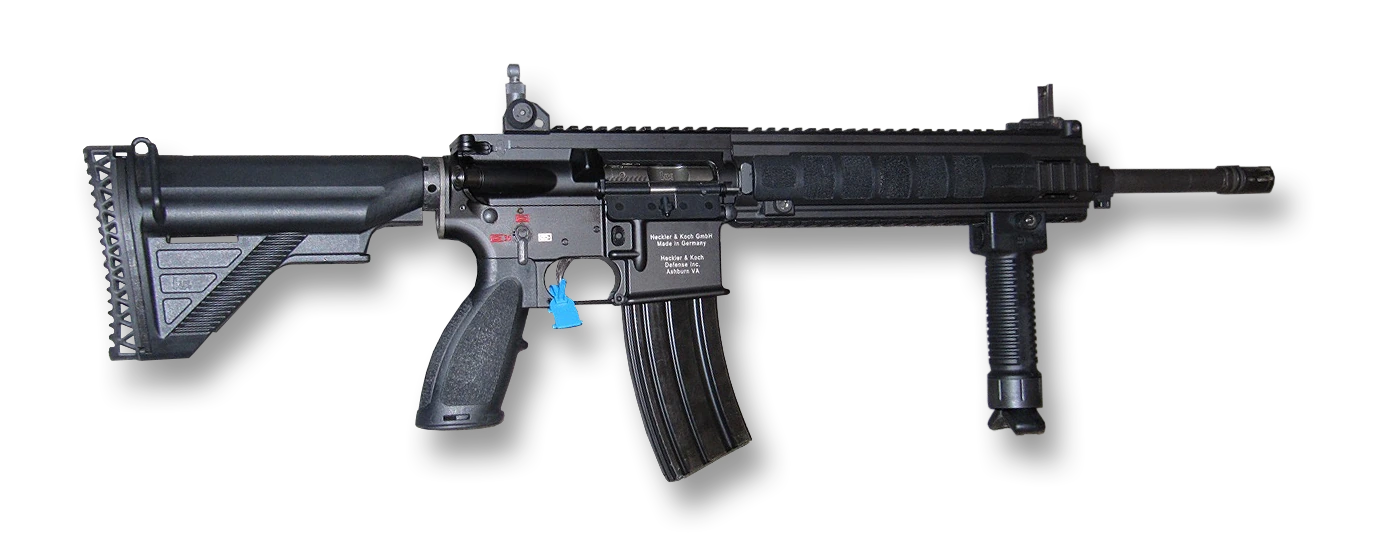
Image credit
- Title
- File:M27 Infantry Automatic Rifle noBG.png
- Author
- Steve(attribution required)
- Licence
- CC BY-SA 4.0
- Source
- https://commons.wikimedia.org/wiki/File:M27_Infantry_Automatic_Rifle_noBG.png

How Muzzle energy is calculated
E = ½ · m · v²
Inputs
- m4.018 g62.01 grverifiedsource62 gr as published, converted to grams.
- v919.7 m/s3,017 fpsestimatedInterpolated between sourced measurements at 368.3 mm and 508 mm.
1 of 2 inputs link to their source.
How Muzzle velocity is calculated
linear interpolation between the two nearest sourced barrel lengths
Inputs
- v at 368.3 mm905.3 m/s2,970 fpsverifiedsourceTable 2-1, muzzle velocity for the M4: 2,970 fps.
- v at 508 mm944.9 m/s3,100 fpsverifiedsourceTable 2-1, muzzle velocity for the M16A2: 3,100 fps. The M855 is the manual's service round for that rifle.
Assumptions
- Velocity is assumed to vary linearly between the two measurements. Over a short span that is a reasonable reading of the data; it is not a law.
2 of 2 inputs link to their source.
How Loaded mass is calculated
m_loaded = m_empty + m_magazine + n · m_cartridge
Not calculated: m_magazine has no sourced figure yet. Nothing is substituted for a missing input.
Assumptions
- One magazine, filled to the stated capacity. Spare magazines, optics, slings and lights are the owner’s, not the arm’s.
3 of 4 inputs link to their source.
How Free recoil is calculated
E_recoil = ½ · m_firearm · v_recoil²
Inputs
- m_firearm3.583 kg7.899 lbverifiedsource7.9 lb empty. The article gives 9.8 lb loaded with a sling, so this figure is the bare rifle.
- v_recoil1.031 m/s3.384 fpsestimated
Assumptions
- Propellant gas momentum is excluded: ARMAG does not record charge weights. This is therefore a lower bound on the real free recoil, consistent between entries but smaller than a figure that includes the gas term.
- Free recoil: the arm is unrestrained. Stock design, muzzle devices, stance and shooter mass are not modelled, because none of them is a property of the arm.
1 of 2 inputs link to their source.
How Capacity is calculated
as published for the primary chambering
Inputs
- capacity30verifiedsourceSTANAG magazine. The programme's original requirement asked for at least 100 rounds and was changed to the standard 30-round magazine.
1 of 1 inputs link to their source.
Derived figures
Computed from the sourced values above. Open ƒ on any figure for the formula, its inputs, and the assumptions it makes.
How Momentum is calculated
p = m · v
Inputs
- m4.018 g62.01 grverifiedsource62 gr as published, converted to grams.
- v919.7 m/s3,017 fpsestimatedInterpolated between sourced measurements at 368.3 mm and 508 mm.
1 of 2 inputs link to their source.
How Sectional density is calculated
SD = mass(gr) / (7000 · diameter(in)²)
Inputs
- mass4.018 g62.01 grverifiedsource62 gr as published, converted to grams.
- diameter5.7 mm0.2244 inestimatedsourceNo free NATO dimensional standard is published. The C.I.P. datasheet for the .223 Remington, which shares this bullet, gives a cartridge-maximum bullet diameter of 5.70 mm.
Assumptions
- Reported in the conventional lb/in² so it is directly comparable with published figures.
2 of 2 inputs link to their source.
How Power factor is calculated
PF = mass(gr) · velocity(fps) / 1000
Inputs
- mass4.018 g62.01 grverifiedsource62 gr as published, converted to grams.
- velocity919.7 m/s3,017 fpsestimatedInterpolated between sourced measurements at 368.3 mm and 508 mm.
Assumptions
- A competition classification defined by the IPSC and USPSA rulebooks, stated in their units. It describes a scoring category, not an effect.
1 of 2 inputs link to their source.
How Magazine dump is calculated
t = (n − 1) / (rpm / 60)
Inputs
- n30verifiedsourceSTANAG magazine. The programme's original requirement asked for at least 100 rounds and was changed to the standard 30-round magazine.
- rpm800 rpmestimatedsourceThe article gives a cyclic range of 700 to 900 rounds a minute; the midpoint of that range is recorded here because a PropertyValue holds one number. The sustained rate is given separately as 36 rounds a minute.
Assumptions
- Cyclic rate held for the whole magazine, no stoppages, trigger held down. A theoretical figure for comparing mechanisms, not a measured one.
2 of 2 inputs link to their source.
How Sight error at 1 mm is calculated
θ = atan(misalignment / sight radius)
Not calculated: sight radius has no sourced figure yet. Nothing is substituted for a missing input.
Assumptions
- Shows what a stated aiming error costs. The misalignment is the reader’s figure; the site does not claim how well anyone aims.
No input on this calculation carries a clickable source yet.
Specifications
Every row here is generated from the schema, so a figure recorded on this entry cannot be missing from the table, and the same rows, read the same way, are what the comparison shows.
Identity
- Type
- Rifle
- Action
- Self-loading
- Fire modes
- Semi-automatic
- Fully automatic
- Operating system
- Gas, short-stroke piston
- Designed in
- Germany
- Produced in
- Introduced
- 2010
- Production
- 2010–present
Dimensions and mass
- Mass, empty
- 3.583 kg7.899 lbsource
7.9 lb empty. The article gives 9.8 lb loaded with a sling, so this figure is the bare rifle.
- Magazine, empty
- not recorded
- Length
- 937.3 mm36.90 insource
36.9 in, the adjustable stock at its longest setting.
- Length, folded
- 838.2 mm33.00 insource
33 in, the adjustable stock fully collapsed. The stock telescopes rather than folding.
- Width
- 78.74 mm3.100 insource
3.1 in.
- Height
- 238.8 mm9.402 insource
9.4 in.
- Barrel length
- 419.1 mm16.50 insource
16.5 in, the standard barrel. A shorter 11 in barrel is issued for the Reconnaissance Weapons Kit.
Sights and rifling
- Sight radius
- not recorded
- Sight height over bore
- not recorded
- Rifling twist
- not recorded
- Twist direction
- not recorded
- Grooves
- not recorded
- Sight graduation
- not recorded
Operation
- Cyclic rate
The article gives a cyclic range of 700 to 900 rounds a minute; the midpoint of that range is recorded here because a PropertyValue holds one number. The sustained rate is given separately as 36 rounds a minute.
- Trigger pull
- not recorded
- Effective range
- 550 m601.5 ydsource
Effective range against a point target. The same source gives 700 m against an area target.
- Units produced
- 14,100source
The number of rifles the Marine Corps had bought as of April 2019, not a lifetime production figure.
- Launch price
- USD 1,300 · 2018 · USabout USD 1,667 in 2025 money, by US consumer prices
Chamberings
- 5.56x45mm NATOprimary30 rounds
Scale
A to-scale outline against family siblings. The dimensions are sourced; the shape is a representative outline for the type, and says so.
- M27 Infantry Automatic Rifle937.3 mm36.90 in
Representative outline: the dimensions are sourced, the shape is not. Overall length, and barrel length where recorded, are drawn from this entry's own figures; the profile is a generic one for the firearm type and says nothing about this arm's actual contours.
Lineage
This design
- Derived from Heckler & Koch HK416
Gallery
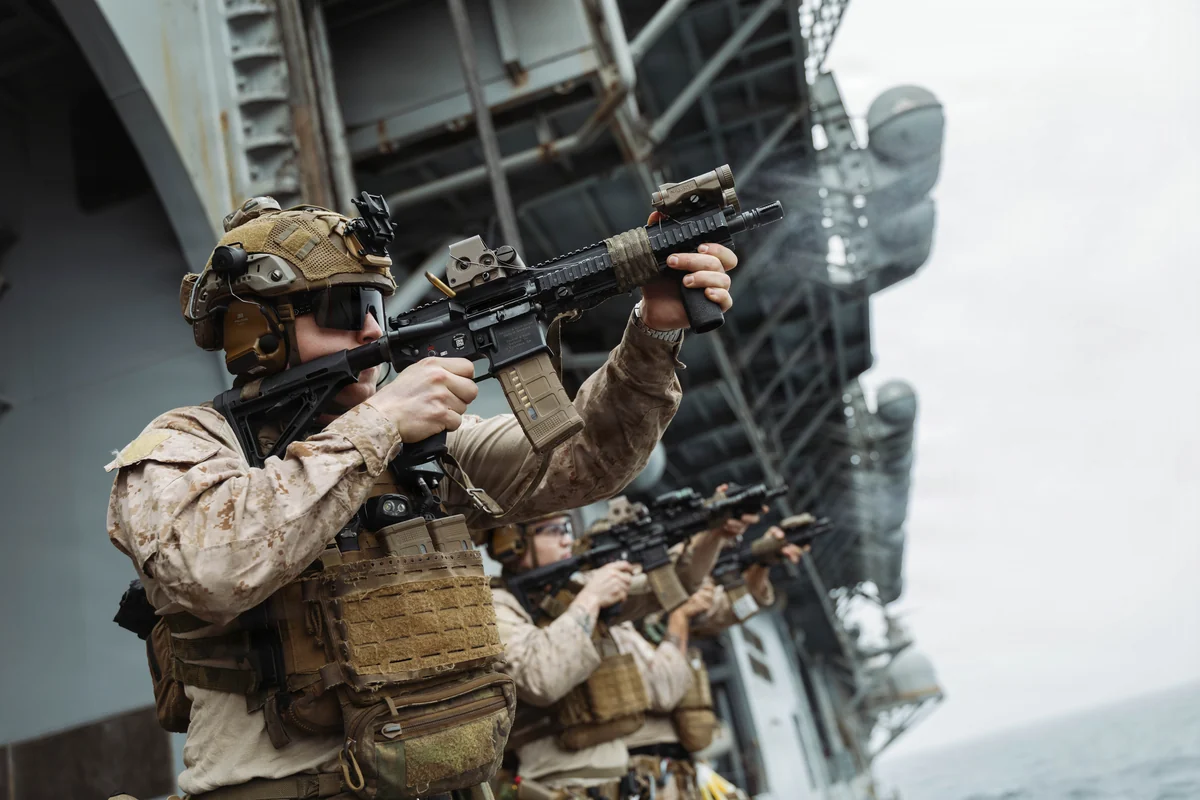
Image credit
- Title
- 11th MEU Maritime Raid Force Conducts Live-Fire Range Aboard USS Boxer
- Author
- Sgt. Joseph Helms
- Licence
- Public domain
- Source
- https://www.dvidshub.net/image/9898959/11th-meu-maritime-raid-force-conducts-live-fire-range-aboard-uss-boxer
- Note
- Work of the United States Government, uncopyrighted under 17 U.S.C. §105: photographed for the Marines (11th Marine Expeditionary Unit), VIRIN 260824-M-YF186-2083. DVIDS states no separate licence per asset.
Detail
The M27 is the answer the United States Marine Corps gave to a question nobody else was asking: what if the automatic rifleman in a fire team carried something that looked and handled exactly like everybody else’s rifle. Heckler & Koch won the Infantry Automatic Rifle competition in December 2009 with a version of the HK416, and the weapon was designated in the summer of 2010.
The requirement is what makes the rifle interesting, because most of it is about not standing out. The Marine Corps asked in 2005 for portability, for similarity in appearance to the other rifles in the squad, and for the ability to keep up a high volume of fire; an early demand for a magazine of at least a hundred rounds was dropped in favour of the standard thirty-round STANAG box. What the M27 gives up against the belt-fed M249 it was bought to replace is exactly what a magazine gives up against a belt, and the trade is deliberate: a 3.58 kg rifle firing from a closed bolt, with a 16.5-inch barrel, instead of a belt-fed open-bolt machine gun twice its weight. The sustained rate is quoted at 36 rounds a minute, a sixth of what the cyclic rate suggests, and that number is the honest measure of the compromise.
Underneath it is HK’s short-stroke gas piston rather than the AR-15’s direct impingement, so the carrier is driven by a rod and an operating pusher instead of by gas admitted into the receiver. That is the HK416’s contribution; almost everything the Marine sees and touches is the AR-15’s.
The programme then went somewhere it was never intended to. Fielding began with 458 rifles to five battalions bound for Afghanistan in 2011; by 2019 the Corps had bought 14,100 and had decided to issue the M27 to every infantry rifleman in place of the M16A4 and the M4A1, turning an automatic rifle into a service rifle. A variant with a variable-power optic and a suppressor is issued one per squad as the M38 designated marksman rifle.
Gaps on this page: no sight radius, trigger pull or rifling twist is published for the M27 in any free source, and the barrel is recorded only by length. The 14,100 figure is what the Marine Corps had bought by April 2019, not a production total; the $1,300 unit cost is a 2018 contract price to the government, not a retail one. The cyclic rate is published as a 700-to-900-rounds-a-minute range and is recorded here as its midpoint, marked estimated. The 11-inch barrel issued with the Reconnaissance Weapons Kit is noted but not modelled as a variant, because no separate weight or overall length is published for it.
References
This entry's own bibliography. Every citation key on this page resolves into this list.
- M27 Infantry Automatic Rifle · Wikipedia · 1369134770 · read 2026-09-01 · CC BY-SA 4.0
- All of the Marine M27 rifles are in · Marine Corps Times · read 2026-09-01
- Marines are buying M27 rifles at half price · Business Insider · read 2026-09-01
Last verified 2026-09-01 · review status: agent-populated