
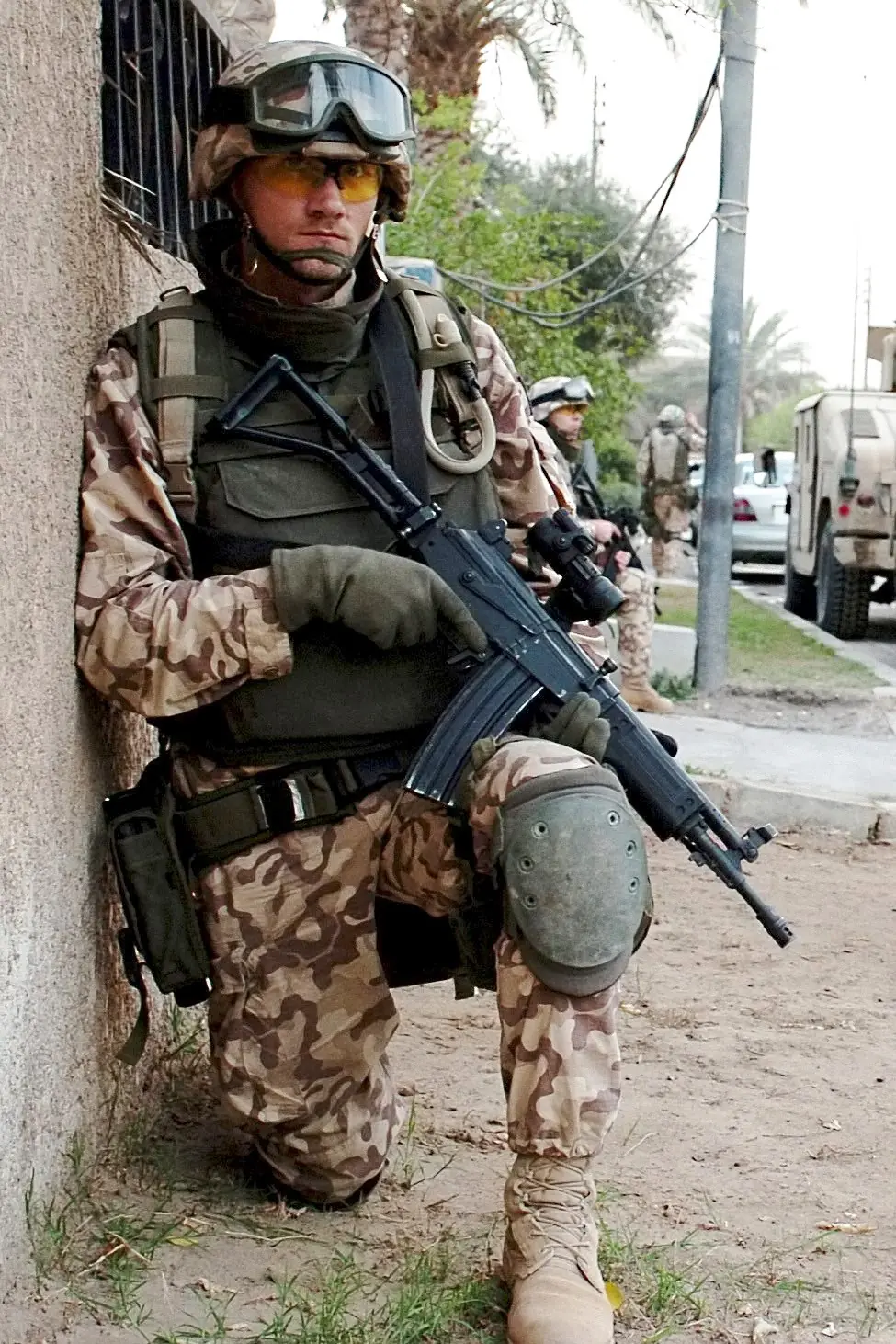
Image credit
- Title
- File:Estonian soldier DA-SD-06-03436 c1.jpg
- Author
- Sgt. David Foley, U.S. Army.
- Licence
- Public domain
- Source
- https://commons.wikimedia.org/wiki/File:Estonian_soldier_DA-SD-06-03436_c1.jpg

How Muzzle energy is calculated
E = ½ · m · v²
Inputs
- m4.018 g62.01 grverifiedsource62 gr as published, converted to grams.
- v905.3 m/s2,970 fpsverifiedMeasured with a 368.3 mm barrel, not this arm's 332 mm. Velocity outside the sourced range is not projected.
1 of 2 inputs link to their source.
How Muzzle velocity is calculated
nearest sourced barrel length, no extrapolation
Inputs
- v at 368.3 mm905.3 m/s2,970 fpsverifiedsourceTable 2-1, muzzle velocity for the M4: 2,970 fps.
Assumptions
- This figure belongs to a 368.3 mm barrel. It is shown because it is the closest measurement that exists, not because it applies here.
1 of 1 inputs link to their source.
How Loaded mass is calculated
m_loaded = m_empty + m_magazine + n · m_cartridge
Not calculated: m_magazine has no sourced figure yet. Nothing is substituted for a missing input.
Assumptions
- One magazine, filled to the stated capacity. Spare magazines, optics, slings and lights are the owner’s, not the arm’s.
3 of 4 inputs link to their source.
How Free recoil is calculated
E_recoil = ½ · m_firearm · v_recoil²
Inputs
- m_firearm3.75 kg8.267 lbverifiedsourceSAR. The AR is published at 3.95 kg and the ARM at 4.35 kg.
- v_recoil0.9700 m/s3.182 fpsestimated
Assumptions
- Propellant gas momentum is excluded: ARMAG does not record charge weights. This is therefore a lower bound on the real free recoil, consistent between entries but smaller than a figure that includes the gas term.
- Free recoil: the arm is unrestrained. Stock design, muzzle devices, stance and shooter mass are not modelled, because none of them is a property of the arm.
1 of 2 inputs link to their source.
How Capacity is calculated
as published for the primary chambering
Inputs
- capacity35verifiedsourceProprietary magazines of 35, 50 and 65 rounds; STANAG 30-round magazines also fit.
1 of 1 inputs link to their source.
Derived figures
Computed from the sourced values above. Open ƒ on any figure for the formula, its inputs, and the assumptions it makes.
How Momentum is calculated
p = m · v
Inputs
- m4.018 g62.01 grverifiedsource62 gr as published, converted to grams.
- v905.3 m/s2,970 fpsverifiedMeasured with a 368.3 mm barrel, not this arm's 332 mm. Velocity outside the sourced range is not projected.
1 of 2 inputs link to their source.
How Sectional density is calculated
SD = mass(gr) / (7000 · diameter(in)²)
Inputs
- mass4.018 g62.01 grverifiedsource62 gr as published, converted to grams.
- diameter5.7 mm0.2244 inestimatedsourceNo free NATO dimensional standard is published. The C.I.P. datasheet for the .223 Remington, which shares this bullet, gives a cartridge-maximum bullet diameter of 5.70 mm.
Assumptions
- Reported in the conventional lb/in² so it is directly comparable with published figures.
2 of 2 inputs link to their source.
How Power factor is calculated
PF = mass(gr) · velocity(fps) / 1000
Inputs
- mass4.018 g62.01 grverifiedsource62 gr as published, converted to grams.
- velocity905.3 m/s2,970 fpsverifiedMeasured with a 368.3 mm barrel, not this arm's 332 mm. Velocity outside the sourced range is not projected.
Assumptions
- A competition classification defined by the IPSC and USPSA rulebooks, stated in their units. It describes a scoring category, not an effect.
1 of 2 inputs link to their source.
How Magazine dump is calculated
t = (n − 1) / (rpm / 60)
Inputs
- n35verifiedsourceProprietary magazines of 35, 50 and 65 rounds; STANAG 30-round magazines also fit.
- rpm650 rpmverifiedsource
Assumptions
- Cyclic rate held for the whole magazine, no stoppages, trigger held down. A theoretical figure for comparing mechanisms, not a measured one.
2 of 2 inputs link to their source.
How Sight error at 1 mm is calculated
θ = atan(misalignment / sight radius)
Not calculated: sight radius has no sourced figure yet. Nothing is substituted for a missing input.
Assumptions
- Shows what a stated aiming error costs. The misalignment is the reader’s figure; the site does not claim how well anyone aims.
No input on this calculation carries a clickable source yet.
Specifications
Every row here is generated from the schema, so a figure recorded on this entry cannot be missing from the table, and the same rows, read the same way, are what the comparison shows.
Identity
- Type
- Rifle
- Action
- Self-loading
- Fire modes
- Semi-automatic
- Fully automatic
- Operating system
- Gas, long-stroke piston
- Designed in
- Israel
- Produced in
- Introduced
- 1972
- Production
- 1972–1998
Dimensions and mass
- Mass, empty
- 3.75 kg8.267 lbsource
SAR. The AR is published at 3.95 kg and the ARM at 4.35 kg.
- Magazine, empty
- not recorded
- Length
- 850 mm33.46 insource
SAR, stock extended.
- Length, folded
- 614 mm24.17 insource
SAR, stock folded.
- Width
- not recorded
- Height
- not recorded
- Barrel length
- 332 mm13.07 insource
SAR. The AR and ARM use a 460 mm barrel.
Sights and rifling
- Sight radius
- not recorded
- Sight height over bore
- not recorded
- Rifling twist
- not recorded
- Twist direction
- not recorded
- Grooves
- not recorded
- Sight graduation
- not recorded
Operation
- Cyclic rate
- 650 rpmsource
- Trigger pull
- not recorded
- Effective range
- not recorded
- Units produced
- not recorded
- Launch price
- not recorded
Chamberings
- 5.56x45mm NATOprimary35 rounds
- 7.62×51mm NATO25 rounds
Scale
A to-scale outline against family siblings. The dimensions are sourced; the shape is a representative outline for the type, and says so.
- IWI Galil850 mm33.46 inheight not recorded
Representative outline: the dimensions are sourced, the shape is not. Overall length, and barrel length where recorded, are drawn from this entry's own figures; the profile is a generic one for the firearm type and says nothing about this arm's actual contours. IWI Galil records no height, so its outline is drawn at the type's proportion. That height is part of the shape, not a measurement.
Lineage
Detail
Israel came out of 1967 having concluded that the FN FAL was too long, too heavy and too sensitive to sand for the way its army fought, and ran a trial to replace it. Yisrael Galili and Yakov Lior’s entry beat the Stoner 63 and the M16, and what they submitted was essentially a Kalashnikov: the same long-stroke piston and rotating bolt, licensed from Valmet’s Finnish version rather than copied, in 5.56×45mm.
The changes are all ergonomic and all telling. A folding stock that folds sideways rather than under, a charging handle bent upwards so it can be worked with either hand, a second safety lever above the pistol grip, and, on the ARM, a bipod that doubles as a wire cutter and a bottle opener on the magazine well, which is the detail everyone remembers.
It never fully displaced the M16 in Israeli service, largely because American rifles arrived as aid and Israeli ones had to be paid for.
The article publishes its figures per configuration; every dimension above is the SAR unless its note says otherwise, and no width, height or sight radius is given for any of them.
References
This entry's own bibliography. Every citation key on this page resolves into this list.
- IWI Galil · Wikipedia · 1371293647 · read 2026-08-31 · CC BY-SA 4.0
Last verified 2026-08-31 · review status: agent-populated