
M16 rifle
Colt's Manufacturing Company1963–presentEarly Cold War
Also known as Rifle, Caliber 5.56 mm, M16, M16A2
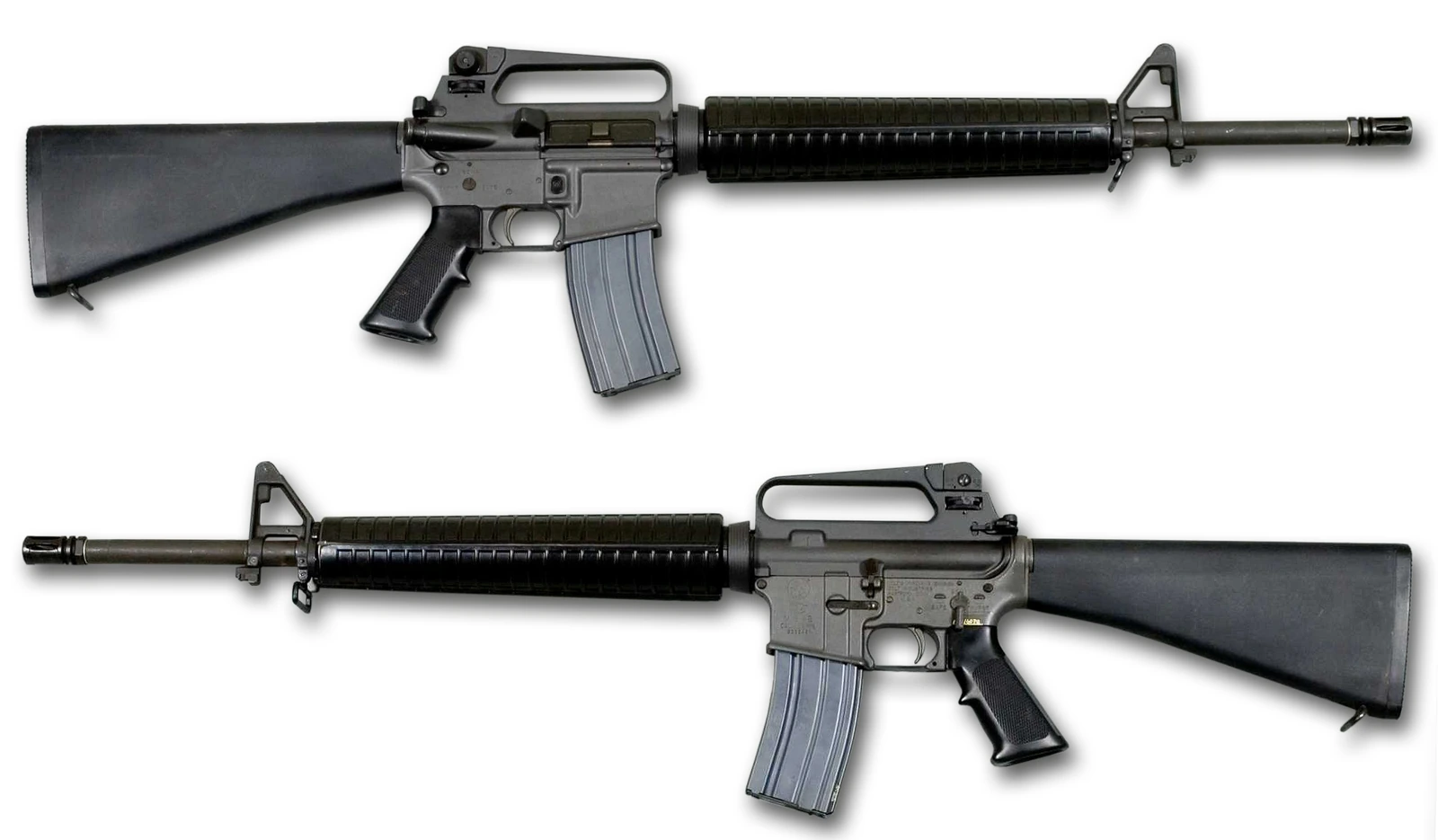
Image credit
- Title
- File:M16A2 noBG.jpg
- Author
- Armémuseum (The Swedish Army Museum)(attribution required)
- Licence
- CC BY-SA 4.0
- Source
- https://commons.wikimedia.org/wiki/File:M16A2_noBG.jpg

How Muzzle energy is calculated
E = ½ · m · v²
Inputs
- m4.018 g62.01 grverifiedsource62 gr as published, converted to grams.
- v944.9 m/s3,100 fpsverified
1 of 2 inputs link to their source.
How Muzzle velocity is calculated
measured at this barrel length
Inputs
- v944.9 m/s3,100 fpsverifiedsourceTable 2-1, muzzle velocity for the M16A2: 3,100 fps. The M855 is the manual's service round for that rifle.
1 of 1 inputs link to their source.
How Loaded mass is calculated
m_loaded = m_empty + m_magazine + n · m_cartridge
Not calculated: m_magazine has no sourced figure yet. Nothing is substituted for a missing input.
Assumptions
- One magazine, filled to the stated capacity. Spare magazines, optics, slings and lights are the owner’s, not the arm’s.
3 of 4 inputs link to their source.
How Free recoil is calculated
E_recoil = ½ · m_firearm · v_recoil²
Inputs
- m_firearm3.402 kg7.500 lbverifiedsourcePublished as 7.5 lb; 1 lb = 0.45359237 kg exactly. M16A2, without magazine or sling.
- v_recoil1.116 m/s3.661 fpsestimated
Assumptions
- Propellant gas momentum is excluded: ARMAG does not record charge weights. This is therefore a lower bound on the real free recoil, consistent between entries but smaller than a figure that includes the gas term.
- Free recoil: the arm is unrestrained. Stock design, muzzle devices, stance and shooter mass are not modelled, because none of them is a property of the arm.
1 of 2 inputs link to their source.
How Capacity is calculated
as published for the primary chambering
Inputs
- capacity30verifiedsourceSTANAG magazines of 20, 30, 40 and 60 rounds and a 100-round drum are listed.
1 of 1 inputs link to their source.
Derived figures
Computed from the sourced values above. Open ƒ on any figure for the formula, its inputs, and the assumptions it makes.
How Momentum is calculated
p = m · v
Inputs
- m4.018 g62.01 grverifiedsource62 gr as published, converted to grams.
- v944.9 m/s3,100 fpsverified
1 of 2 inputs link to their source.
How Sectional density is calculated
SD = mass(gr) / (7000 · diameter(in)²)
Inputs
- mass4.018 g62.01 grverifiedsource62 gr as published, converted to grams.
- diameter5.7 mm0.2244 inestimatedsourceNo free NATO dimensional standard is published. The C.I.P. datasheet for the .223 Remington, which shares this bullet, gives a cartridge-maximum bullet diameter of 5.70 mm.
Assumptions
- Reported in the conventional lb/in² so it is directly comparable with published figures.
2 of 2 inputs link to their source.
How Power factor is calculated
PF = mass(gr) · velocity(fps) / 1000
Inputs
- mass4.018 g62.01 grverifiedsource62 gr as published, converted to grams.
- velocity944.9 m/s3,100 fpsverified
Assumptions
- A competition classification defined by the IPSC and USPSA rulebooks, stated in their units. It describes a scoring category, not an effect.
1 of 2 inputs link to their source.
How Magazine dump is calculated
t = (n − 1) / (rpm / 60)
Inputs
- n30verifiedsourceSTANAG magazines of 20, 30, 40 and 60 rounds and a 100-round drum are listed.
- rpm800 rpmestimatedsourceThe article publishes 700–900 rounds/min for the M16A2 and M16A3 and a single 800 for the M16A4. Recorded as the M16A4 figure, which falls inside the earlier range.
Assumptions
- Cyclic rate held for the whole magazine, no stoppages, trigger held down. A theoretical figure for comparing mechanisms, not a measured one.
2 of 2 inputs link to their source.
How Sight error at 1 mm is calculated
θ = atan(misalignment / sight radius)
Not calculated: sight radius has no sourced figure yet. Nothing is substituted for a missing input.
Assumptions
- Shows what a stated aiming error costs. The misalignment is the reader’s figure; the site does not claim how well anyone aims.
No input on this calculation carries a clickable source yet.
Variants
M16A1
1967–1982
Forward assist, chrome-lined chamber and a 1:12 twist. The rifle of the Vietnam War, and the one whose early reliability problems produced a Congressional inquiry.
M16A2
1983–1994
Three-round burst instead of automatic, a heavier barrel in 1:7 twist for the new SS109 bullet, and an adjustable rear sight. The configuration this entry’s dimensions describe.
M16A4
1998–present
A flat-top receiver with a Picatinny rail in place of the fixed carrying handle.
| Variant | Years | Changes |
|---|---|---|
| M16A1 | 1967–1982 | no spec change |
| M16A2 | 1983–1994 | no spec change |
| M16A4 | 1998–present | no spec change |
Specifications
Every row here is generated from the schema, so a figure recorded on this entry cannot be missing from the table, and the same rows, read the same way, are what the comparison shows.
Identity
- Type
- Rifle
- Action
- Self-loading
- Fire modes
- Semi-automatic
- Burst
- Fully automatic
- Operating system
- Gas, direct impingement
- Designed in
- United States
- Produced in
- Introduced
- 1964
- Production
- 1963–present
Dimensions and mass
- Mass, empty
- 3.402 kg7.500 lbsource
Published as 7.5 lb; 1 lb = 0.45359237 kg exactly. M16A2, without magazine or sling.
- Magazine, empty
- not recorded
- Length
- 1,007 mm39.63 insource
Published as 39.63 in; 1 in = 25.4 mm exactly. M16A2.
- Length, folded
- not recorded
- Width
- not recorded
- Height
- not recorded
- Barrel length
- 508 mm20.00 insource
Published as 20 in; 1 in = 25.4 mm exactly.
Sights and rifling
- Sight radius
- not recorded
- Sight height over bore
- not recorded
- Rifling twist
- not recorded
- Twist direction
- not recorded
- Grooves
- not recorded
- Sight graduation
- not recorded
Operation
- Cyclic rate
The article publishes 700–900 rounds/min for the M16A2 and M16A3 and a single 800 for the M16A4. Recorded as the M16A4 figure, which falls inside the earlier range.
- Trigger pull
- not recorded
- Effective range
- 550 m601.5 ydsource
Published as the point-target effective range; 800 m is given for an area target.
- Units produced
The cited article gives "~8 million" for the M16 itself, separately from about 28 million AR-15–style rifles.
- Launch price
- not recorded
Chamberings
- 5.56x45mm NATOprimary30 rounds
Scale
A to-scale outline against family siblings. The dimensions are sourced; the shape is a representative outline for the type, and says so.
- M16 rifle1,007 mm39.63 inheight not recorded
- CAR-15 XM177 Commando787.4 mm31.00 inheight not recorded
- Colt M4 Carbine838.2 mm33.00 inheight not recorded
- La France M16K673.1 mm26.50 inheight not recorded
Representative outline: the dimensions are sourced, the shape is not. Overall length, and barrel length where recorded, are drawn from this entry's own figures; the profile is a generic one for the firearm type and says nothing about this arm's actual contours. M16 rifle, CAR-15 XM177 Commando, Colt M4 Carbine, La France M16K record no height, so their outline is drawn at the type's proportion. That height is part of the shape, not a measurement.
Lineage
What came from it
- Derivatives CAR-15 XM177 Commando
- Derivatives Colt M4 Carbine
- Derivatives La France M16K
- Cloned as Smith & Wesson M&P15 Sport III
Family
Detail
The rifle that made direct gas impingement respectable. Eugene Stoner’s AR-10 and the smaller AR-15 that followed it vent propellant gas down a tube directly onto the bolt carrier, with no piston at all, and the bolt carrier itself acts as the cylinder. The mechanism is light, has few parts and puts the reciprocating mass in line with the bore rather than above it, which is why the rifle stays flatter under automatic fire than anything it replaced.
The price is that combustion products go into the receiver instead of being vented at the gas block, and the rifle’s reputation was made and nearly destroyed by that. Early M16s issued in Vietnam without adequate cleaning kits and with a chamber that was not chrome-plated suffered repeated stoppages in combat, and soldiers’ letters home made the failures public in 1967. The M16A1 added a chrome-plated chamber and bore, and the Army issued new cleaning kits and trained troops to use them; the argument about the gas system has never quite finished.
What is not in dispute is that the pattern won. Nearly every Western service rifle of the last thirty years is either this rifle, a piston-driven answer to it, or a design that had to explain itself against it.
References
This entry's own bibliography. Every citation key on this page resolves into this list.
- M16 rifle · Wikipedia · 1371381489 · read 2026-08-31 · CC BY-SA 4.0
Last verified 2026-08-31 · review status: agent-populated