
Image credit
- Title
- File:Daewoo K11 Rifle noBG.png
- Author
- https://commons.wikimedia.org/w/index.php?title=User:Cinnamontrees&action=edit&redlink=1(attribution required)
- Licence
- CC BY-SA 4.0
- Source
- https://commons.wikimedia.org/wiki/File:Daewoo_K11_Rifle_noBG.png

How Muzzle energy is calculated
E = ½ · m · v²
Inputs
- m4.018 g62.01 grverifiedsource62 gr as published, converted to grams.
- v905.3 m/s2,970 fpsverifiedMeasured with a 368.3 mm barrel, not this arm's 310 mm. Velocity outside the sourced range is not projected.
1 of 2 inputs link to their source.
How Muzzle velocity is calculated
nearest sourced barrel length, no extrapolation
Inputs
- v at 368.3 mm905.3 m/s2,970 fpsverifiedsourceTable 2-1, muzzle velocity for the M4: 2,970 fps.
Assumptions
- This figure belongs to a 368.3 mm barrel. It is shown because it is the closest measurement that exists, not because it applies here.
1 of 1 inputs link to their source.
How Loaded mass is calculated
m_loaded = m_empty + m_magazine + n · m_cartridge
Not calculated: m_magazine has no sourced figure yet. Nothing is substituted for a missing input.
Assumptions
- One magazine, filled to the stated capacity. Spare magazines, optics, slings and lights are the owner’s, not the arm’s.
3 of 4 inputs link to their source.
How Free recoil is calculated
E_recoil = ½ · m_firearm · v_recoil²
Inputs
- m_firearm6.1 kg13.45 lbverifiedsourceEmpty, for the complete rifle-and-launcher unit; this entry covers the rifle (KE) section only.
- v_recoil0.5963 m/s1.956 fpsestimated
Assumptions
- Propellant gas momentum is excluded: ARMAG does not record charge weights. This is therefore a lower bound on the real free recoil, consistent between entries but smaller than a figure that includes the gas term.
- Free recoil: the arm is unrestrained. Stock design, muzzle devices, stance and shooter mass are not modelled, because none of them is a property of the arm.
1 of 2 inputs link to their source.
How Capacity is calculated
as published for the primary chambering
Inputs
- capacity30verifiedsourceStandard STANAG-pattern 20- or 30-round 5.56×45mm NATO magazines; 30 is the larger of the two.
1 of 1 inputs link to their source.
Derived figures
Computed from the sourced values above. Open ƒ on any figure for the formula, its inputs, and the assumptions it makes.
How Momentum is calculated
p = m · v
Inputs
- m4.018 g62.01 grverifiedsource62 gr as published, converted to grams.
- v905.3 m/s2,970 fpsverifiedMeasured with a 368.3 mm barrel, not this arm's 310 mm. Velocity outside the sourced range is not projected.
1 of 2 inputs link to their source.
How Sectional density is calculated
SD = mass(gr) / (7000 · diameter(in)²)
Inputs
- mass4.018 g62.01 grverifiedsource62 gr as published, converted to grams.
- diameter5.7 mm0.2244 inestimatedsourceNo free NATO dimensional standard is published. The C.I.P. datasheet for the .223 Remington, which shares this bullet, gives a cartridge-maximum bullet diameter of 5.70 mm.
Assumptions
- Reported in the conventional lb/in² so it is directly comparable with published figures.
2 of 2 inputs link to their source.
How Power factor is calculated
PF = mass(gr) · velocity(fps) / 1000
Inputs
- mass4.018 g62.01 grverifiedsource62 gr as published, converted to grams.
- velocity905.3 m/s2,970 fpsverifiedMeasured with a 368.3 mm barrel, not this arm's 310 mm. Velocity outside the sourced range is not projected.
Assumptions
- A competition classification defined by the IPSC and USPSA rulebooks, stated in their units. It describes a scoring category, not an effect.
1 of 2 inputs link to their source.
How Magazine dump is calculated
t = (n − 1) / (rpm / 60)
Inputs
- n30verifiedsourceStandard STANAG-pattern 20- or 30-round 5.56×45mm NATO magazines; 30 is the larger of the two.
- rpm700 rpmestimatedFrom the Wikipedia infobox, uncited there. Rifle (KE) section only.
Assumptions
- Cyclic rate held for the whole magazine, no stoppages, trigger held down. A theoretical figure for comparing mechanisms, not a measured one.
1 of 2 inputs link to their source.
How Sight error at 1 mm is calculated
θ = atan(misalignment / sight radius)
Not calculated: sight radius has no sourced figure yet. Nothing is substituted for a missing input.
Assumptions
- Shows what a stated aiming error costs. The misalignment is the reader’s figure; the site does not claim how well anyone aims.
No input on this calculation carries a clickable source yet.
Specifications
Every row here is generated from the schema, so a figure recorded on this entry cannot be missing from the table, and the same rows, read the same way, are what the comparison shows.
Identity
- Type
- Rifle
- Action
- Self-loading
- Fire modes
- Semi-automatic
- Burst
- Operating system
- not recorded
- Roles
- Designed in
- South Korea
- Produced in
- Introduced
- 2010
- Production
- 2010–2019
Dimensions and mass
- Mass, empty
- 6.1 kg13.45 lbsource
Empty, for the complete rifle-and-launcher unit; this entry covers the rifle (KE) section only.
- Magazine, empty
- not recorded
- Length
- 860 mm33.86 insource
Overall length of the complete bullpup unit.
- Length, folded
- not recorded
- Width
- not recorded
- Height
- not recorded
- Barrel length
- 310 mm12.20 insource
The 5.56×45mm (KE) barrel; the 20×30mm grenade-launcher barrel is stated separately at 405 mm.
Sights and rifling
- Sight radius
- not recorded
- Sight height over bore
- not recorded
- Rifling twist
- not recorded
- Twist direction
- not recorded
- Grooves
- not recorded
- Sight graduation
- not recorded
Operation
- Cyclic rate
- 700 rpmestimated
From the Wikipedia infobox, uncited there. Rifle (KE) section only.
- Trigger pull
- not recorded
- Effective range
- not recorded
- Units produced
- not recorded
- Launch price
- not recorded
Chamberings
- 5.56x45mm NATOprimary30 rounds
Scale
A to-scale outline against family siblings. The dimensions are sourced; the shape is a representative outline for the type, and says so.
- S&T Daewoo K11860 mm33.86 inheight not recorded
Representative outline: the dimensions are sourced, the shape is not. Overall length, and barrel length where recorded, are drawn from this entry's own figures; the profile is a generic one for the firearm type and says nothing about this arm's actual contours. S&T Daewoo K11 records no height, so its outline is drawn at the type's proportion. That height is part of the shape, not a measurement.
Gallery
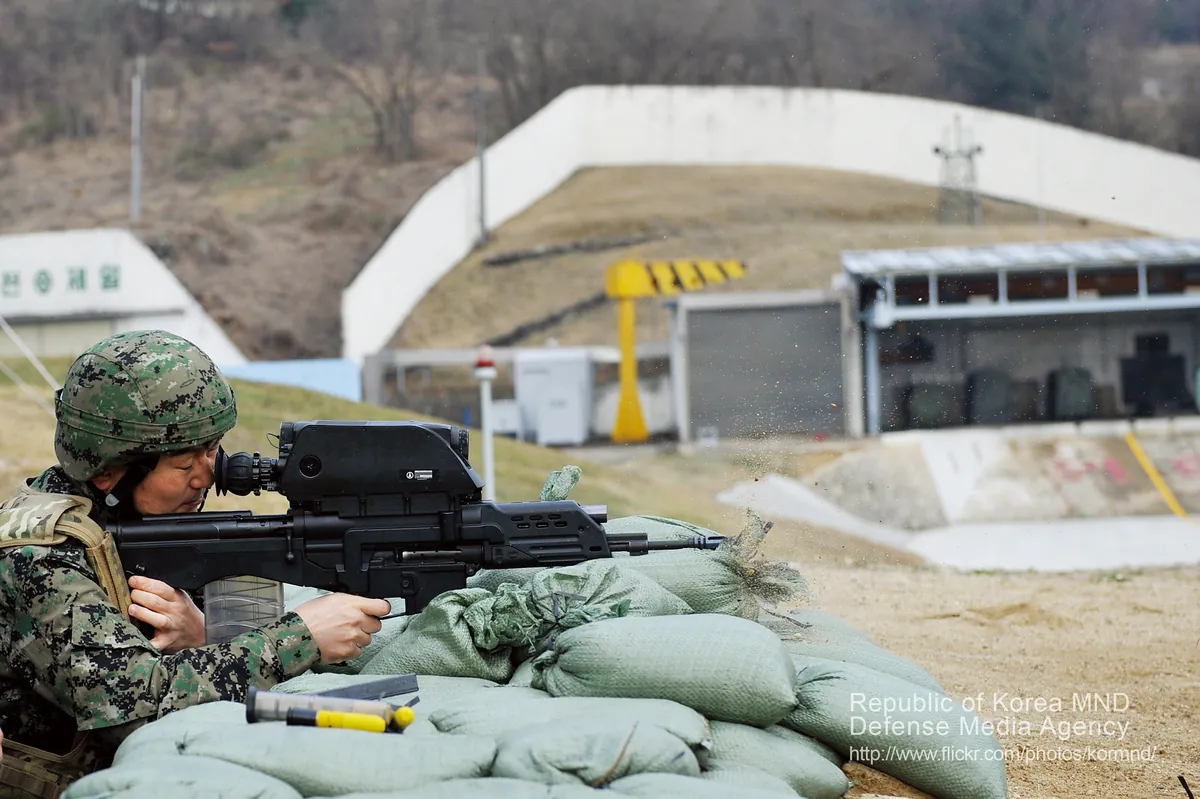
Image credit
- Title
- File:K11차기복합소총 (7439016000).jpg
- Author
- 대한민국 국군 Republic of Korea Armed Forces(attribution required)
- Licence
- CC BY-SA 2.0
- Source
- https://commons.wikimedia.org/wiki/File:K11차기복합소총_(7439016000).jpg

Detail
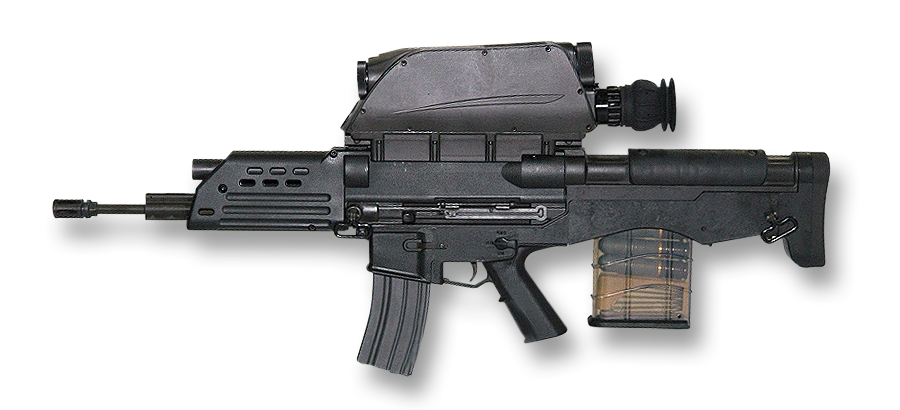
The K11 is a South Korean combination infantry weapon developed from 2000 to 2008 by the Agency for Defense Development with S&T Motiv, EO System, Poongsan and Hansung ILS, conceived along the same lines as the earlier American XM29 OICW: a single bullpup unit pairing a conventional rifle with a 20×30mm grenade launcher and a shared electronic sight. This entry covers only the rifle section, chambered for 5.56×45mm NATO; the grenade-launcher section, which fires programmable air-bursting rounds set to detonate at a range dialled in through a laser rangefinder and ballistics computer, falls outside what this site catalogues and is not represented in the data here.
South Korea adopted the K11 in 2008 and issued it to the Republic of Korea Army from 2010, making it the first military to field an airburst infantry weapon as standard issue, with squads receiving two rifles each rather than a full replacement for existing K2 rifles and their underslung K201 grenade launchers. The United Arab Emirates bought forty for evaluation the same year. The programme was troubled from early in its service life: a 2011 review found defects including barrel movement under fire and problems switching between single and automatic fire, and a further fire-control fault suspended use of the roughly 900 rifles then in the field in 2014. South Korea officially cancelled the K11 programme in December 2019, citing accuracy shortfalls and the unresolved defects.
The rifle section is a gas-operated, rotating-bolt design that feeds from standard STANAG-pattern 5.56mm box magazines in 20- or 30-round capacity, selected through the same fire-control selector that also switches the unit into grenade-launcher mode; the rifle and launcher share one trigger and cannot be fired in the same instant. Its fire selector layout borrows the M16/M4 pattern in principle, with an added position for the grenade launcher.
No source states whether the gas system is a short- or long-stroke piston design, so this page leaves that detail unspecified rather than guess. Cyclic rate for the rifle section is recorded from an uncited Wikipedia figure and is therefore estimated rather than verified, and no rifling twist rate for the 5.56mm barrel has been found.
References
This entry's own bibliography. Every citation key on this page resolves into this list.
- S&T Daewoo K11 · Wikipedia · 1335801921 · read 2026-09-24 · CC BY-SA 4.0
- Infantry Weapons: The Future Beckons for Asia · Asian Military Review · 2010 · read 2026-09-24
- K11 / XK11 (South Korea) · Modern Firearms (world.guns.ru) · read 2026-09-24
- K11 소총 관련 국방일보 기사 · Kookbang Ilbo (Republic of Korea Ministry of National Defense) · read 2026-09-24
Last verified 2026-09-24 · review status: agent-populated