
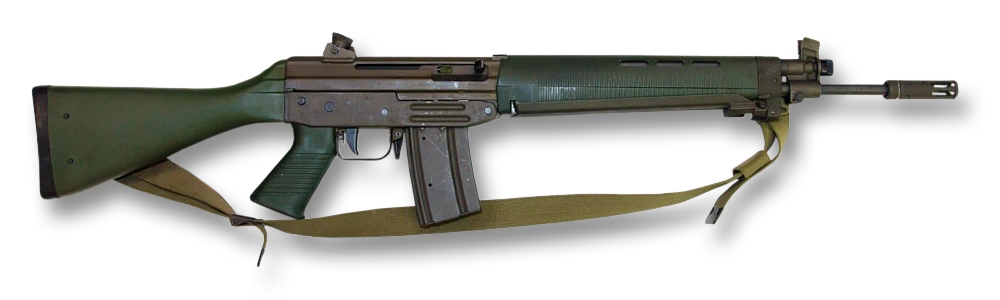
Image credit
- Title
- File:SG 540 Manurhin noBG.png
- Author
- https://commons.wikimedia.org/wiki/User:Sanandros(attribution required)
- Licence
- CC BY-SA 4.0
- Source
- https://commons.wikimedia.org/wiki/File:SG_540_Manurhin_noBG.png

How Muzzle energy is calculated
E = ½ · m · v²
Inputs
- m4.018 g62.01 grverifiedsource62 gr as published, converted to grams.
- v931.3 m/s3,055 fpsestimatedInterpolated between sourced measurements at 368.3 mm and 508 mm.
1 of 2 inputs link to their source.
How Muzzle velocity is calculated
linear interpolation between the two nearest sourced barrel lengths
Inputs
- v at 368.3 mm905.3 m/s2,970 fpsverifiedsourceTable 2-1, muzzle velocity for the M4: 2,970 fps.
- v at 508 mm944.9 m/s3,100 fpsverifiedsourceTable 2-1, muzzle velocity for the M16A2: 3,100 fps. The M855 is the manual's service round for that rifle.
Assumptions
- Velocity is assumed to vary linearly between the two measurements. Over a short span that is a reasonable reading of the data; it is not a law.
2 of 2 inputs link to their source.
How Loaded mass is calculated
m_loaded = m_empty + m_magazine + n · m_cartridge
Not calculated: m_magazine has no sourced figure yet. Nothing is substituted for a missing input.
Assumptions
- One magazine, filled to the stated capacity. Spare magazines, optics, slings and lights are the owner’s, not the arm’s.
1 of 4 inputs link to their source.
How Free recoil is calculated
E_recoil = ½ · m_firearm · v_recoil²
Inputs
- m_firearm3.52 kg7.760 lbestimatedFrom the Wikipedia infobox, uncited there. Fixed-stock configuration.
- v_recoil1.063 m/s3.488 fpsestimated
Assumptions
- Propellant gas momentum is excluded: ARMAG does not record charge weights. This is therefore a lower bound on the real free recoil, consistent between entries but smaller than a figure that includes the gas term.
- Free recoil: the arm is unrestrained. Stock design, muzzle devices, stance and shooter mass are not modelled, because none of them is a property of the arm.
No input on this calculation carries a clickable source yet.
How Capacity is calculated
as published for the primary chambering
Inputs
- capacity30estimatedFrom the Wikipedia infobox, uncited there: a 20- or 30-round detachable box magazine; 30 is the larger of the two.
No input on this calculation carries a clickable source yet.
Derived figures
Computed from the sourced values above. Open ƒ on any figure for the formula, its inputs, and the assumptions it makes.
How Momentum is calculated
p = m · v
Inputs
- m4.018 g62.01 grverifiedsource62 gr as published, converted to grams.
- v931.3 m/s3,055 fpsestimatedInterpolated between sourced measurements at 368.3 mm and 508 mm.
1 of 2 inputs link to their source.
How Sectional density is calculated
SD = mass(gr) / (7000 · diameter(in)²)
Inputs
- mass4.018 g62.01 grverifiedsource62 gr as published, converted to grams.
- diameter5.7 mm0.2244 inestimatedsourceNo free NATO dimensional standard is published. The C.I.P. datasheet for the .223 Remington, which shares this bullet, gives a cartridge-maximum bullet diameter of 5.70 mm.
Assumptions
- Reported in the conventional lb/in² so it is directly comparable with published figures.
2 of 2 inputs link to their source.
How Power factor is calculated
PF = mass(gr) · velocity(fps) / 1000
Inputs
- mass4.018 g62.01 grverifiedsource62 gr as published, converted to grams.
- velocity931.3 m/s3,055 fpsestimatedInterpolated between sourced measurements at 368.3 mm and 508 mm.
Assumptions
- A competition classification defined by the IPSC and USPSA rulebooks, stated in their units. It describes a scoring category, not an effect.
1 of 2 inputs link to their source.
How Magazine dump is calculated
t = (n − 1) / (rpm / 60)
Inputs
- n30estimatedFrom the Wikipedia infobox, uncited there: a 20- or 30-round detachable box magazine; 30 is the larger of the two.
- rpm725 rpmestimatedMidpoint of a published 650–800 rounds/min range, uncited on Wikipedia.
Assumptions
- Cyclic rate held for the whole magazine, no stoppages, trigger held down. A theoretical figure for comparing mechanisms, not a measured one.
No input on this calculation carries a clickable source yet.
How Sight error at 1 mm is calculated
θ = atan(misalignment / sight radius)
Not calculated: sight radius has no sourced figure yet. Nothing is substituted for a missing input.
Assumptions
- Shows what a stated aiming error costs. The misalignment is the reader’s figure; the site does not claim how well anyone aims.
No input on this calculation carries a clickable source yet.
Variants
SG 543
The carbine of the family: a folding stock and a shorter barrel, in the same 5.56×45mm NATO chambering as the base SG 540.
- Mass, empty
- 3 kg6.614 lbestimated
From the Wikipedia infobox, uncited there. Folding-stock configuration.
- Length
- 805 mm31.69 inestimated
From the Wikipedia infobox, uncited there. Stock extended.
- Length, folded
- 569 mm22.40 inestimated
From the Wikipedia infobox, uncited there. Stock folded.
- Barrel length
- 300 mm11.81 inestimated
From the Wikipedia infobox, uncited there.
| Variant | Years | Changes |
|---|---|---|
| SG 543 | — | Mass, empty, Length, Length, folded, Barrel length |
Specifications
Every row here is generated from the schema, so a figure recorded on this entry cannot be missing from the table, and the same rows, read the same way, are what the comparison shows.
Identity
- Type
- Rifle
- Action
- Self-loading
- Fire modes
- Semi-automatic
- Burst
- Fully automatic
- Operating system
- Gas, long-stroke piston
- Roles
- Designed in
- Switzerland
- Introduced
- 1977
- Production
- 1977–2002
Dimensions and mass
- Mass, empty
- 3.52 kg7.760 lbestimated
From the Wikipedia infobox, uncited there. Fixed-stock configuration.
- Magazine, empty
- not recorded
- Length
- 950 mm37.40 inestimated
From the Wikipedia infobox, uncited there. Fixed-stock configuration, stock extended.
- Length, folded
- 733 mm28.86 inestimated
From the Wikipedia infobox, uncited there. Folding-stock configuration.
- Width
- not recorded
- Height
- not recorded
- Barrel length
- 460 mm18.11 inestimated
From the Wikipedia infobox, uncited there.
Sights and rifling
- Sight radius
- not recorded
- Sight height over bore
- not recorded
- Rifling twist
- not recorded
- Twist direction
- not recorded
- Grooves
- not recorded
- Sight graduation
- 500 m546.8 ydestimated
From Wikipedia's design-details section, uncited there: the rear diopter drum's furthest of four settings (100, 200, 300, 500 m).
Operation
- Cyclic rate
- 725 rpmestimated
Midpoint of a published 650–800 rounds/min range, uncited on Wikipedia.
- Trigger pull
- not recorded
- Effective range
- not recorded
- Units produced
- not recorded
- Launch price
- not recorded
Chamberings
- 5.56x45mm NATOprimary30 rounds
Scale
A to-scale outline against family siblings. The dimensions are sourced; the shape is a representative outline for the type, and says so.
- SIG SG 540950 mm37.40 inheight not recorded
Representative outline: the dimensions are sourced, the shape is not. Overall length, and barrel length where recorded, are drawn from this entry's own figures; the profile is a generic one for the firearm type and says nothing about this arm's actual contours. SIG SG 540 records no height, so its outline is drawn at the type's proportion. That height is part of the shape, not a measurement.
Gallery
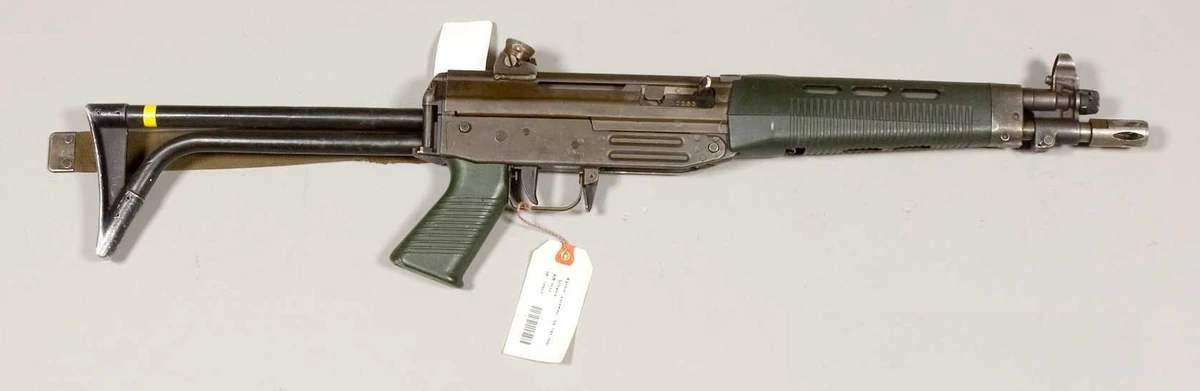
Image credit
- Title
- File:SIG SG 543 Right.jpg
- Author
- Armémuseum (The Swedish Army Museum)
- Licence
- Public domain
- Source
- https://commons.wikimedia.org/wiki/File:SIG_SG_543_Right.jpg

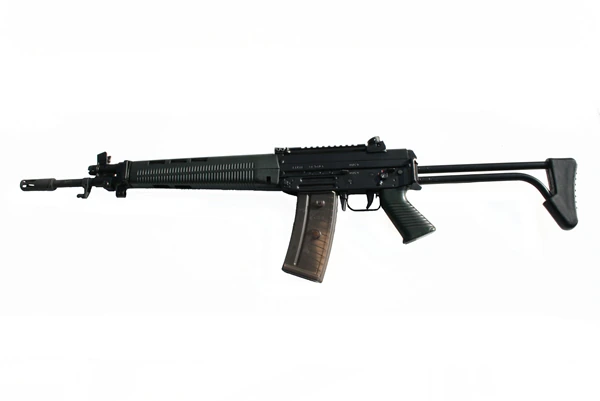
Image credit
- Title
- File:SG 540-1 FAMAE.jpg
- Author
- Fabricas y Maestranzas del Ejercito (Chile)(attribution required)
- Licence
- CC BY 2.5
- Source
- https://commons.wikimedia.org/wiki/File:SG_540-1_FAMAE.jpg

Detail
The SG 540 was SIG’s second attempt at a lightweight 5.56×45mm rifle. Its predecessor, the SG 530-1, used a gas-assisted roller-delayed blowback action that proved too complicated and expensive to build, so in 1969 SIG replaced it with a simpler and more robust gas-piston rotating-bolt mechanism derived from the Soviet AK-47’s, developed through the early 1970s and put into production from 1977. SIG designed it largely as a private-venture export rifle and a possible replacement for its own 7.5×55mm SG 510 in Swiss service, though Swiss federal restrictions on arms exports meant its series production was carried out at Manurhin’s plant in Mulhouse, France.
The rifle fires from a closed bolt with a long-stroke gas piston and a two-lug rotating bolt actuated by a cam slot in the carrier, and its gas regulator has three settings: one for rifle grenades, one for normal use, and one for fouled or extreme conditions. Its receiver and most furniture make heavy use of stamped and pressed steel and polymer parts rather than machined ones, a deliberate cost-saving choice for an export design competing on price. Portugal’s INDEP later licensed production of the carbine variant in 1988, and Chile’s FAMAE has manufactured the SG 540, SG 542 and SG 543 domestically under licence for the Chilean Armed Forces, work that also produced the SAF, a 9×19mm submachine gun FAMAE developed from the SG 540’s layout.
This entry covers the SG 540 and its 5.56mm carbine derivative, the SG 543, which is recorded here as a variant differing only in barrel length, overall length and mass, with a folding stock in place of the SG 540’s fixed one. The family’s third member, the SG 542, is chambered for the full-size 7.62×51mm NATO cartridge rather than 5.56mm, and has its own entry. The SG 540 series has seen use with military, police and irregular forces in conflicts including the Lebanese Civil War, the Somali Civil War and Syria’s civil war, and with organised-crime groups in Brazil.
No maker specification sheet independent of Wikipedia’s uncited infobox was found for any figure on this page, so mass, length, barrel length and cyclic rate are recorded as estimated rather than verified. No source pairs a muzzle velocity with a stated barrel length, so none is recorded.
References
This entry's own bibliography. Every citation key on this page resolves into this list.
- SIG SG 540 · Wikipedia · 1372688728 · read 2026-09-24 · CC BY-SA 4.0
Last verified 2026-09-24 · review status: agent-populated