
Image credit
- Title
- File:Gewehr G36 noBG.png
- Author
- Quelle: DomoK / Freisteller, Erweiterung, Bildbearbeitung & Retusche von Auge=mit(attribution required)
- Licence
- CC BY-SA 4.0
- Source
- https://commons.wikimedia.org/wiki/File:Gewehr_G36_noBG.png

How Muzzle energy is calculated
E = ½ · m · v²
Inputs
- m4.018 g62.01 grverifiedsource62 gr as published, converted to grams.
- v937.0 m/s3,074 fpsestimatedInterpolated between sourced measurements at 368.3 mm and 508 mm.
1 of 2 inputs link to their source.
How Muzzle velocity is calculated
linear interpolation between the two nearest sourced barrel lengths
Inputs
- v at 368.3 mm905.3 m/s2,970 fpsverifiedsourceTable 2-1, muzzle velocity for the M4: 2,970 fps.
- v at 508 mm944.9 m/s3,100 fpsverifiedsourceTable 2-1, muzzle velocity for the M16A2: 3,100 fps. The M855 is the manual's service round for that rifle.
Assumptions
- Velocity is assumed to vary linearly between the two measurements. Over a short span that is a reasonable reading of the data; it is not a law.
2 of 2 inputs link to their source.
How Loaded mass is calculated
m_loaded = m_empty + m_magazine + n · m_cartridge
Not calculated: m_magazine has no sourced figure yet. Nothing is substituted for a missing input.
Assumptions
- One magazine, filled to the stated capacity. Spare magazines, optics, slings and lights are the owner’s, not the arm’s.
3 of 4 inputs link to their source.
How Free recoil is calculated
E_recoil = ½ · m_firearm · v_recoil²
Inputs
- m_firearm3.63 kg8.003 lbestimatedsource3.63 kg from the encyclopedia infobox, which carries no citation for the figure and does not say whether a magazine is included. Heckler & Koch's own specification page lists weights only through a script the page loads separately, and publishes none in its markup.
- v_recoil1.037 m/s3.403 fpsestimated
Assumptions
- Propellant gas momentum is excluded: ARMAG does not record charge weights. This is therefore a lower bound on the real free recoil, consistent between entries but smaller than a figure that includes the gas term.
- Free recoil: the arm is unrestrained. Stock design, muzzle devices, stance and shooter mass are not modelled, because none of them is a property of the arm.
1 of 2 inputs link to their source.
How Capacity is calculated
as published for the primary chambering
Inputs
- capacity30verifiedsourceThe maker lists magazine capacities of 10, 20 and 30 rounds; 30 is the service magazine. The 100-round C-Mag drum is a separate feed device rather than a magazine option on that list.
1 of 1 inputs link to their source.
Derived figures
Computed from the sourced values above. Open ƒ on any figure for the formula, its inputs, and the assumptions it makes.
How Momentum is calculated
p = m · v
Inputs
- m4.018 g62.01 grverifiedsource62 gr as published, converted to grams.
- v937.0 m/s3,074 fpsestimatedInterpolated between sourced measurements at 368.3 mm and 508 mm.
1 of 2 inputs link to their source.
How Sectional density is calculated
SD = mass(gr) / (7000 · diameter(in)²)
Inputs
- mass4.018 g62.01 grverifiedsource62 gr as published, converted to grams.
- diameter5.7 mm0.2244 inestimatedsourceNo free NATO dimensional standard is published. The C.I.P. datasheet for the .223 Remington, which shares this bullet, gives a cartridge-maximum bullet diameter of 5.70 mm.
Assumptions
- Reported in the conventional lb/in² so it is directly comparable with published figures.
2 of 2 inputs link to their source.
How Power factor is calculated
PF = mass(gr) · velocity(fps) / 1000
Inputs
- mass4.018 g62.01 grverifiedsource62 gr as published, converted to grams.
- velocity937.0 m/s3,074 fpsestimatedInterpolated between sourced measurements at 368.3 mm and 508 mm.
Assumptions
- A competition classification defined by the IPSC and USPSA rulebooks, stated in their units. It describes a scoring category, not an effect.
1 of 2 inputs link to their source.
How Magazine dump is calculated
t = (n − 1) / (rpm / 60)
Inputs
- n30verifiedsourceThe maker lists magazine capacities of 10, 20 and 30 rounds; 30 is the service magazine. The 100-round C-Mag drum is a separate feed device rather than a magazine option on that list.
- rpm750 rpmverifiedsourceRate of fire 750 rounds/min, from the maker's technical specification table.
Assumptions
- Cyclic rate held for the whole magazine, no stoppages, trigger held down. A theoretical figure for comparing mechanisms, not a measured one.
2 of 2 inputs link to their source.
How Sight error at 1 mm is calculated
θ = atan(misalignment / sight radius)
Not calculated: sight radius has no sourced figure yet. Nothing is substituted for a missing input.
Assumptions
- Shows what a stated aiming error costs. The misalignment is the reader’s figure; the site does not claim how well anyone aims.
No input on this calculation carries a clickable source yet.
Variants
G36K
The carbine, introduced in 1997. Kurz means short: the barrel is cut to 318 mm and given an open-prong flash hider, the handguard is shortened and a bottom rail added. The shorter barrel cannot launch rifle grenades and carries no bayonet lug, but the 40 mm AG36 launcher still fits.
- Barrel length
318 mm, the second of the three barrel lengths in the uncited encyclopedia infobox.
G36C
The compact model of 2001, developed from the G36K. Its 228 mm barrel is short enough that the gas block had to be moved towards the muzzle and the piston rod shortened. The carry-handle optic is replaced by a rail with detachable iron sights, and the handguard and stock are shortened to match.
- Barrel length
228 mm, the shortest of the three barrel lengths in the uncited encyclopedia infobox.
| Variant | Years | Changes |
|---|---|---|
| G36K | — | Barrel length |
| G36C | — | Barrel length |
Specifications
Every row here is generated from the schema, so a figure recorded on this entry cannot be missing from the table, and the same rows, read the same way, are what the comparison shows.
Identity
- Type
- Rifle
- Action
- Self-loading
- Fire modes
- Semi-automatic
- Fully automatic
- Operating system
- Gas, short-stroke piston
- Designed in
- Germany
- Introduced
- 1996
- Production
- not recorded
Dimensions and mass
- Mass, empty
3.63 kg from the encyclopedia infobox, which carries no citation for the figure and does not say whether a magazine is included. Heckler & Koch's own specification page lists weights only through a script the page loads separately, and publishes none in its markup.
- Magazine, empty
- not recorded
- Length
999 mm with the stock extended, from the uncited encyclopedia infobox.
- Length, folded
758 mm with the stock folded to the right, from the uncited encyclopedia infobox.
- Width
64 mm from the uncited encyclopedia infobox. The folded stock adds to this and the figure does not say which state it describes.
- Height
320 mm from the uncited encyclopedia infobox, over the carry-handle sight bridge.
- Barrel length
480 mm for the full-length rifle, from the uncited encyclopedia infobox, which lists 318 mm and 228 mm alongside it for the carbine and compact models.
Sights and rifling
- Sight radius
- not recorded
- Sight height over bore
- not recorded
- Rifling twist
One turn in 178 mm, given in the encyclopedia's description of the barrel as 1 in 178 mm (1:7 in) with no citation. Heckler & Koch confirms the six-groove right-hand profile but publishes no twist length.
- Twist direction
- Right
- Grooves
- 6
- Sight graduation
- not recorded
Operation
- Cyclic rate
- 750 rpmsource
Rate of fire 750 rounds/min, from the maker's technical specification table.
- Trigger pull
- 40 N8.992 lbfsource
Trigger pull 40 N, from the maker's technical specification table.
- Effective range
600 m from the uncited encyclopedia infobox. This is a doctrinal figure for the full-length rifle with its 3x sight, not a measurement, and Heckler & Koch quotes a band rather than one number across the family.
- Units produced
The uncited encyclopedia infobox gives 260,000 or more. The figure is recorded as a floor rather than a total, and it includes the 75,219 rifles built under licence in Spain.
- Launch price
- not recorded
Chamberings
- 5.56x45mm NATOprimary30 rounds
Scale
A to-scale outline against family siblings. The dimensions are sourced; the shape is a representative outline for the type, and says so.
- Heckler & Koch G36999 mm39.33 in
Representative outline: the dimensions are sourced, the shape is not. Overall length, and barrel length where recorded, are drawn from this entry's own figures; the profile is a generic one for the firearm type and says nothing about this arm's actual contours.
Gallery
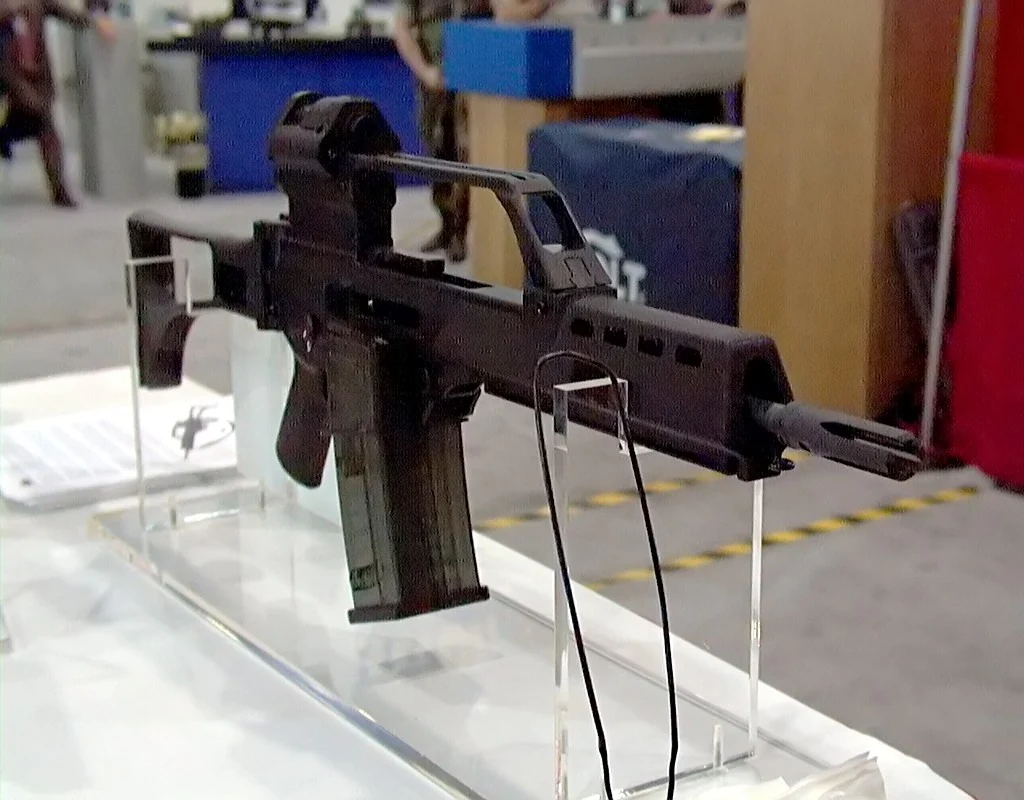
Image credit
- Title
- File:G36 Select-Fire Carbine.JPEG
- Author
- Sgt. Keith A. Stevenson
- Licence
- Public domain
- Source
- https://commons.wikimedia.org/wiki/File:G36_Select-Fire_Carbine.JPEG
- Note
- Work of the United States Government, uncopyrighted under 17 U.S.C. section 105: photographed for the United States Marine Corps.

Image credit
- Title
- File:German policeman with a Heckler & Koch G36 rifle.jpg
- Author
- Martin Greeson, U.S. Army
- Licence
- Public domain
- Source
- https://commons.wikimedia.org/wiki/File:German_policeman_with_a_Heckler_&_Koch_G36_rifle.jpg
- Note
- Work of the United States Government, uncopyrighted under 17 U.S.C. section 105: photographed for the United States Army.

Detail
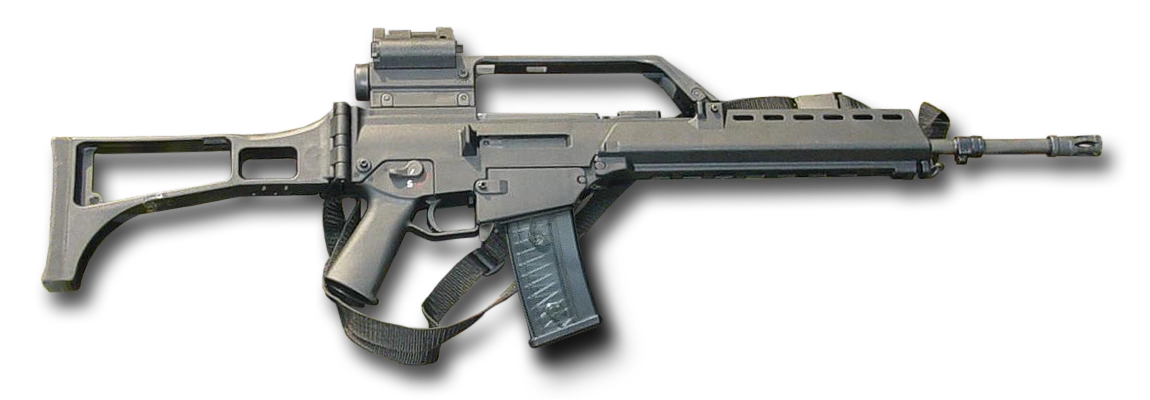
The G36 is the rifle with which Heckler & Koch gave up on the roller-delayed blowback that had defined the company since the G3. Submitted for trials as the HK50 and adopted by the Bundeswehr in 1997, it is a short-stroke gas piston rifle with a rotating bolt (the conventional layout the firm had spent forty years avoiding), wrapped in a carbon-fibre-reinforced polyamide shell that made it more than a kilogram lighter than the battle rifle it replaced.
The polymer is the design, not the finish. Receiver housing, stock, trigger group, magazine well, handguard and carry handle are all moulded, with a steel trunnion set into the receiver to carry the locking recesses; the barrel is fastened to that trunnion with a nut and floats free of the handguard. The sight bridge is moulded as one piece with an integral 3x telescope and a reflex sight above it, which is why the standard rifle has no rail and why the export G36V, sold with a single 1.5x sight, needed a different bridge rather than a different mount. The magazine is proprietary and translucent, with studs on its sides so that two or three clip together edge to edge in a soldier’s pouch.
The plastic construction is also the source of the rifle’s public difficulty. From 2012 the Bundeswehr reported that sustained firing heated the barrel and its surrounding structure enough to shift the point of impact, and after tests by the Fraunhofer Ernst-Mach-Institut and a ministerial dispute over whether the cause was the weapon or the ammunition, Germany opened the Sturmgewehr replacement competition that eventually selected the HK416 as the G95A1. The G36 remained in service throughout, and remains a widespread export: Spain adopted it in 1998 and built 75,219 rifles under licence at La Coruña between 1999 and 2005.
Gaps on this page: Heckler & Koch’s own specification page publishes the calibre, the operating principle, the rate of fire, the trigger pull and the barrel profile, but loads the weight and dimension block through a script and puts no numbers in the page itself, so every length and the empty weight here come from the encyclopedia’s uncited infobox and are recorded as estimates. The same applies to the rifling twist. No free source gives per-variant weights or overall lengths for the G36K or the G36C, so those tabs carry only the barrel length that distinguishes them. Spanish licensed production is described in the prose but not recorded as a production country, because the taxonomy has no term for Spain yet.
References
This entry's own bibliography. Every citation key on this page resolves into this list.
- G36 technical specifications · Heckler & Koch GmbH · read 2026-08-31
- Heckler & Koch G36 · Wikipedia · 1368388400 · read 2026-08-31 · CC BY-SA 4.0
Last verified 2026-08-31 · review status: agent-populated