
Steyr AUG
Armee-Universal-Gewehr
Steyr Arms1977–presentLate Cold War
Also known as StG 77, F88 Austeyr
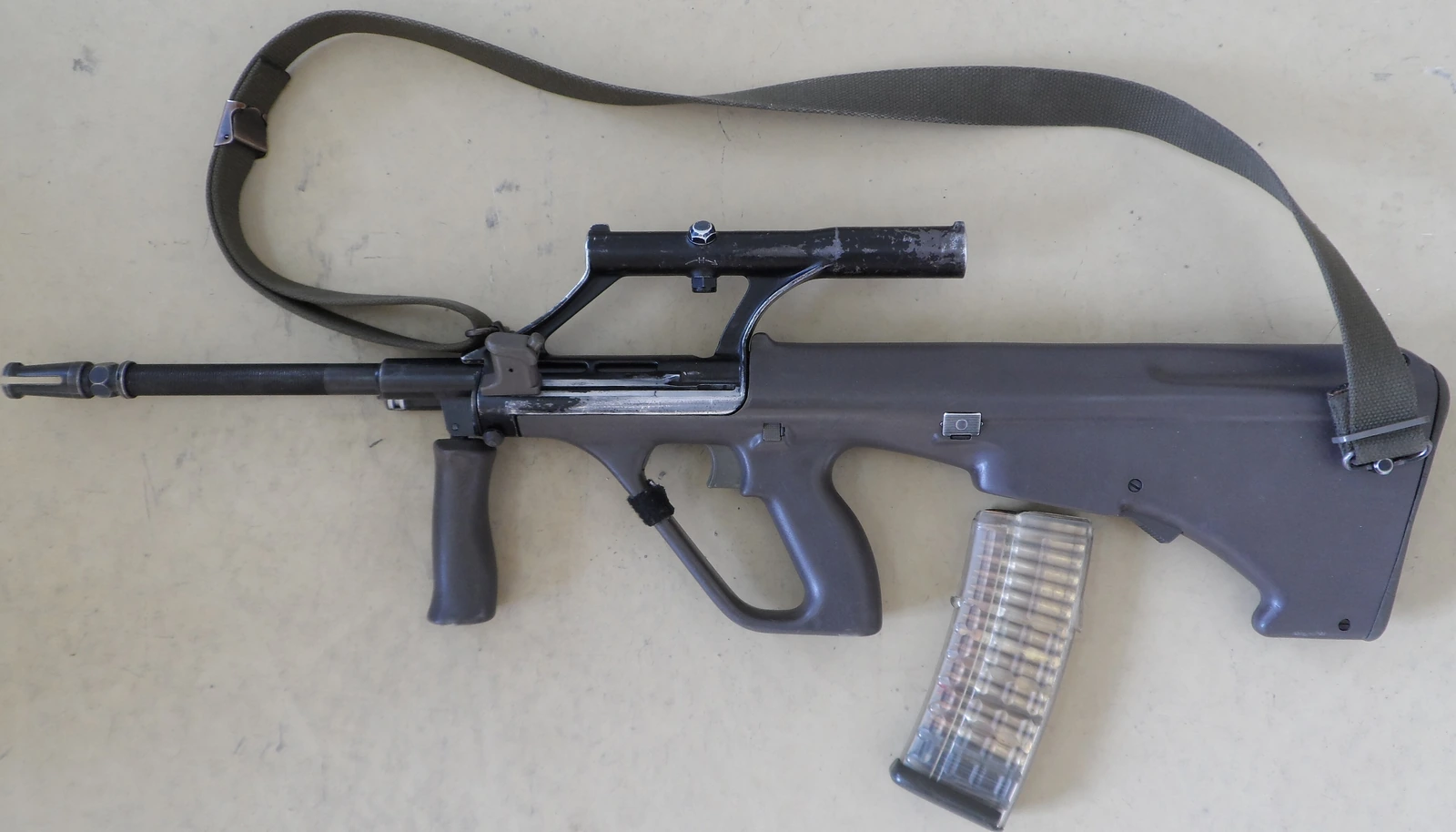
Image credit
- Title
- File:Steyr AUG 5,56 mm.JPG
- Author
- MoserB
- Licence
- Public domain
- Source
- https://commons.wikimedia.org/wiki/File:Steyr_AUG_5,56_mm.JPG

How Muzzle energy is calculated
E = ½ · m · v²
Inputs
- m4.018 g62.01 grverifiedsource62 gr as published, converted to grams.
- v944.9 m/s3,100 fpsverified
1 of 2 inputs link to their source.
How Muzzle velocity is calculated
measured at this barrel length
Inputs
- v944.9 m/s3,100 fpsverifiedsourceTable 2-1, muzzle velocity for the M16A2: 3,100 fps. The M855 is the manual's service round for that rifle.
1 of 1 inputs link to their source.
How Loaded mass is calculated
m_loaded = m_empty + m_magazine + n · m_cartridge
Not calculated: m_magazine has no sourced figure yet. Nothing is substituted for a missing input.
Assumptions
- One magazine, filled to the stated capacity. Spare magazines, optics, slings and lights are the owner’s, not the arm’s.
3 of 4 inputs link to their source.
How Free recoil is calculated
E_recoil = ½ · m_firearm · v_recoil²
Inputs
- m_firearm3.6 kg7.937 lbverifiedsourceWith the 20-inch barrel; 3.3 kg with the 16.4-inch and 3.2 kg with the 15-inch.
- v_recoil1.055 m/s3.460 fpsestimated
Assumptions
- Propellant gas momentum is excluded: ARMAG does not record charge weights. This is therefore a lower bound on the real free recoil, consistent between entries but smaller than a figure that includes the gas term.
- Free recoil: the arm is unrestrained. Stock design, muzzle devices, stance and shooter mass are not modelled, because none of them is a property of the arm.
1 of 2 inputs link to their source.
How Capacity is calculated
as published for the primary chambering
Inputs
- capacity30verifiedsourceProprietary translucent box magazines of 30 and 42 rounds.
1 of 1 inputs link to their source.
Derived figures
Computed from the sourced values above. Open ƒ on any figure for the formula, its inputs, and the assumptions it makes.
How Momentum is calculated
p = m · v
Inputs
- m4.018 g62.01 grverifiedsource62 gr as published, converted to grams.
- v944.9 m/s3,100 fpsverified
1 of 2 inputs link to their source.
How Sectional density is calculated
SD = mass(gr) / (7000 · diameter(in)²)
Inputs
- mass4.018 g62.01 grverifiedsource62 gr as published, converted to grams.
- diameter5.7 mm0.2244 inestimatedsourceNo free NATO dimensional standard is published. The C.I.P. datasheet for the .223 Remington, which shares this bullet, gives a cartridge-maximum bullet diameter of 5.70 mm.
Assumptions
- Reported in the conventional lb/in² so it is directly comparable with published figures.
2 of 2 inputs link to their source.
How Power factor is calculated
PF = mass(gr) · velocity(fps) / 1000
Inputs
- mass4.018 g62.01 grverifiedsource62 gr as published, converted to grams.
- velocity944.9 m/s3,100 fpsverified
Assumptions
- A competition classification defined by the IPSC and USPSA rulebooks, stated in their units. It describes a scoring category, not an effect.
1 of 2 inputs link to their source.
How Magazine dump is calculated
t = (n − 1) / (rpm / 60)
Inputs
- n30verifiedsourceProprietary translucent box magazines of 30 and 42 rounds.
- rpm715 rpmestimatedsourceThe article publishes 680–750 rounds/min for the AUG HBAR. Recorded as the midpoint of that range; no single figure is given for the standard rifle.
Assumptions
- Cyclic rate held for the whole magazine, no stoppages, trigger held down. A theoretical figure for comparing mechanisms, not a measured one.
2 of 2 inputs link to their source.
How Sight error at 1 mm is calculated
θ = atan(misalignment / sight radius)
Not calculated: sight radius has no sourced figure yet. Nothing is substituted for a missing input.
Assumptions
- Shows what a stated aiming error costs. The misalignment is the reader’s figure; the site does not claim how well anyone aims.
No input on this calculation carries a clickable source yet.
Specifications
Every row here is generated from the schema, so a figure recorded on this entry cannot be missing from the table, and the same rows, read the same way, are what the comparison shows.
Identity
- Type
- Rifle
- Action
- Self-loading
- Fire modes
- Semi-automatic
- Fully automatic
- Operating system
- Gas, short-stroke piston
- Designed in
- Austria
- Introduced
- 1978
- Production
- 1977–present
Dimensions and mass
- Mass, empty
- 3.6 kg7.937 lbsource
With the 20-inch barrel; 3.3 kg with the 16.4-inch and 3.2 kg with the 15-inch.
- Magazine, empty
- not recorded
- Length
- 790 mm31.10 insource
With the 20-inch barrel; 725 mm with the 16.4-inch and 690 mm with the 15-inch.
- Length, folded
- not recorded
- Width
- not recorded
- Height
- not recorded
- Barrel length
- 508 mm20.00 insource
The rifle barrel. Barrels of 417 mm and 382 mm are also standard, and the weapon is designed to be changed between them.
Sights and rifling
- Sight radius
- not recorded
- Sight height over bore
- not recorded
- Rifling twist
- not recorded
- Twist direction
- not recorded
- Grooves
- not recorded
- Sight graduation
- not recorded
Chamberings
- 5.56x45mm NATOprimary30 rounds
Scale
A to-scale outline against family siblings. The dimensions are sourced; the shape is a representative outline for the type, and says so.
- Steyr AUG790 mm31.10 inheight not recorded
Representative outline: the dimensions are sourced, the shape is not. Overall length, and barrel length where recorded, are drawn from this entry's own figures; the profile is a generic one for the firearm type and says nothing about this arm's actual contours. Steyr AUG records no height, so its outline is drawn at the type's proportion. That height is part of the shape, not a measurement.
Detail
The first bullpup to be adopted by a Western army and still the one that most obviously earned its place. The AUG’s argument is not the layout by itself but what the layout allowed Steyr to do with it: a quick-change barrel with a folding grip that doubles as a handle, a receiver of aluminium with a fixed 1.5× optic cast into it, a two-stage trigger that gives automatic fire when pulled all the way through, and a transparent magazine.
The optic mattered more than anything else at the time. In 1977 every other service rifle had iron sights and optics were an accessory for specialists; the AUG made a low-power sight standard issue two decades before anyone else did.
The consequence of the fixed sight was that it was very hard to add anything else, and later variants replaced the cast-in optic with a rail. That is the pattern of the whole design: brilliant in 1977, gradually conventionalised since.
The article publishes eight barrel lengths across five configurations and a cyclic rate only for the heavy barrel version, which is why the rate here is an estimate and the barrel note names the alternatives.
References
This entry's own bibliography. Every citation key on this page resolves into this list.
- Steyr AUG · Wikipedia · 1371210441 · read 2026-08-31 · CC BY-SA 4.0
Last verified 2026-08-31 · review status: agent-populated