
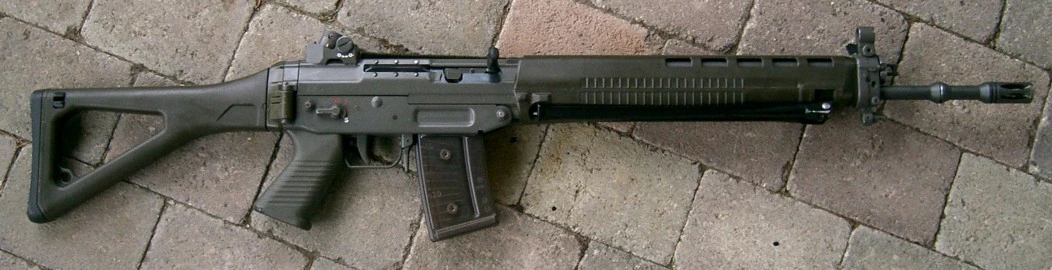
Image credit
- Title
- File:Stgw 90 3.jpg
- Author
- stw(attribution required)
- Licence
- CC BY-SA 3.0
- Source
- https://commons.wikimedia.org/wiki/File:Stgw_90_3.jpg

How Muzzle energy is calculated
E = ½ · m · v²
Inputs
- m4.018 g62.01 grverifiedsource62 gr as published, converted to grams.
- v944.9 m/s3,100 fpsverifiedMeasured with a 508 mm barrel, not this arm's 528 mm. Velocity outside the sourced range is not projected.
1 of 2 inputs link to their source.
How Muzzle velocity is calculated
nearest sourced barrel length, no extrapolation
Inputs
- v at 508 mm944.9 m/s3,100 fpsverifiedsourceTable 2-1, muzzle velocity for the M16A2: 3,100 fps. The M855 is the manual's service round for that rifle.
Assumptions
- This figure belongs to a 508 mm barrel. It is shown because it is the closest measurement that exists, not because it applies here.
1 of 1 inputs link to their source.
How Loaded mass is calculated
m_loaded = m_empty + m_magazine + n · m_cartridge
Not calculated: m_magazine has no sourced figure yet. Nothing is substituted for a missing input.
Assumptions
- One magazine, filled to the stated capacity. Spare magazines, optics, slings and lights are the owner’s, not the arm’s.
3 of 4 inputs link to their source.
How Free recoil is calculated
E_recoil = ½ · m_firearm · v_recoil²
Inputs
- m_firearm4.1 kg9.039 lbestimatedsourcefrom the infobox, uncited on Wikipedia
- v_recoil0.9260 m/s3.038 fpsestimated
Assumptions
- Propellant gas momentum is excluded: ARMAG does not record charge weights. This is therefore a lower bound on the real free recoil, consistent between entries but smaller than a figure that includes the gas term.
- Free recoil: the arm is unrestrained. Stock design, muzzle devices, stance and shooter mass are not modelled, because none of them is a property of the arm.
1 of 2 inputs link to their source.
How Capacity is calculated
as published for the primary chambering
Inputs
- capacity30estimatedsourcelargest of the proprietary 10-, 20- and 30-round box magazines published for the SG 550 series, uncited on Wikipedia; later variants also accept STANAG magazines
1 of 1 inputs link to their source.
Derived figures
Computed from the sourced values above. Open ƒ on any figure for the formula, its inputs, and the assumptions it makes.
How Momentum is calculated
p = m · v
Inputs
- m4.018 g62.01 grverifiedsource62 gr as published, converted to grams.
- v944.9 m/s3,100 fpsverifiedMeasured with a 508 mm barrel, not this arm's 528 mm. Velocity outside the sourced range is not projected.
1 of 2 inputs link to their source.
How Sectional density is calculated
SD = mass(gr) / (7000 · diameter(in)²)
Inputs
- mass4.018 g62.01 grverifiedsource62 gr as published, converted to grams.
- diameter5.7 mm0.2244 inestimatedsourceNo free NATO dimensional standard is published. The C.I.P. datasheet for the .223 Remington, which shares this bullet, gives a cartridge-maximum bullet diameter of 5.70 mm.
Assumptions
- Reported in the conventional lb/in² so it is directly comparable with published figures.
2 of 2 inputs link to their source.
How Power factor is calculated
PF = mass(gr) · velocity(fps) / 1000
Inputs
- mass4.018 g62.01 grverifiedsource62 gr as published, converted to grams.
- velocity944.9 m/s3,100 fpsverifiedMeasured with a 508 mm barrel, not this arm's 528 mm. Velocity outside the sourced range is not projected.
Assumptions
- A competition classification defined by the IPSC and USPSA rulebooks, stated in their units. It describes a scoring category, not an effect.
1 of 2 inputs link to their source.
How Magazine dump is calculated
t = (n − 1) / (rpm / 60)
Inputs
- n30estimatedsourcelargest of the proprietary 10-, 20- and 30-round box magazines published for the SG 550 series, uncited on Wikipedia; later variants also accept STANAG magazines
- rpm700 rpmestimatedsourcepublished as 'c. 700 rounds/min', uncited on Wikipedia
Assumptions
- Cyclic rate held for the whole magazine, no stoppages, trigger held down. A theoretical figure for comparing mechanisms, not a measured one.
2 of 2 inputs link to their source.
How Sight error at 1 mm is calculated
θ = atan(misalignment / sight radius)
Inputs
- sight radius540 mm21.26 inestimatedsourceSG 550, from the infobox, uncited on Wikipedia
- misalignment1 mm0.03937 inverified
Assumptions
- Shows what a stated aiming error costs. The misalignment is the reader’s figure; the site does not claim how well anyone aims.
1 of 2 inputs link to their source.
Specifications
Every row here is generated from the schema, so a figure recorded on this entry cannot be missing from the table, and the same rows, read the same way, are what the comparison shows.
Identity
- Type
- Rifle
- Action
- Self-loading
- Fire modes
- Semi-automatic
- Burst
- Fully automatic
- Operating system
- Gas, long-stroke piston
- Roles
- Designed in
- Switzerland
- Produced in
- Introduced
- 1986
- Production
- 1986–present
Dimensions and mass
- Mass, empty
from the infobox, uncited on Wikipedia
- Magazine, empty
- not recorded
- Length
stock extended, from the infobox, uncited on Wikipedia
- Length, folded
stock folded, from the infobox, uncited on Wikipedia
- Width
- not recorded
- Height
- not recorded
- Barrel length
from the infobox, uncited on Wikipedia
Sights and rifling
- Sight radius
SG 550, from the infobox, uncited on Wikipedia
- Sight height over bore
- not recorded
- Rifling twist
- not recorded
- Twist direction
- not recorded
- Grooves
- not recorded
- Sight graduation
- not recorded
Chamberings
- 5.56x45mm NATOprimary30 rounds
Scale
A to-scale outline against family siblings. The dimensions are sourced; the shape is a representative outline for the type, and says so.
- SIG SG 5501,000 mm39.37 inheight not recorded
Representative outline: the dimensions are sourced, the shape is not. Overall length, and barrel length where recorded, are drawn from this entry's own figures; the profile is a generic one for the firearm type and says nothing about this arm's actual contours. SIG SG 550 records no height, so its outline is drawn at the type's proportion. That height is part of the shape, not a measurement.
Gallery
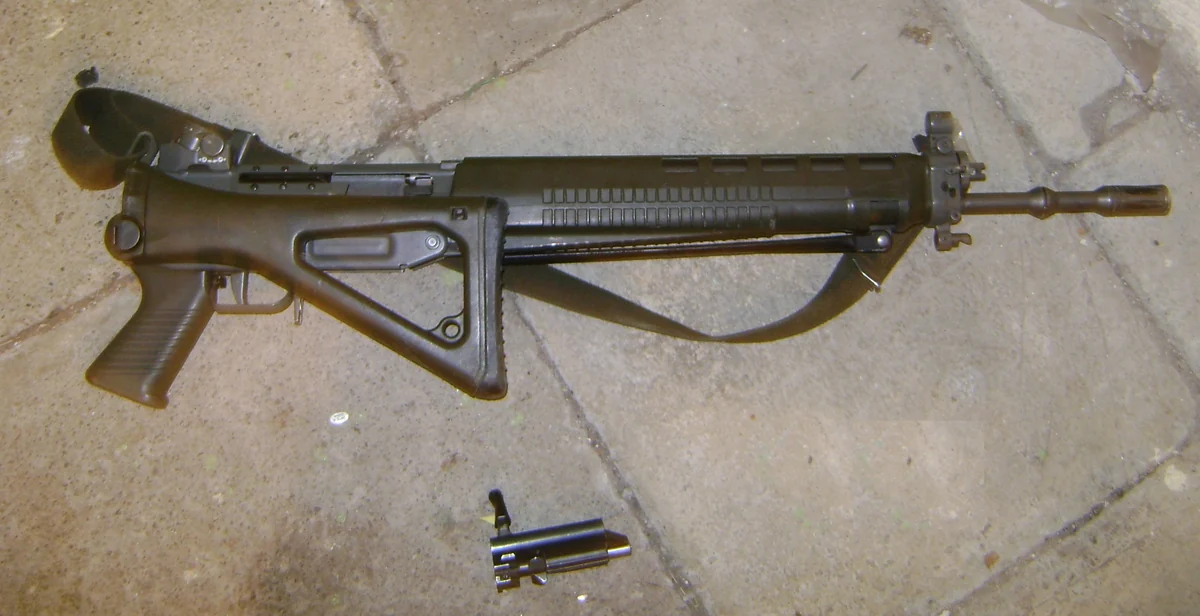
Image credit
- Title
- File:StGw90 geklappt.JPG
- Author
- Hornet Driver(attribution required)
- Licence
- CC BY-SA 3.0
- Source
- https://commons.wikimedia.org/wiki/File:StGw90_geklappt.JPG

Detail
The SG 550 was developed through the 1970s and 1980s by the Swiss firm then known as Schweizerische Industrie-Gesellschaft (SIG), now trading as SIG Sauer AG, and adopted by the Swiss Army in 1986 as the Stgw 90, replacing the earlier SIG SG 510. It kept the layout and general reliability philosophy of Swiss service rifles before it while switching from the 7.5×55mm Swiss cartridge to 5.56×45mm NATO, giving Swiss infantry a lighter rifle and lighter ammunition load without abandoning the country’s tradition of building its own service arms rather than adopting a foreign design outright.
Mechanically it is gas-operated with a rotating bolt, broadly related to the AK-pattern gas system but built to Swiss manufacturing tolerances that gave it a strong reputation for accuracy among 5.56mm service rifles of its generation. Its fire selector offers safe, semi-automatic, three-round burst and fully automatic settings, and its stock, when folded, brings the rifle to a notably compact overall length for a full-power 5.56mm service rifle. Early proprietary translucent polymer magazines, distinctive for the small studs moulded onto their sides that let several be clipped together, were later supplemented by compatibility with STANAG magazines on export and later-production variants.
The base SG 550 sits at the head of a wider family that includes shorter SG 551, 552 and 553 carbines, the export-oriented SIG 556 series, and rechambered relatives such as the SG 553R and SIG563 in 7.62×39mm and the SG 750/751 in 6.5mm Creedmoor and 7.62×51mm NATO. Because each of those changes either the receiver length class or the rifle’s primary cartridge family rather than only cosmetic details, they are treated on this site as separate designs from the base SG 550 rather than variants of this entry.
Every figure in this entry comes from Wikipedia’s infobox, none of it individually cited on Wikipedia itself, so all figures here are recorded as estimated. No muzzle velocity is recorded because no source found ties the infobox’s published 911 m/s figure to a stated barrel length, and total production of 600,000 is published for the whole SG 550 family rather than the base rifle alone.
References
This entry's own bibliography. Every citation key on this page resolves into this list.
- SIG SG 550 · Wikipedia · 1371089050 · read 2026-09-04 · CC BY-SA 4.0
Last verified 2026-09-04 · review status: draft