
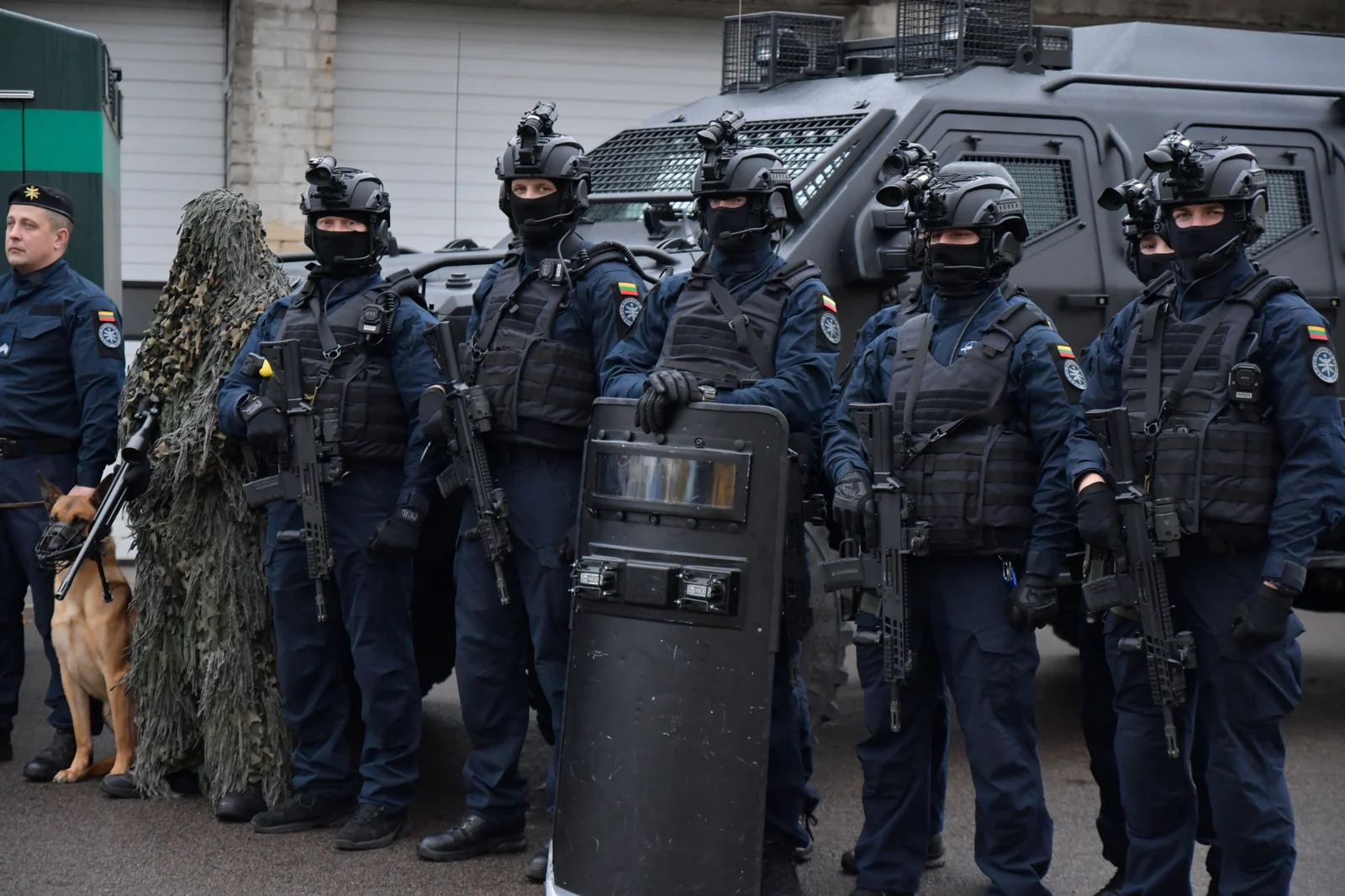
Image credit
- Title
- File:ORKA unit (Public Safety Service of Lithuania).jpg
- Author
- Lithuanian Ministry of National Defense(attribution required)
- Licence
- GFDL
- Source
- https://commons.wikimedia.org/wiki/File:ORKA_unit_(Public_Safety_Service_of_Lithuania).jpg

How Muzzle energy is calculated
E = ½ · m · v²
Inputs
- m4.018 g62.01 grverifiedsource62 gr as published, converted to grams.
- v905.3 m/s2,970 fpsverifiedMeasured with a 368.3 mm barrel, not this arm's 308 mm. Velocity outside the sourced range is not projected.
1 of 2 inputs link to their source.
How Muzzle velocity is calculated
nearest sourced barrel length, no extrapolation
Inputs
- v at 368.3 mm905.3 m/s2,970 fpsverifiedsourceTable 2-1, muzzle velocity for the M4: 2,970 fps.
Assumptions
- This figure belongs to a 368.3 mm barrel. It is shown because it is the closest measurement that exists, not because it applies here.
1 of 1 inputs link to their source.
How Loaded mass is calculated
m_loaded = m_empty + m_magazine + n · m_cartridge
Not calculated: m_magazine has no sourced figure yet. Nothing is substituted for a missing input.
Assumptions
- One magazine, filled to the stated capacity. Spare magazines, optics, slings and lights are the owner’s, not the arm’s.
3 of 4 inputs link to their source.
How Free recoil is calculated
E_recoil = ½ · m_firearm · v_recoil²
Inputs
- m_firearm3.57 kg7.871 lbverifiedsourceFrom the specification table of B&T's APC556 datasheet (02/2016), column BT-36050. Given as "weight empty".
- v_recoil1.019 m/s3.343 fpsestimated
Assumptions
- Propellant gas momentum is excluded: ARMAG does not record charge weights. This is therefore a lower bound on the real free recoil, consistent between entries but smaller than a figure that includes the gas term.
- Free recoil: the arm is unrestrained. Stock design, muzzle devices, stance and shooter mass are not modelled, because none of them is a property of the arm.
1 of 2 inputs link to their source.
How Capacity is calculated
as published for the primary chambering
Inputs
- capacity30verifiedsourceSTANAG-type magazines; two 30-round polymer magazines are supplied.
1 of 1 inputs link to their source.
Derived figures
Computed from the sourced values above. Open ƒ on any figure for the formula, its inputs, and the assumptions it makes.
How Momentum is calculated
p = m · v
Inputs
- m4.018 g62.01 grverifiedsource62 gr as published, converted to grams.
- v905.3 m/s2,970 fpsverifiedMeasured with a 368.3 mm barrel, not this arm's 308 mm. Velocity outside the sourced range is not projected.
1 of 2 inputs link to their source.
How Sectional density is calculated
SD = mass(gr) / (7000 · diameter(in)²)
Inputs
- mass4.018 g62.01 grverifiedsource62 gr as published, converted to grams.
- diameter5.7 mm0.2244 inestimatedsourceNo free NATO dimensional standard is published. The C.I.P. datasheet for the .223 Remington, which shares this bullet, gives a cartridge-maximum bullet diameter of 5.70 mm.
Assumptions
- Reported in the conventional lb/in² so it is directly comparable with published figures.
2 of 2 inputs link to their source.
How Power factor is calculated
PF = mass(gr) · velocity(fps) / 1000
Inputs
- mass4.018 g62.01 grverifiedsource62 gr as published, converted to grams.
- velocity905.3 m/s2,970 fpsverifiedMeasured with a 368.3 mm barrel, not this arm's 308 mm. Velocity outside the sourced range is not projected.
Assumptions
- A competition classification defined by the IPSC and USPSA rulebooks, stated in their units. It describes a scoring category, not an effect.
1 of 2 inputs link to their source.
How Magazine dump is calculated
t = (n − 1) / (rpm / 60)
Inputs
- n30verifiedsourceSTANAG-type magazines; two 30-round polymer magazines are supplied.
- rpm600 rpmverifiedsourceFrom the specification table of B&T's APC556 datasheet (02/2016), column BT-36050. Selective-fire model.
Assumptions
- Cyclic rate held for the whole magazine, no stoppages, trigger held down. A theoretical figure for comparing mechanisms, not a measured one.
2 of 2 inputs link to their source.
How Sight error at 1 mm is calculated
θ = atan(misalignment / sight radius)
Not calculated: sight radius has no sourced figure yet. Nothing is substituted for a missing input.
Assumptions
- Shows what a stated aiming error costs. The misalignment is the reader’s figure; the site does not claim how well anyone aims.
No input on this calculation carries a clickable source yet.
Variants
APC556 (264 mm barrel)
The same rifle with a shorter 26.4 cm barrel, item BT-36057.
- Mass, empty
- 3.47 kg7.650 lbsource
From the specification table of B&T's APC556 datasheet (02/2016), column BT-36057.
- Length
- 797 mm31.38 insource
From the specification table of B&T's APC556 datasheet (02/2016), column BT-36057. Stock fully extended; adjusts over 737–797 mm.
- Length, folded
- 568 mm22.36 insource
From the specification table of B&T's APC556 datasheet (02/2016), column BT-36057.
- Barrel length
- 264 mm10.39 insource
From the specification table of B&T's APC556 datasheet (02/2016), column BT-36057.
APC556 PDW
A short-barrelled, short-stocked version offered only with automatic fire, item BT-36063.
- Mass, empty
- 3.59 kg7.915 lbsource
From the specification table of B&T's APC556 datasheet (02/2016), column BT-36063.
- Length
- 725 mm28.54 insource
From the specification table of B&T's APC556 datasheet (02/2016), column BT-36063. Longest of three stock positions (665, 695, 725 mm).
- Length, folded
- 545 mm21.46 insource
From the specification table of B&T's APC556 datasheet (02/2016), column BT-36063.
- Barrel length
- 222 mm8.740 insource
From the specification table of B&T's APC556 datasheet (02/2016), column BT-36063.
APC556 Carbine
The semi-automatic-only model, in both barrel lengths (items BT-36052 and BT-36059).
| Variant | Years | Changes |
|---|---|---|
| APC556 (264 mm barrel) | — | Mass, empty, Length, Length, folded, Barrel length |
| APC556 PDW | — | Mass, empty, Length, Length, folded, Barrel length |
| APC556 Carbine | — | Fire modes |
Specifications
Every row here is generated from the schema, so a figure recorded on this entry cannot be missing from the table, and the same rows, read the same way, are what the comparison shows.
Identity
- Type
- Carbine
- Action
- Self-loading
- Fire modes
- Semi-automatic
- Fully automatic
- Operating system
- Gas, short-stroke piston
- Designed in
- Switzerland
- Produced in
- Introduced
- 2015
- Production
- not recorded
Dimensions and mass
- Mass, empty
- 3.57 kg7.871 lbsource
From the specification table of B&T's APC556 datasheet (02/2016), column BT-36050. Given as "weight empty".
- Magazine, empty
- not recorded
- Length
- 841 mm33.11 insource
From the specification table of B&T's APC556 datasheet (02/2016), column BT-36050. Stock fully extended; the stock adjusts over 781–841 mm.
- Length, folded
- 612 mm24.09 insource
From the specification table of B&T's APC556 datasheet (02/2016), column BT-36050. Stock folded.
- Width
- not recorded
- Height
- not recorded
- Barrel length
- 308 mm12.13 insource
From the specification table of B&T's APC556 datasheet (02/2016), column BT-36050. 30.8 cm.
Sights and rifling
- Sight radius
- not recorded
- Sight height over bore
- not recorded
- Rifling twist
- 177.8 mm7.000 insource
One turn in 7 inches, as stated on the datasheet.
- Twist direction
- not recorded
- Grooves
- not recorded
- Sight graduation
- not recorded
Operation
- Cyclic rate
- 600 rpmsource
From the specification table of B&T's APC556 datasheet (02/2016), column BT-36050. Selective-fire model.
- Trigger pull
- not recorded
- Effective range
- not recorded
- Units produced
- not recorded
- Launch price
- not recorded
Chamberings
- 5.56x45mm NATOprimary30 rounds
Scale
A to-scale outline against family siblings. The dimensions are sourced; the shape is a representative outline for the type, and says so.
- B&T APC556841 mm33.11 inheight not recorded
Representative outline: the dimensions are sourced, the shape is not. Overall length, and barrel length where recorded, are drawn from this entry's own figures; the profile is a generic one for the firearm type and says nothing about this arm's actual contours. B&T APC556 records no height, so its outline is drawn at the type's proportion. That height is part of the shape, not a measurement.
Detail
The APC556 is the 5.56×45mm NATO member of B&T’s Advanced Police Carbine family, first shown at the SHOT Show in 2015. It shares the family’s controls and more than half of its parts with the pistol-calibre APC9, but not its mechanism: where the APC9 is a straight blowback submachine gun, the APC556 is gas-operated, with a short-stroke piston driving a rotating bolt, which makes it a separate rifle rather than another chambering of the same one.
B&T built it as a police carbine meant to be shared between officers on different shifts, and its datasheet puts the emphasis there: a safety that can be applied with the hammer down, unlike an AR-pattern rifle’s, ambidextrous charging handle, bolt release and magazine catch, a folding stock that also adjusts for length over body armour, and the family’s hydraulic buffer to soften recoil. It feeds from standard STANAG magazines. The maker offers it with a 30.8 cm or 26.4 cm barrel, as a selective-fire rifle or a semi-automatic-only “Carbine”, and as a shorter PDW that is made only with automatic fire; B&T’s datasheet describes the selector’s settings as safe, single and burst. A semi-automatic civilian model is sold as the APC223, and Lithuania’s ORKA tactical unit is among its users.
Every dimension, mass, twist and cyclic rate on this page comes from B&T’s own datasheet, read through a permanent archived copy. The datasheet gives no muzzle velocity, and no source consulted states whether its “weight empty” figures include the supplied magazine.
References
This entry's own bibliography. Every citation key on this page resolves into this list.
- Brügger & Thomet APC · Wikipedia · 1373702344 · read 2026-09-24 · CC BY-SA 4.0
- APC556 – Advanced Police Carbine (datasheet 02/2016) · B&T AG · read 2026-09-24
- Brügger & Thomet APC 556/300 Coming in 2015 · The Firearm Blog · read 2026-09-24
Last verified 2026-09-24 · review status: draft