
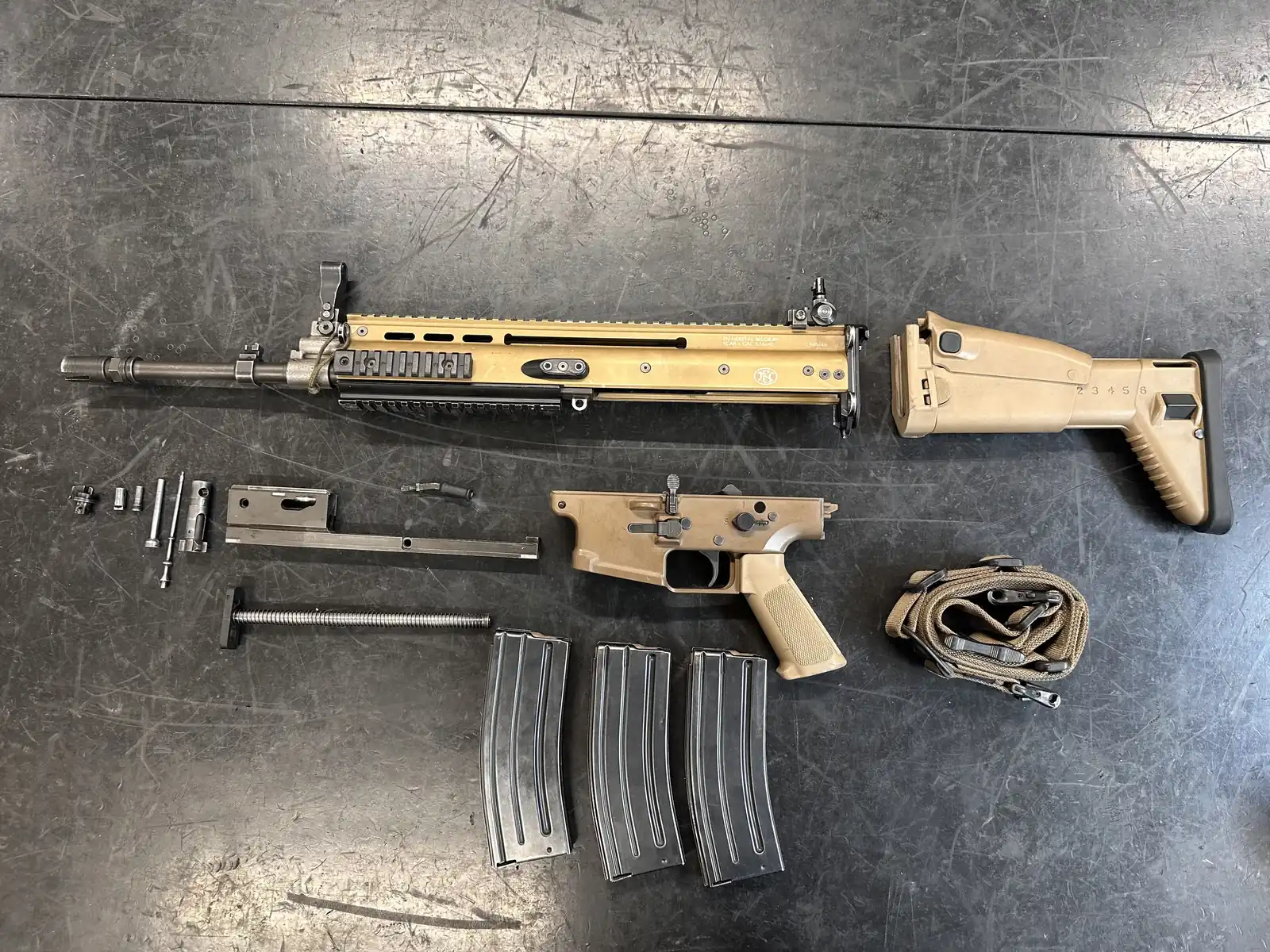
Image credit
- Title
- File:FN SCAR-L fieldstripped.jpg
- Author
- The RedBurn(attribution required)
- Licence
- CC BY-SA 4.0
- Source
- https://commons.wikimedia.org/wiki/File:FN_SCAR-L_fieldstripped.jpg

How Muzzle energy is calculated
E = ½ · m · v²
Inputs
- m4.018 g62.01 grverifiedsource62 gr as published, converted to grams.
- v905.3 m/s2,970 fpsverifiedMeasured with a 368.3 mm barrel, not this arm's 355 mm. Velocity outside the sourced range is not projected.
1 of 2 inputs link to their source.
How Muzzle velocity is calculated
nearest sourced barrel length, no extrapolation
Inputs
- v at 368.3 mm905.3 m/s2,970 fpsverifiedsourceTable 2-1, muzzle velocity for the M4: 2,970 fps.
Assumptions
- This figure belongs to a 368.3 mm barrel. It is shown because it is the closest measurement that exists, not because it applies here.
1 of 1 inputs link to their source.
How Loaded mass is calculated
m_loaded = m_empty + m_magazine + n · m_cartridge
Not calculated: m_magazine has no sourced figure yet. Nothing is substituted for a missing input.
Assumptions
- One magazine, filled to the stated capacity. Spare magazines, optics, slings and lights are the owner’s, not the arm’s.
3 of 4 inputs link to their source.
How Free recoil is calculated
E_recoil = ½ · m_firearm · v_recoil²
Inputs
- m_firearm3.29 kg7.253 lbverifiedsourceSCAR-L. The SCAR-H is published at 3.58 kg.
- v_recoil1.106 m/s3.627 fpsestimated
Assumptions
- Propellant gas momentum is excluded: ARMAG does not record charge weights. This is therefore a lower bound on the real free recoil, consistent between entries but smaller than a figure that includes the gas term.
- Free recoil: the arm is unrestrained. Stock design, muzzle devices, stance and shooter mass are not modelled, because none of them is a property of the arm.
1 of 2 inputs link to their source.
How Capacity is calculated
as published for the primary chambering
Inputs
- capacity30verifiedsourceSTANAG magazine, SCAR-L.
1 of 1 inputs link to their source.
Derived figures
Computed from the sourced values above. Open ƒ on any figure for the formula, its inputs, and the assumptions it makes.
How Momentum is calculated
p = m · v
Inputs
- m4.018 g62.01 grverifiedsource62 gr as published, converted to grams.
- v905.3 m/s2,970 fpsverifiedMeasured with a 368.3 mm barrel, not this arm's 355 mm. Velocity outside the sourced range is not projected.
1 of 2 inputs link to their source.
How Sectional density is calculated
SD = mass(gr) / (7000 · diameter(in)²)
Inputs
- mass4.018 g62.01 grverifiedsource62 gr as published, converted to grams.
- diameter5.7 mm0.2244 inestimatedsourceNo free NATO dimensional standard is published. The C.I.P. datasheet for the .223 Remington, which shares this bullet, gives a cartridge-maximum bullet diameter of 5.70 mm.
Assumptions
- Reported in the conventional lb/in² so it is directly comparable with published figures.
2 of 2 inputs link to their source.
How Power factor is calculated
PF = mass(gr) · velocity(fps) / 1000
Inputs
- mass4.018 g62.01 grverifiedsource62 gr as published, converted to grams.
- velocity905.3 m/s2,970 fpsverifiedMeasured with a 368.3 mm barrel, not this arm's 355 mm. Velocity outside the sourced range is not projected.
Assumptions
- A competition classification defined by the IPSC and USPSA rulebooks, stated in their units. It describes a scoring category, not an effect.
1 of 2 inputs link to their source.
How Magazine dump is calculated
t = (n − 1) / (rpm / 60)
Inputs
- n30verifiedsourceSTANAG magazine, SCAR-L.
- rpm650 rpmverifiedsourceSCAR-L. The SCAR-H is published at 550 rounds/min.
Assumptions
- Cyclic rate held for the whole magazine, no stoppages, trigger held down. A theoretical figure for comparing mechanisms, not a measured one.
2 of 2 inputs link to their source.
How Sight error at 1 mm is calculated
θ = atan(misalignment / sight radius)
Not calculated: sight radius has no sourced figure yet. Nothing is substituted for a missing input.
Assumptions
- Shows what a stated aiming error costs. The misalignment is the reader’s figure; the site does not claim how well anyone aims.
No input on this calculation carries a clickable source yet.
Variants
SCAR-L (Mk 16)
The 5.56 mm version, and the one whose figures this entry records. Dropped by US SOCOM in 2010 on the argument that it offered too little over an M4.
SCAR-H (Mk 17)
The 7.62 mm version on a longer receiver, which SOCOM kept. The reason the platform is usually described as two rifles rather than one.
Mk 20 SSR
A semi-automatic marksman configuration of the SCAR-H with a longer, heavier barrel and an adjustable stock.
| Variant | Years | Changes |
|---|---|---|
| SCAR-L (Mk 16) | — | no spec change |
| SCAR-H (Mk 17) | — | no spec change |
| Mk 20 SSR | — | no spec change |
Specifications
Every row here is generated from the schema, so a figure recorded on this entry cannot be missing from the table, and the same rows, read the same way, are what the comparison shows.
Identity
- Type
- Rifle
- Action
- Self-loading
- Fire modes
- Semi-automatic
- Fully automatic
- Operating system
- Gas, short-stroke piston
- Designed in
- Belgium
- Produced in
- Introduced
- 2009
- Production
- 2004–present
Dimensions and mass
- Mass, empty
- 3.29 kg7.253 lbsource
SCAR-L. The SCAR-H is published at 3.58 kg.
- Magazine, empty
- not recorded
- Length
- 889 mm35.00 insource
SCAR-L, stock extended; 635 mm folded. The SCAR-H is 965 mm extended.
- Length, folded
- 635 mm25.00 insource
SCAR-L, stock folded.
- Width
- not recorded
- Height
- not recorded
- Barrel length
- 355 mm13.98 insource
SCAR-L. The SCAR-H barrel is 400 mm.
Sights and rifling
- Sight radius
- not recorded
- Sight height over bore
- not recorded
- Rifling twist
- not recorded
- Twist direction
- not recorded
- Grooves
- not recorded
- Sight graduation
- not recorded
Chamberings
- 5.56x45mm NATOprimary30 rounds
- 7.62×51mm NATO20 rounds
Scale
A to-scale outline against family siblings. The dimensions are sourced; the shape is a representative outline for the type, and says so.
- FN SCAR889 mm35.00 inheight not recorded
Representative outline: the dimensions are sourced, the shape is not. Overall length, and barrel length where recorded, are drawn from this entry's own figures; the profile is a generic one for the firearm type and says nothing about this arm's actual contours. FN SCAR records no height, so its outline is drawn at the type's proportion. That height is part of the shape, not a measurement.
Detail
FN’s answer to a 2004 US Special Operations Command requirement for one rifle family covering two cartridges with common controls, common training and interchangeable barrels. What it produced is an extruded aluminium upper receiver with the barrel clamped in rather than screwed in, a short-stroke gas piston instead of the M16’s direct impingement, and a folding, telescoping stock.
The barrel-change idea is the interesting part and the part that has not really been used. In principle a soldier swaps a 355 mm barrel for a 400 mm one with a hex key and the rifle re-zeroes acceptably; in practice units draw the configuration they need and leave it alone.
SOCOM bought both versions and then cancelled the 5.56 mm one in 2010, having concluded it did not improve enough on the M4 to justify a second logistics chain. The 7.62 mm version stayed, and it is the one most photographs show.
Every figure above describes the SCAR-L unless its note says otherwise; the article publishes most of its specifications twice, once per version, and mixing the two would produce a rifle that does not exist.
References
This entry's own bibliography. Every citation key on this page resolves into this list.
- FN SCAR · Wikipedia · 1362919440 · read 2026-08-31 · CC BY-SA 4.0
Last verified 2026-08-31 · review status: agent-populated