
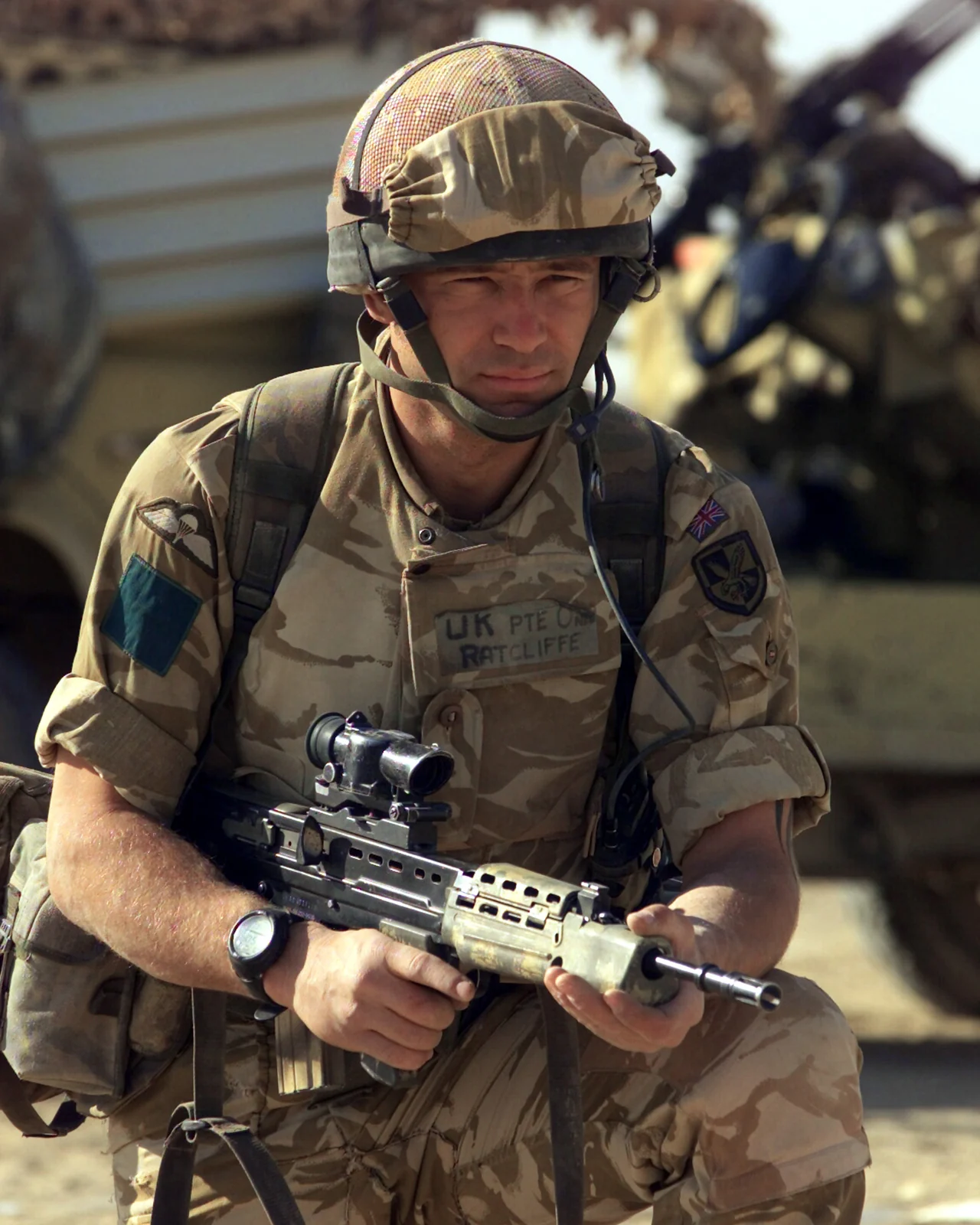
Image credit
- Title
- File:British L85A2.JPEG
- Author
- Sgt. Mauricio Campino, U.S. Marine Corps
- Licence
- Public domain
- Source
- https://commons.wikimedia.org/wiki/File:British_L85A2.JPEG

How Muzzle energy is calculated
E = ½ · m · v²
Inputs
- m4.018 g62.01 grverifiedsource62 gr as published, converted to grams.
- v944.9 m/s3,100 fpsverifiedMeasured with a 508 mm barrel, not this arm's 518 mm. Velocity outside the sourced range is not projected.
1 of 2 inputs link to their source.
How Muzzle velocity is calculated
nearest sourced barrel length, no extrapolation
Inputs
- v at 508 mm944.9 m/s3,100 fpsverifiedsourceTable 2-1, muzzle velocity for the M16A2: 3,100 fps. The M855 is the manual's service round for that rifle.
Assumptions
- This figure belongs to a 508 mm barrel. It is shown because it is the closest measurement that exists, not because it applies here.
1 of 1 inputs link to their source.
How Loaded mass is calculated
m_loaded = m_empty + m_magazine + n · m_cartridge
Not calculated: m_magazine has no sourced figure yet. Nothing is substituted for a missing input.
Assumptions
- One magazine, filled to the stated capacity. Spare magazines, optics, slings and lights are the owner’s, not the arm’s.
3 of 4 inputs link to their source.
How Free recoil is calculated
E_recoil = ½ · m_firearm · v_recoil²
Inputs
- m_firearm4.98 kg10.98 lbestimatedsourceL85A2 with SUSAT sight and a loaded 30-round magazine; the infobox cites a UK MoD PDF that no longer resolves and has no working archive link found, so the figure is recorded as estimated rather than verified
- v_recoil0.7624 m/s2.501 fpsestimated
Assumptions
- Propellant gas momentum is excluded: ARMAG does not record charge weights. This is therefore a lower bound on the real free recoil, consistent between entries but smaller than a figure that includes the gas term.
- Free recoil: the arm is unrestrained. Stock design, muzzle devices, stance and shooter mass are not modelled, because none of them is a property of the arm.
1 of 2 inputs link to their source.
How Capacity is calculated
as published for the primary chambering
Inputs
- capacity30estimatedsource30-round detachable STANAG magazine, from the infobox, uncited on Wikipedia; a 60-round casket magazine and a 20-round carbine magazine are also published for other configurations
1 of 1 inputs link to their source.
Derived figures
Computed from the sourced values above. Open ƒ on any figure for the formula, its inputs, and the assumptions it makes.
How Momentum is calculated
p = m · v
Inputs
- m4.018 g62.01 grverifiedsource62 gr as published, converted to grams.
- v944.9 m/s3,100 fpsverifiedMeasured with a 508 mm barrel, not this arm's 518 mm. Velocity outside the sourced range is not projected.
1 of 2 inputs link to their source.
How Sectional density is calculated
SD = mass(gr) / (7000 · diameter(in)²)
Inputs
- mass4.018 g62.01 grverifiedsource62 gr as published, converted to grams.
- diameter5.7 mm0.2244 inestimatedsourceNo free NATO dimensional standard is published. The C.I.P. datasheet for the .223 Remington, which shares this bullet, gives a cartridge-maximum bullet diameter of 5.70 mm.
Assumptions
- Reported in the conventional lb/in² so it is directly comparable with published figures.
2 of 2 inputs link to their source.
How Power factor is calculated
PF = mass(gr) · velocity(fps) / 1000
Inputs
- mass4.018 g62.01 grverifiedsource62 gr as published, converted to grams.
- velocity944.9 m/s3,100 fpsverifiedMeasured with a 508 mm barrel, not this arm's 518 mm. Velocity outside the sourced range is not projected.
Assumptions
- A competition classification defined by the IPSC and USPSA rulebooks, stated in their units. It describes a scoring category, not an effect.
1 of 2 inputs link to their source.
How Magazine dump is calculated
t = (n − 1) / (rpm / 60)
Inputs
- n30estimatedsource30-round detachable STANAG magazine, from the infobox, uncited on Wikipedia; a 60-round casket magazine and a 20-round carbine magazine are also published for other configurations
- rpm692 rpmestimatedsourcemidpoint of the published, uncited range of 610-775 rounds a minute
Assumptions
- Cyclic rate held for the whole magazine, no stoppages, trigger held down. A theoretical figure for comparing mechanisms, not a measured one.
2 of 2 inputs link to their source.
How Sight error at 1 mm is calculated
θ = atan(misalignment / sight radius)
Not calculated: sight radius has no sourced figure yet. Nothing is substituted for a missing input.
Assumptions
- Shows what a stated aiming error costs. The misalignment is the reader’s figure; the site does not claim how well anyone aims.
No input on this calculation carries a clickable source yet.
Specifications
Every row here is generated from the schema, so a figure recorded on this entry cannot be missing from the table, and the same rows, read the same way, are what the comparison shows.
Identity
- Type
- Rifle
- Action
- Self-loading
- Fire modes
- Semi-automatic
- Fully automatic
- Operating system
- Gas, short-stroke piston
- Roles
- Designed in
- United Kingdom
- Produced in
- Introduced
- 1985
- Production
- 1985–1994
Dimensions and mass
- Mass, empty
L85A2 with SUSAT sight and a loaded 30-round magazine; the infobox cites a UK MoD PDF that no longer resolves and has no working archive link found, so the figure is recorded as estimated rather than verified
- Magazine, empty
- not recorded
- Length
L85A2, from the infobox, uncited on Wikipedia
- Length, folded
- not recorded
- Width
- not recorded
- Height
- not recorded
- Barrel length
L85A2, from the infobox, uncited on Wikipedia
Sights and rifling
- Sight radius
- not recorded
- Sight height over bore
- not recorded
- Rifling twist
- not recorded
- Twist direction
- not recorded
- Grooves
- not recorded
- Sight graduation
- not recorded
Operation
- Cyclic rate
midpoint of the published, uncited range of 610-775 rounds a minute
- Trigger pull
- not recorded
- Effective range
the infobox cites the British Army's own equipment page, which returned a 403 error rather than resolving, so this figure is recorded as estimated rather than verified
- Units produced
L85 and L86 combined, published as 'approx. 350,000', uncited on Wikipedia; the L98 cadet rifle's separate figure of approx. 21,700 is not included
- Launch price
- not recorded
Chamberings
- 5.56x45mm NATOprimary30 rounds
Scale
A to-scale outline against family siblings. The dimensions are sourced; the shape is a representative outline for the type, and says so.
- SA80785 mm30.91 inheight not recorded
Representative outline: the dimensions are sourced, the shape is not. Overall length, and barrel length where recorded, are drawn from this entry's own figures; the profile is a generic one for the firearm type and says nothing about this arm's actual contours. SA80 records no height, so its outline is drawn at the type's proportion. That height is part of the shape, not a measurement.
Gallery
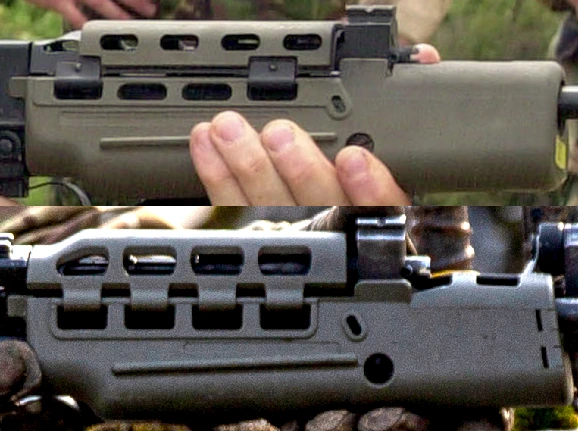
Image credit
- Title
- File:L85A2 non-railed handguard comparison.jpg
- Author
- Original US Army photos by Kaye Richey and Sgt. Christian Aquino, cropping etc. by User:Dvaderv2
- Licence
- Public domain
- Source
- https://commons.wikimedia.org/wiki/File:L85A2_non-railed_handguard_comparison.jpg

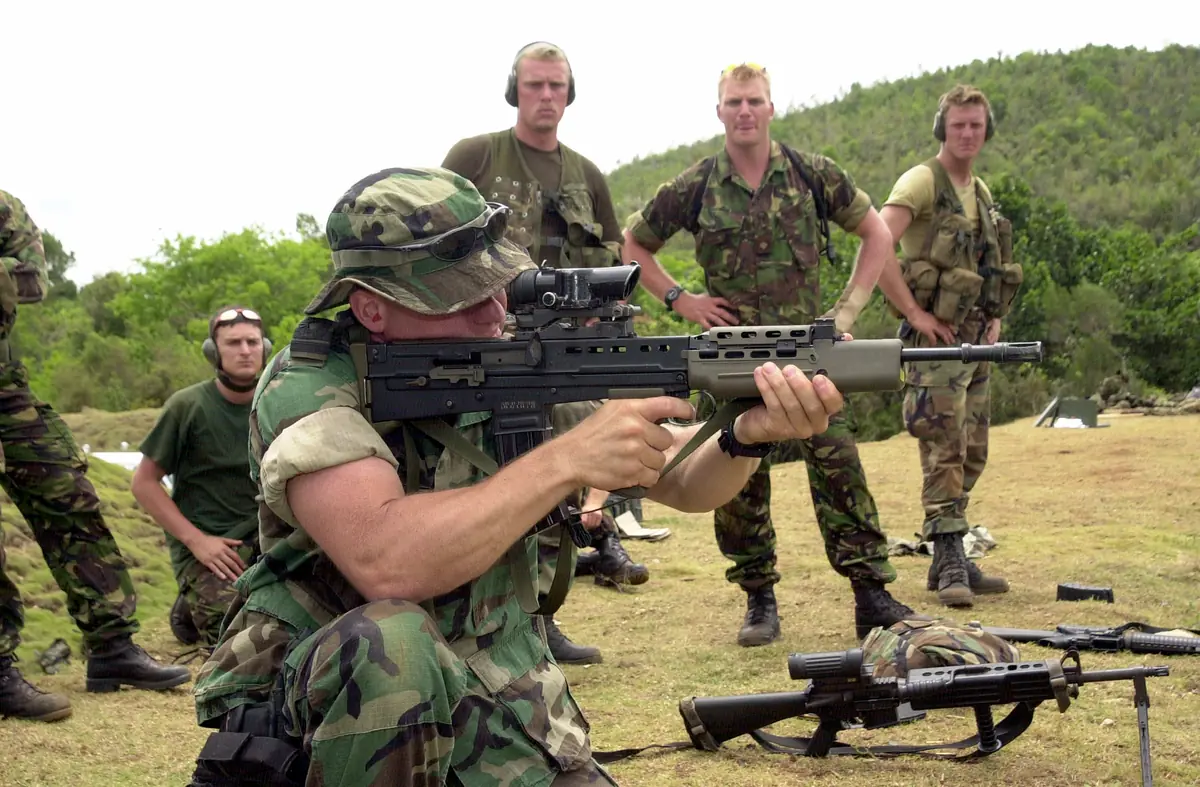
Image credit
- Title
- File:Charles Suilen at Sierra Prieta-L85A2.jpg
- Author
- U.S. Army photo by Kaye Richey
- Licence
- Public domain
- Source
- https://commons.wikimedia.org/wiki/File:Charles_Suilen_at_Sierra_Prieta-L85A2.jpg

Detail
The SA80 was developed at the Royal Small Arms Factory, Enfield, through the 1970s and 1980s as Britain’s replacement for the L1A1 self-loading rifle, and it adopted the bullpup layout (the action and magazine set behind the trigger, inside the buttstock) to keep a full-length barrel within a compact overall length, the same trade-off that drove other European bullpup rifles of the period such as the FAMAS and Steyr AUG. It entered service in 1985 as the L85 individual weapon, alongside the L86 Light Support Weapon, a heavier-barrelled version of the same action intended to give a section sustained automatic fire from the same magazine-fed system, and the shorter L22 carbine built for vehicle crews and other roles where the full-length rifle was unwieldy.
The rifle’s early service life was marked by persistent reliability problems, serious enough that the design underwent a comprehensive rebuild by Heckler & Koch in the early 2000s, producing the improved A2 standard that gives this entry’s figures. That rebuild replaced or reworked the magazine, extractor, cocking handle, gas system and other components, and it is generally credited with resolving the faults that had dogged the original A1-standard rifle in earlier service, including during the 1991 Gulf War.
Mechanically the SA80 is gas-operated with a rotating bolt, feeding from STANAG-pattern magazines shared with other 5.56×45mm NATO rifles, and its bullpup layout means the ejection port sits close to a right-handed firer’s face. This is a well-known limitation of the pattern that makes it awkward to fire from the left shoulder without a dedicated left-handed ejection configuration. The rifle mounts optical sights as standard rather than relying on iron sights alone, originally the SUSAT and more recently the ELCAN LDS or ACOG, reflecting a design philosophy that assumed an optic from the outset rather than treating it as an add-on.
This entry describes the L85A2 rifle rather than the L86 LSW or L22 carbine, both of which share its gas-operated rotating-bolt action but differ enough in barrel length, weight and role that this single entry does not attempt to give them their own figures. Most figures here come from Wikipedia’s infobox: the weight figure’s own cited source, a UK Ministry of Defence PDF, no longer resolves and no working archived copy was found, and the effective-range figure’s cited source, the British Army’s own equipment page, returned an access error rather than the page itself, so both are recorded as estimated rather than verified. No muzzle velocity is recorded because no source found ties a published velocity figure to a stated barrel length.
References
This entry's own bibliography. Every citation key on this page resolves into this list.
- SA80 · Wikipedia · 1369897200 · read 2026-09-04 · CC BY-SA 4.0
Last verified 2026-09-04 · review status: draft