
Image credit
- Title
- File:SS2-V1 ID2008.jpg
- Author
- Dragunova(attribution required)
- Licence
- CC BY-SA 3.0
- Source
- https://commons.wikimedia.org/wiki/File:SS2-V1_ID2008.jpg

How Muzzle energy is calculated
E = ½ · m · v²
Inputs
- m4.018 g62.01 grverifiedsource62 gr as published, converted to grams.
- v931.3 m/s3,055 fpsestimatedInterpolated between sourced measurements at 368.3 mm and 508 mm.
1 of 2 inputs link to their source.
How Muzzle velocity is calculated
linear interpolation between the two nearest sourced barrel lengths
Inputs
- v at 368.3 mm905.3 m/s2,970 fpsverifiedsourceTable 2-1, muzzle velocity for the M4: 2,970 fps.
- v at 508 mm944.9 m/s3,100 fpsverifiedsourceTable 2-1, muzzle velocity for the M16A2: 3,100 fps. The M855 is the manual's service round for that rifle.
Assumptions
- Velocity is assumed to vary linearly between the two measurements. Over a short span that is a reasonable reading of the data; it is not a law.
2 of 2 inputs link to their source.
How Loaded mass is calculated
m_loaded = m_empty + m_magazine + n · m_cartridge
Not calculated: m_magazine has no sourced figure yet. Nothing is substituted for a missing input.
Assumptions
- One magazine, filled to the stated capacity. Spare magazines, optics, slings and lights are the owner’s, not the arm’s.
1 of 4 inputs link to their source.
How Free recoil is calculated
E_recoil = ½ · m_firearm · v_recoil²
Inputs
- m_firearm3.4 kg7.496 lbestimatedMilitary Factory's SS2 spec listing gives 7.50 lb (3.40 kg) empty for the base SS2-V1; recorded as estimated rather than verified because the same listing's barrel-length figure is internally inconsistent with Wikipedia's own sourcing, which lowers confidence in the page generally. No Pindad-published figure for the base V1 was found: the manufacturer's own cited figures cover only the V2, V4, V5, SS3 and SPM-1 variants
- v_recoil1.101 m/s3.611 fpsestimated
Assumptions
- Propellant gas momentum is excluded: ARMAG does not record charge weights. This is therefore a lower bound on the real free recoil, consistent between entries but smaller than a figure that includes the gas term.
- Free recoil: the arm is unrestrained. Stock design, muzzle devices, stance and shooter mass are not modelled, because none of them is a property of the arm.
No input on this calculation carries a clickable source yet.
How Capacity is calculated
as published for the primary chambering
Inputs
- capacity30estimatedWikipedia infobox describes 'various STANAG magazines'; Military Factory's spec listing gives a 20- or 30-round detachable box magazine, and 30 rounds is recorded here as the standard STANAG capacity
No input on this calculation carries a clickable source yet.
Derived figures
Computed from the sourced values above. Open ƒ on any figure for the formula, its inputs, and the assumptions it makes.
How Momentum is calculated
p = m · v
Inputs
- m4.018 g62.01 grverifiedsource62 gr as published, converted to grams.
- v931.3 m/s3,055 fpsestimatedInterpolated between sourced measurements at 368.3 mm and 508 mm.
1 of 2 inputs link to their source.
How Sectional density is calculated
SD = mass(gr) / (7000 · diameter(in)²)
Inputs
- mass4.018 g62.01 grverifiedsource62 gr as published, converted to grams.
- diameter5.7 mm0.2244 inestimatedsourceNo free NATO dimensional standard is published. The C.I.P. datasheet for the .223 Remington, which shares this bullet, gives a cartridge-maximum bullet diameter of 5.70 mm.
Assumptions
- Reported in the conventional lb/in² so it is directly comparable with published figures.
2 of 2 inputs link to their source.
How Power factor is calculated
PF = mass(gr) · velocity(fps) / 1000
Inputs
- mass4.018 g62.01 grverifiedsource62 gr as published, converted to grams.
- velocity931.3 m/s3,055 fpsestimatedInterpolated between sourced measurements at 368.3 mm and 508 mm.
Assumptions
- A competition classification defined by the IPSC and USPSA rulebooks, stated in their units. It describes a scoring category, not an effect.
1 of 2 inputs link to their source.
How Magazine dump is calculated
t = (n − 1) / (rpm / 60)
Not calculated: rpm has no sourced figure yet. Nothing is substituted for a missing input.
Assumptions
- Cyclic rate held for the whole magazine, no stoppages, trigger held down. A theoretical figure for comparing mechanisms, not a measured one.
1 of 2 inputs link to their source.
How Sight error at 1 mm is calculated
θ = atan(misalignment / sight radius)
Not calculated: sight radius has no sourced figure yet. Nothing is substituted for a missing input.
Assumptions
- Shows what a stated aiming error costs. The misalignment is the reader’s figure; the site does not claim how well anyone aims.
No input on this calculation carries a clickable source yet.
Variants
SS2-V2
2005–present
A carbine version of the SS2-V1 with a shorter barrel.
- Mass, empty
- 3.8 kg8.378 lbestimated
Wikipedia infobox, cited on Wikipedia to an Indonesian-language spec article (lancercell.com) whose ballistic-data table is presented as images rather than text and could not be independently re-read
- Length
- 920 mm36.22 inestimated
Wikipedia infobox, uncited on Wikipedia itself, stock extended
- Length, folded
- 670 mm26.38 inestimated
Wikipedia infobox, uncited on Wikipedia itself, stock folded
- Barrel length
- 403 mm15.87 inestimated
Wikipedia infobox 'part_length' for the SS2-V2, uncited on Wikipedia itself
SS2-V4
2006–present
The carrying handle is replaced with a Picatinny rail for scope mounting and the barrel lengthened and accurised, marketed as a designated-marksman configuration; 150 units were purchased by the Indonesian Army in 2007.
- Mass, empty
- 4.15 kg9.149 lbestimated
Wikipedia infobox, cited on Wikipedia to an Indonesian-language spec article (lancercell.com) whose ballistic-data table is presented as images rather than text and could not be independently re-read
- Length
- 990 mm38.98 inestimated
Wikipedia infobox, uncited on Wikipedia itself, stock extended
- Length, folded
- 740 mm29.13 inestimated
Wikipedia infobox, uncited on Wikipedia itself, stock folded
- Barrel length
- 460 mm18.11 inestimated
Wikipedia infobox 'part_length' for the SS2-V4, uncited on Wikipedia itself
SS2-V5
2016–present
A lighter, third-generation carbine with a folding-telescoping stock and Picatinny handguard rails, built for vehicle crews and airborne troops; ordered in large numbers by the Indonesian police.
- Mass, empty
- 3.35 kg7.385 lbsource
Shephard Media's own reporting from Indo Defence 2016 states the SS2-V5 weighs 3.35 kg without magazine, matching the figure independently given in Wikipedia's infobox
- Length
Wikipedia's infobox states 770 mm extended / 520 mm folded (uncited on Wikipedia itself); Shephard Media's own reporting instead states the rifle is 725 mm long, without specifying a stock position; the two published figures disagree and neither is preferred here
- Barrel length
- 252 mm9.921 inestimated
Wikipedia infobox 'part_length' for the SS2-V5, uncited on Wikipedia itself
| Variant | Years | Changes |
|---|---|---|
| SS2-V2 | 2005–present | Mass, empty, Length, Length, folded, Barrel length |
| SS2-V4 | 2006–present | Mass, empty, Length, Length, folded, Barrel length |
| SS2-V5 | 2016–present | Mass, empty, Length, Barrel length |
Specifications
Every row here is generated from the schema, so a figure recorded on this entry cannot be missing from the table, and the same rows, read the same way, are what the comparison shows.
Identity
- Type
- Rifle
- Action
- Self-loading
- Fire modes
- Semi-automatic
- Fully automatic
- Operating system
- Gas, long-stroke piston
- Designed in
- Indonesia
- Produced in
- Introduced
- 2005
- Production
- 2005–present
Dimensions and mass
- Mass, empty
- 3.4 kg7.496 lbestimated
Military Factory's SS2 spec listing gives 7.50 lb (3.40 kg) empty for the base SS2-V1; recorded as estimated rather than verified because the same listing's barrel-length figure is internally inconsistent with Wikipedia's own sourcing, which lowers confidence in the page generally. No Pindad-published figure for the base V1 was found: the manufacturer's own cited figures cover only the V2, V4, V5, SS3 and SPM-1 variants
- Magazine, empty
- not recorded
- Length
- 990 mm38.98 inestimated
Wikipedia infobox, uncited on Wikipedia itself, stock extended; corroborated by Military Factory's independently listed 990 mm overall length
- Length, folded
- 740 mm29.13 inestimated
Wikipedia infobox, uncited on Wikipedia itself, stock folded
- Width
- not recorded
- Height
- not recorded
- Barrel length
- 460 mm18.11 inestimated
Wikipedia infobox 'part_length' for the SS2-V1, uncited on Wikipedia itself
Sights and rifling
- Sight radius
- not recorded
- Sight height over bore
- not recorded
- Rifling twist
- not recorded
- Twist direction
- not recorded
- Grooves
- not recorded
- Sight graduation
- not recorded
Operation
- Cyclic rate
- not recordedsource
Wikipedia's infobox states 720-760 rpm (uncited on Wikipedia itself); Military Factory's independent spec listing states a single figure of 700 rpm, just outside that range
- Trigger pull
- not recorded
- Effective range
- not recorded
- Units produced
- not recorded
- Launch price
- not recorded
Chamberings
- 5.56x45mm NATOprimary30 rounds
Scale
A to-scale outline against family siblings. The dimensions are sourced; the shape is a representative outline for the type, and says so.
- Pindad SS2990 mm38.98 inheight not recorded
Representative outline: the dimensions are sourced, the shape is not. Overall length, and barrel length where recorded, are drawn from this entry's own figures; the profile is a generic one for the firearm type and says nothing about this arm's actual contours. Pindad SS2 records no height, so its outline is drawn at the type's proportion. That height is part of the shape, not a measurement.
Gallery
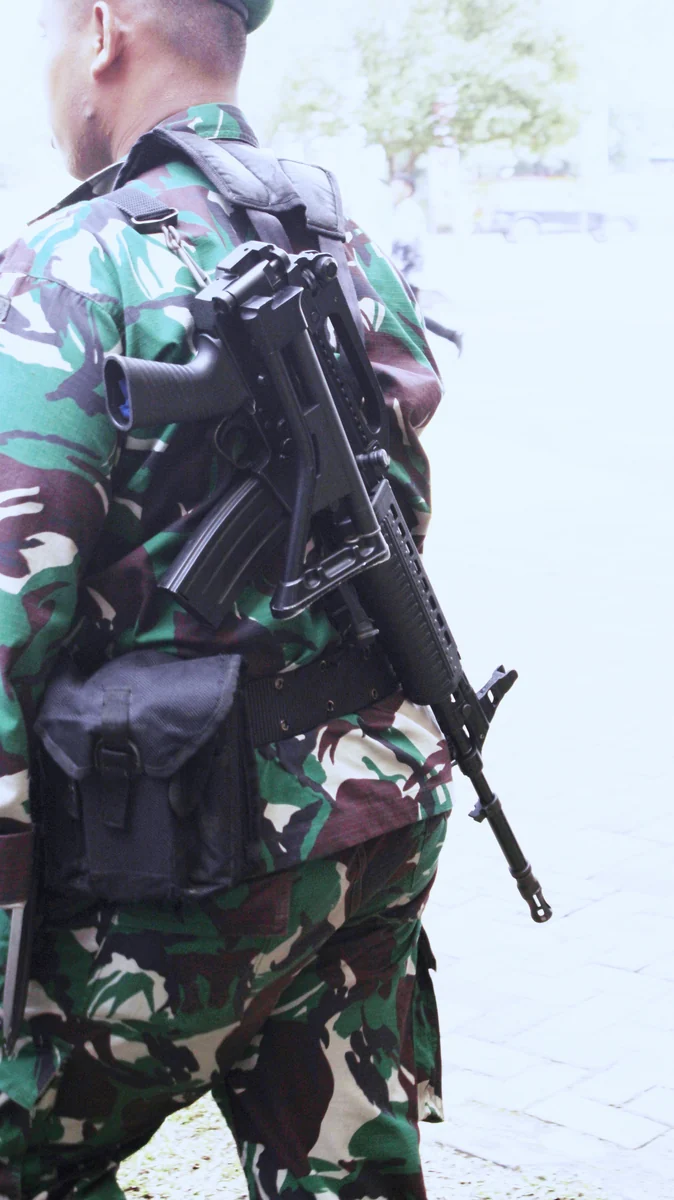
Image credit
- Title
- File:Pindad SS-2.jpg
- Author
- Nafisathallah(attribution required)
- Licence
- CC BY 4.0
- Source
- https://commons.wikimedia.org/wiki/File:Pindad_SS-2.jpg

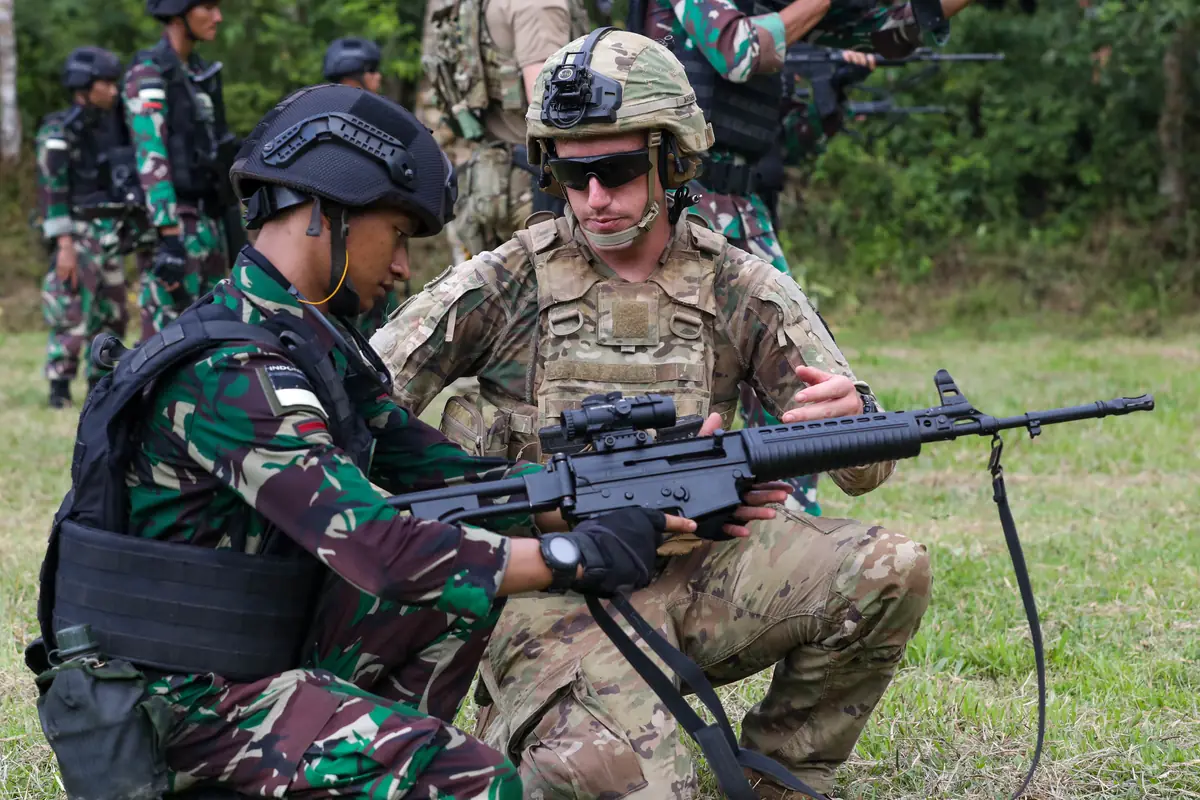
Image credit
- Title
- Super Garuda Shield: U.S. and TNI Soldiers Conduct Range Training
- Author
- Spc. Darbi Colson
- Licence
- Public domain
- Source
- https://www.dvidshub.net/image/7352307/super-garuda-shield-us-and-tni-soldiers-conduct-range-training
- Note
- Work of the United States Government, uncopyrighted under 17 U.S.C. §105: photographed for the Army (3rd Mobile Brigade, 25th Infantry Division), VIRIN 220801-A-IV381-1137. DVIDS states no separate licence per asset.
Detail
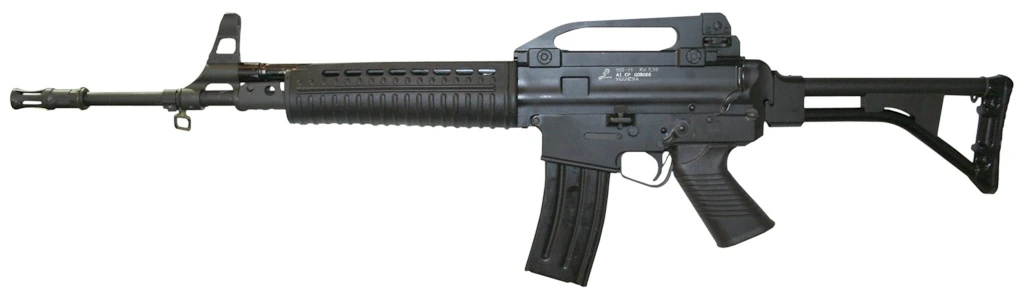
The SS2 (Senapan Serbu 2, “Assault Rifle 2”) is Indonesia’s standard service rifle, developed by the state-owned manufacturer Pindad to replace the earlier SS1 (itself a licensed derivative of the FN FNC) and officially introduced in 2005. Rather than continue building the FNC design under licence, Pindad’s engineers reverse-engineered and substantially reworked it, drawing ergonomic and accuracy features from the M16, ruggedness cues from the AK-47, and the FNC’s own gas-piston layout, while adapting manufacturing tolerances for Indonesia’s tropical climate.
Mechanically the SS2 is a gas-operated, long-stroke-piston rifle with a rotating bolt, feeding from STANAG-pattern box magazines and firing 5.56×45mm NATO. Its most visible feature is a removable carrying handle over the receiver that can be swapped for a Picatinny rail and optic, alongside a side-folding stock, an AK-influenced front sight, and an M16A2-style flash suppressor. This is a combination that gives the rifle a visibly hybrid silhouette compared with either of its influences.
The base rifle has spawned a wide family of variants built around the same action: the SS2-V2 is a shorter carbine, the SS2-V4 trades the carrying handle for a Picatinny rail and a longer, accurised barrel as a designated-marksman configuration, and the SS2-V5 is a lighter third-generation carbine with a folding-telescoping stock, adopted in large numbers by the Indonesian police. Pindad has since extended the platform further still, up to the 7.62×51mm-NATO-chambered SS3 and SPM-series designated-marksman rifles and a semi-automatic civilian “Dopper” variant, none of which share the SS2’s cartridge and so are not covered as variants of this entry. Pindad reports manufacturing around 40,000 SS2-series rifles annually, and the rifle has been exported or offered to a number of other states in Southeast Asia, the Middle East and Africa.
This entry’s dimensions and rate of fire are drawn mostly from Wikipedia’s infobox and are uncited on Wikipedia itself; where a second source could be independently read, it is used and named, and where it disagrees the conflict is recorded rather than resolved by picking one figure. No manufacturer-published specification sheet for the base SS2-V1 was located (Pindad’s own cited figures in the source record cover only later variants), and the cyclic rate is recorded as conflicting between two independent published figures (720-760 rpm against a separate 700 rpm listing) rather than as a single verified number.
References
This entry's own bibliography. Every citation key on this page resolves into this list.
- Pindad SS2 · Wikipedia · 1371888616 · read 2026-09-01 · CC BY-SA 4.0
- Indo Defence 2016: Small arms revolution · Shephard Media · 2016-10-28 · read 2026-09-01
- Pindad SS2 assault rifle (2006) · Military Factory · 2012-10-15 · read 2026-09-01
Last verified 2026-09-01 · review status: draft