Indian · Main Course
Dhansak
A Parsi lamb, lentil and pumpkin stew, sweet-soured with tamarind and jaggery-style sugar and finished with a masala built on Persian braising spice.
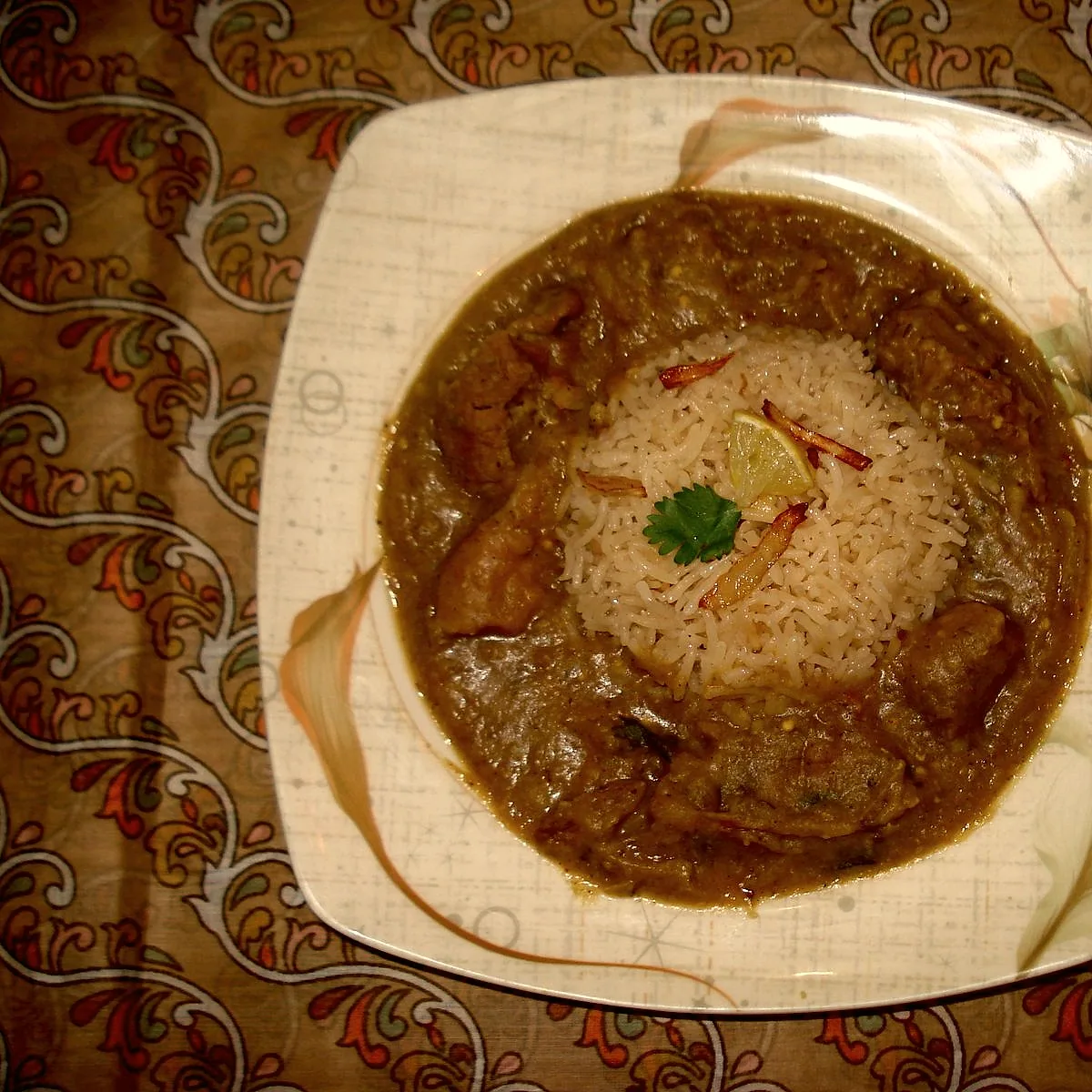

CC0. Cropped and colour-adjusted for this site.
Method
Heat a little of the 40 g ghee in a pan and fry the 100 g yellow onion over a medium heat for 10m, until deep golden-brown and crisp. Lift out and set aside for garnish.
Toast the 5 g whole cumin, 1 ½ cinnamon sticks (4 g), 10 cloves (1 g), 5 cardamom pods (2 g) and 3 g fenugreek seeds in a dry pan for 5m, until fragrant, then grind to a coarse powder.
Combine the 600 g lamb leg, 150 g split, dried pigeon peas, 50 g red lentils, 200 g pumpkin, 150 g potato, 150 g ripe tomatoes, 100 g yellow onion, 4 garlic cloves (20 g), 20 g fresh ginger, 4 g ground turmeric, 3 dried chillies (6 g), the 1.2 L water and the 8 g fine sea salt in a large, heavy pot. Bring to the boil, then reduce to a bare simmer and cook, partly covered, for 1h 15m, until the lamb is completely tender and the lentils have broken down.
Lift the lamb pieces out of the pot and set aside. Blend the remaining dal, vegetables and cooking liquid until smooth, working for 8m, then return the lamb to the pot.
Lifting the lamb out before blending keeps the meat in whole pieces; the dal, pumpkin and potato collapse into the thick, textured purée that carries the dish, in the manner of a Persian khoresh rather than a clear-broth dal.
Stir the ground spice mix from the pan into the pot along with the 8 g ground coriander, the 30 g tamarind and the 15 g light brown sugar, along with the remaining 40 g ghee. Simmer for 15m, until the stew has thickened to the consistency of a loose porridge and tastes clearly sweet and sour. Scatter over the fried 100 g yellow onion and the 10 g fresh coriander to serve.
Common pitfallThe tamarind and sugar are added only at the end, once the base is already thick. Added earlier, the acid slows the lentils and pumpkin from breaking down fully.
Dhansak belongs to the Parsis, the Zoroastrian community that left Persia for Gujarat after the Arab conquest of the seventh and eighth centuries [1][2]. It is generally said to descend from khoresh, the Persian family of stews that braise meat with lentils, vegetables and fruit; an early version made with plums, lentils, spinach and meat, served over rice, is the one most often pointed to as its likely ancestor [2].
That lineage is repeated more confidently than it can actually be documented: no source fixes a date or place for when a Persian meat-and-lentil stew became the distinct, tamarind-soured dish eaten today, and both Wikipedia and Dawn's own account hedge it as "said to be" or "believed to have roots in" rather than settled fact [1][2]. Even the name is not agreed: Wikipedia traces it to the Sanskrit dhānya, grain, and śāka, vegetables, describing what is in the pot, while Dawn's account instead derives it from the Gujarati dhan, wealth, and sak, vegetables [1][2].
What is better attested is the dish's more recent history. Dhansak only became widely known outside Parsi homes in the late nineteenth century, as Bombay and Karachi industrialised and Parsi and Irani cafés began serving it to the local workforce alongside tea, coffee and other snacks [1][2]. Parsis who went on to work as butlers and cooks in British households carried it further still, and it entered British Indian restaurant menus from returning colonists, though there it was flattened into something sweeter and milder than the sour, dal-thick stew eaten in a Parsi home, part of a broader pattern of curry-house kitchens sweetening and simplifying dishes for a British palate [1][3].
In a Parsi household dhansak is still cooked on Sundays, when there is time for a pot that takes hours rather than minutes, and it is also the dish customarily served four days after a death [1] [2].
Sources
- Dhansak, WikipediaCovers the etymology, the Persian khoresh connection and the dish's move into Anglo-Indian and British restaurant menus.
- Food Stories: Dhansak, DawnPakistani national newspaper feature covering the Persian migration, the khoresh origin theory, a rival Gujarati etymology, and the Bombay/Karachi café history.
- British curry: A dish that defines Queen Elizabeth's reign?, The Christian Science MonitorCovers dhansak as a standard curry-house menu dish and describes how restaurant chefs sweeten and simplify dishes for the British palate.