Burmese · Soup
Ohn No Khauk Swè
Egg noodles under a thick, turmeric-yellow chicken and coconut broth, finished with crisp fried noodles, boiled egg and lime.
Also known asOhn no khao swè · Myanmar
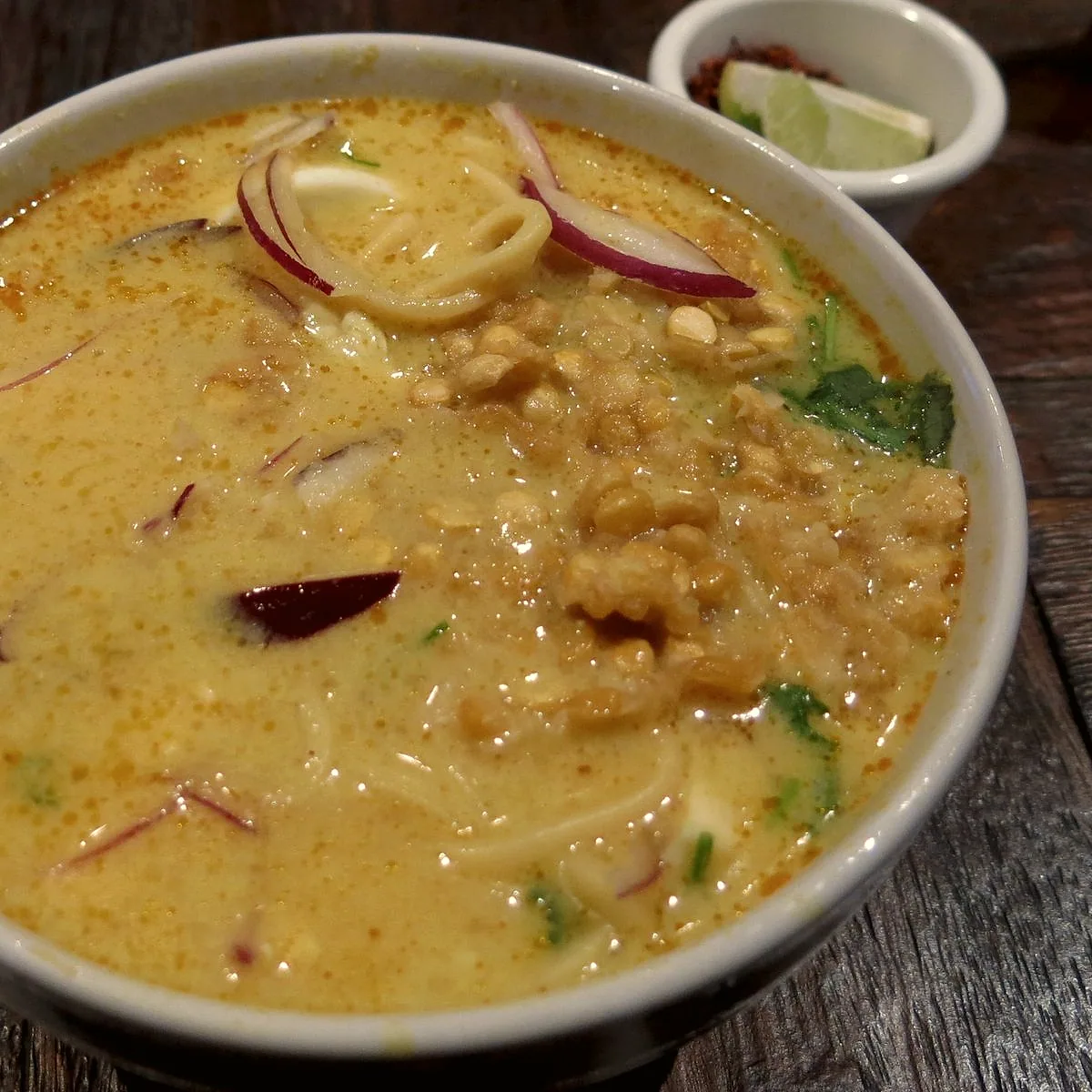
.jpg)
CC BY 2.0. Cropped and colour-adjusted for this site.
Method
Heat the 20 g vegetable oil in a small pan and fry a handful of the 50 g dried egg noodles, uncooked and dry, until golden and crisp, for 8m. Drain and set aside for garnish.
Heat the 40 g vegetable oil in a large pot and fry the 150 g yellow onion, 4 garlic cloves (20 g) and 15 g fresh ginger until softened. Stir in the 4 g ground turmeric, 4 g sweet paprika and 4 g chilli flakes and cook for 12m, until fragrant. Add the 600 g chicken thigh and turn to coat it in the spiced base.
Whisk the 40 g gram flour into the 800 ml coconut milk until smooth, then pour this and the 400 ml chicken stock into the pot with the 8 g fine sea salt. Bring to a gentle simmer and cook for 35m, stirring occasionally, until the chicken is fully tender and the broth has thickened.
The gram flour is whisked into the coconut milk before it meets any heat, which is what keeps the broth from splitting into oil and solids over the long simmer that lets the chicken cook through on the bone.
Boil the 300 g dried egg noodles in plenty of water for 5m, until just tender, then drain.
Divide the noodles between bowls and ladle over the chicken and broth. Top each bowl with the 4 eggs (200 g), the fried noodle garnish, the 1 spring onion (15 g) and 10 g fresh coriander, and serve with the 20 ml fresh lime juice alongside. This takes 5m.
Ohn no khao swè translates plainly as "coconut milk noodles," and the name is a fair description of the whole dish: egg noodles in a broth thickened with both coconut milk and gram flour, ladled over the noodles rather than served on the side. Its early history in Myanmar is thin, though: there are not many surviving records to fix where or when it began, and local tradition pointing to Shwedaung, a town near Pyay, is not confirmed by anything more solid than tradition itself [1][2].
Its clearer history starts with a Muslim trading community rather than a kitchen. Memons, a Gujarati Muslim community with a long-standing trading presence in British-ruled Myanmar, ate and adopted the dish while living there, some settling as far as Akyab, present-day Sittwe [2]. That presence ended abruptly: after the military coup of 2 March 1962 brought Ne Win to power, rising hostility toward Myanmar's Indian-descended communities pushed a large number of Memons to leave the country for India and Pakistan, many settling in Karachi [1][2].
They took the dish with them and changed it as they went. In Pakistan it became "khow suey," rebuilt around what was available and what suited a Memon table: spaghetti in place of egg noodles in some households, a yoghurt-and-gram-flour sauce standing in for coconut milk in others, and South Asian spicing layered over the Burmese base [1][2]. Its social role shifted along with its recipe: from an everyday Rangoon street food to a centrepiece dish for weddings, Eid and other gatherings in the Memon community, served with the same array of textural garnishes and left for each guest to customise their own bowl [2].
Sources
- Ohn no khao swè, WikipediaCovers the dish's unclear early history, its possible origin near Shwedaung, and its adoption by the Memon community into what became Pakistani "khow suey."
- Khow Suey — A Dish Born from Migration and Adaptation, The Daily StarIndependent account of the Memon community's role, the 1962 coup and outmigration from Myanmar, and the dish's adaptation into Pakistani khow suey.