Indian · Main Course
Hyderabadi Biryani
Basmati and raw, spiced lamb sealed into one pot together, so the meat finishes entirely in the steam trapped under the rice rather than in a pan of its own.
Also known asKacchi biryani · Hyderabad
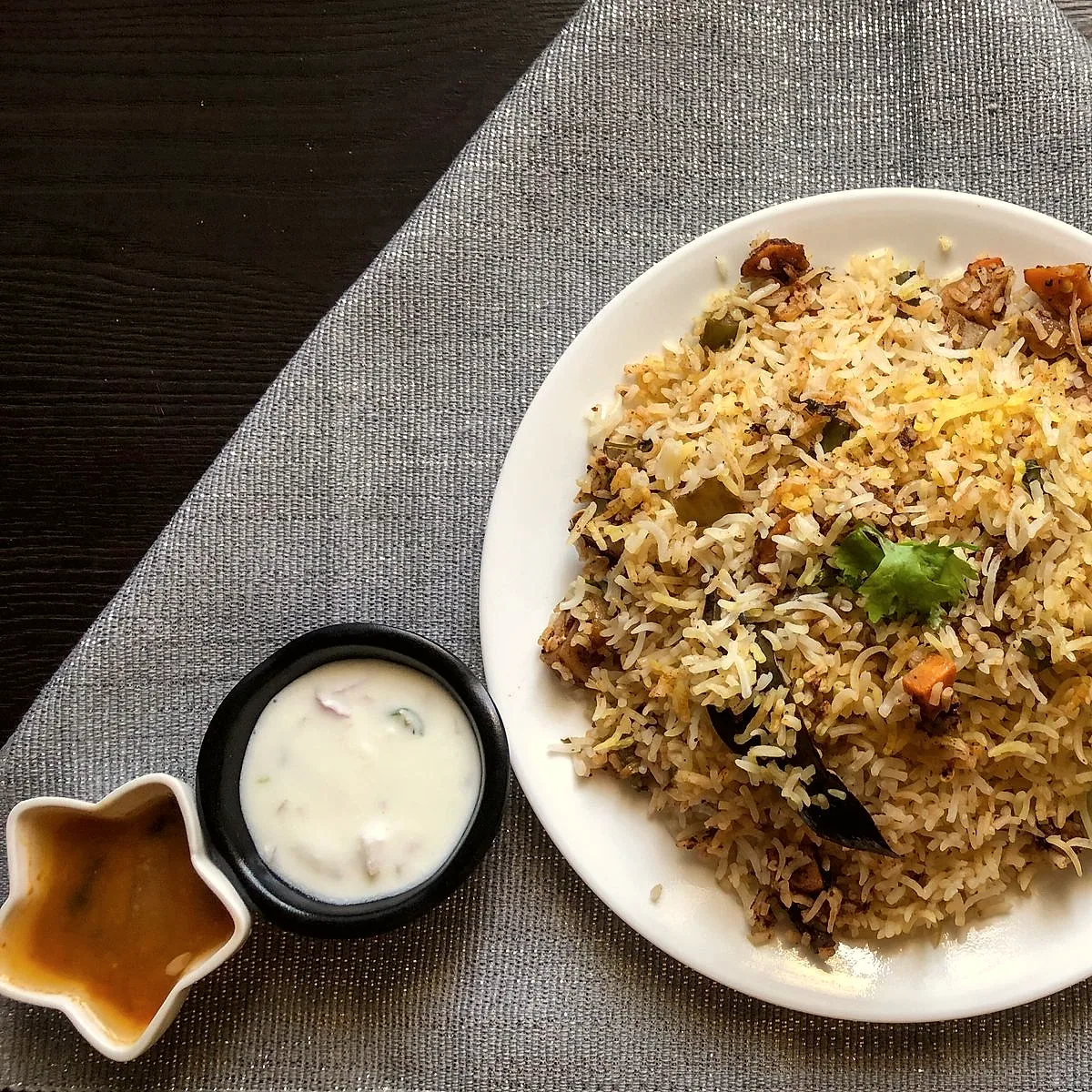

CC BY-SA 4.0. Cropped and colour-adjusted for this site.
The same dish, adapted. Every quantity, time and figure below changes with the version.
Method
Heat half of the 50 g ghee in a wide pan and fry the 100 g yellow onion and 150 g yellow onion together over a medium heat, stirring often, for 15m, until deep golden-brown. Lift out and drain, keeping the two portions separate.
Combine the 450 g lamb leg, 150 g yoghurt, 20 g fresh ginger, 4 garlic cloves (20 g), 3 g ground turmeric, 6 g chilli flakes, 20 ml freshly squeezed lemon juice, the 8 g fine sea salt and the fried 100 g yellow onion in a large bowl, working the marinade into the meat by hand for 12m.
Cover the bowl and refrigerate for 3h, so the yoghurt and spices work into the meat before it goes anywhere near heat.
Rinse the 400 g basmati rice until the water runs clear, then bring the 2.2 L water to the boil with the 12 g fine sea salt, the 15 cardamom pods (6 g), 6 cloves (0.6 g), 2 cinnamon sticks (6 g), 2 bay leaves (0.4 g) and 4 g caraway seed. Add the rinsed rice and boil for 12m, until the grains are still firm at the core, then drain.
Common pitfallRice cooked through at this stage turns to mush once it steams again over the meat. It only needs to be parboiled to about seven-tenths done, still firm at the core, so it finishes correctly during the sealed dum cook.
Spread the marinated lamb in an even layer across the base of a heavy, wide pot. Mound the drained rice on top, then scatter over the fried 150 g yellow onion, the 20 g fresh coriander and the 15 g fresh mint. Bloom the 0.3 g saffron in the warm 30 ml water and drizzle it over the rice along with the remaining 50 g ghee. Seal the lid tightly, sealing the rim with a strip of dough or a double layer of foil if it does not fit snugly. This takes 15m.
Set the sealed pot over the lowest possible heat, ideally on top of a heat diffuser, and leave it completely undisturbed for 45m. The meat cooks through entirely in the steam trapped under the seal.
In kacchi biryani the meat goes into the pot raw. It cooks entirely inside the sealed pot, in the steam given off by the rice and its own juices, rather than in a pan beforehand. This is the technique that separates kacchi from a pakki biryani made with pre-cooked meat.
Break the seal away from the heat and let the biryani rest briefly before turning it out, working from the bottom up so the rice, meat and crisped onion come together in each portion. This takes 5m.
Method
Heat a third of the 50 g ghee in a wide pan and fry the 100 g yellow onion and 100 g yellow onion together over a medium heat, stirring often, for 15m, until golden-brown. Lift out and drain, keeping the two portions separate.
Return the fried 100 g yellow onion to the pan with the 450 g lamb leg, 150 g yoghurt, 15 g fresh ginger, 3 garlic cloves (15 g), 2 g chilli flakes, 15 ml freshly squeezed lemon juice, the 8 g fine sea salt and the 250 ml water. Cover and simmer, stirring occasionally, for 40m, until the lamb is tender and the gravy has thickened around it.
The Awadhi court kitchens this style descends from favoured restraint over heat, so the chilli here is a fraction of the Hyderabadi quantity and the gravy leans on the meat's own stock and whole spices for depth rather than on a large charge of ground chilli.
Rinse the 400 g basmati rice until the water runs clear, then bring the 2.2 L water to the boil with the 12 g fine sea salt, the 15 cardamom pods (6 g), 6 cloves (0.6 g), 2 cinnamon sticks (6 g) and the 2 bay leaves (0.4 g). Add the rinsed rice and boil for 12m, until the grains are still firm at the core, then drain.
Spread the cooked lamb and its gravy across the base of a heavy, wide pot. Mound the drained rice on top, then scatter over the fried 100 g yellow onion, the 15 g fresh coriander and the 10 g fresh mint. Bloom the 0.3 g saffron in the warm 30 ml water, stir in the 5 ml rose water, and drizzle both over the rice along with the remaining 50 g ghee. Seal the lid tightly, sealing the rim with a strip of dough or a double layer of foil if it does not fit snugly. This takes 15m.
Set the sealed pot over the lowest possible heat for 20m. Since the meat is already cooked, this dum only has to finish the rice and let the two layers trade steam and aroma.
Break the seal away from the heat and let the biryani rest briefly before turning it out, working from the bottom up so the rice, meat and crisped onion come together in each portion. This takes 5m.
Method
Heat a third of the 50 g ghee in a wide pan and fry the 100 g yellow onion and 150 g yellow onion together over a medium heat, stirring often, for 15m, until deep golden-brown. Lift out and drain, keeping the two portions separate.
Return the fried 100 g yellow onion to the pan with the 450 g lamb leg, 150 g yoghurt, 20 g fresh ginger, 4 garlic cloves (20 g), 3 g ground turmeric, 6 g chilli flakes, 20 ml freshly squeezed lemon juice, the 8 g fine sea salt and the 250 ml water. Cover and simmer, stirring occasionally, for 40m, until the lamb is tender and the gravy has thickened around it.
Cooking the lamb through in its own gravy before it ever meets the rice is what makes a biryani pakki rather than kacchi; the dum that follows only has to finish the rice and let the two layers exchange aroma, not cook raw meat by steam alone.
Rinse the 400 g basmati rice until the water runs clear, then bring the 2.2 L water to the boil with the 12 g fine sea salt, the 15 cardamom pods (6 g), 6 cloves (0.6 g), 2 cinnamon sticks (6 g), 2 bay leaves (0.4 g) and 4 g caraway seed. Add the rinsed rice and boil for 12m, until the grains are still firm at the core, then drain.
Spread the cooked lamb and its gravy across the base of a heavy, wide pot. Mound the drained rice on top, then scatter over the fried 150 g yellow onion, the 20 g fresh coriander and the 15 g fresh mint. Bloom the 0.3 g saffron in the warm 30 ml water and drizzle it over the rice along with the remaining 50 g ghee. Seal the lid tightly, sealing the rim with a strip of dough or a double layer of foil if it does not fit snugly. This takes 15m.
Set the sealed pot over the lowest possible heat for 20m. Since the meat is already cooked, this dum only has to finish the rice and let the two layers trade steam and aroma.
Break the seal away from the heat and let the biryani rest briefly before turning it out, working from the bottom up so the rice, meat and crisped onion come together in each portion. This takes 5m.
Hyderabad passed under Mughal control in the 1630s and was afterward governed by its own line of Nizams, whose kitchens fused Mughlai cooking with local Deccani and Telugu traditions over the following centuries [2]. Biryani itself predates that court: the wider technique of cooking rice and meat together traces to Persian pilaf, carried into South Asia along Mughal and Arab trade and military routes well before it took on a distinctly Hyderabadi form [1].
A popular story credits the dish's invention to a chef of the first Nizam, Nizam-ul-Mulk Asaf Jah I, improvising with local spices during a mid-eighteenth-century hunting expedition. That account is repeated widely but is folklore rather than a documented event, and it sits alongside the more general, better-evidenced view that Hyderabadi biryani is one regional outcome of a much older Persian pilaf tradition rather than a single act of invention [1]. What is better attested is that the dish took its present form inside the Nizams' own kitchens, where recipes were closely guarded and rarely written down, over roughly the four centuries of Asaf Jahi rule [2].
The kacchi and pakki methods are usually described as the Hyderabadi court's own refinement against a wider Mughal preparation: kacchi, in which raw marinated meat is sealed under parboiled rice and cooks entirely in that shared steam, is named as the Nizam's own signature technique, while pakki, built on meat cooked before it ever meets the rice, is associated instead with Mughal army kitchens that needed a faster, more forgiving version to feed large numbers of soldiers [2]. The distinction between a pulao and a biryani more broadly is itself not a sharp one in the historical record, and both are best understood as branches of the same one-pot tradition of rice cooked with meat rather than as separate inventions [1].
Sources
- Hyderabadi biryani, WikipediaSets out the Nizam-era hunting-expedition legend alongside the scholarly view that the dish descends from Persian pilaf traditions carried into South Asia, and states plainly that the exact origin is uncertain.
- Biryani, a 400-year-old love affair with Hyderabad, Deccan ChronicleRegional newspaper feature naming kacchi gosht biryani as the Nizam's own signature preparation and pakki gosht biryani as the Mughal army-kitchen variant, and dating the dish's presence in Hyderabad to the establishment of Asaf Jahi rule.