Caribbean · Main Course
Curry Goat
Bone-in goat browned in a blend of turmeric, cumin, coriander and fenugreek, then braised with scotch bonnet, thyme and coconut milk until the meat falls from the bone.
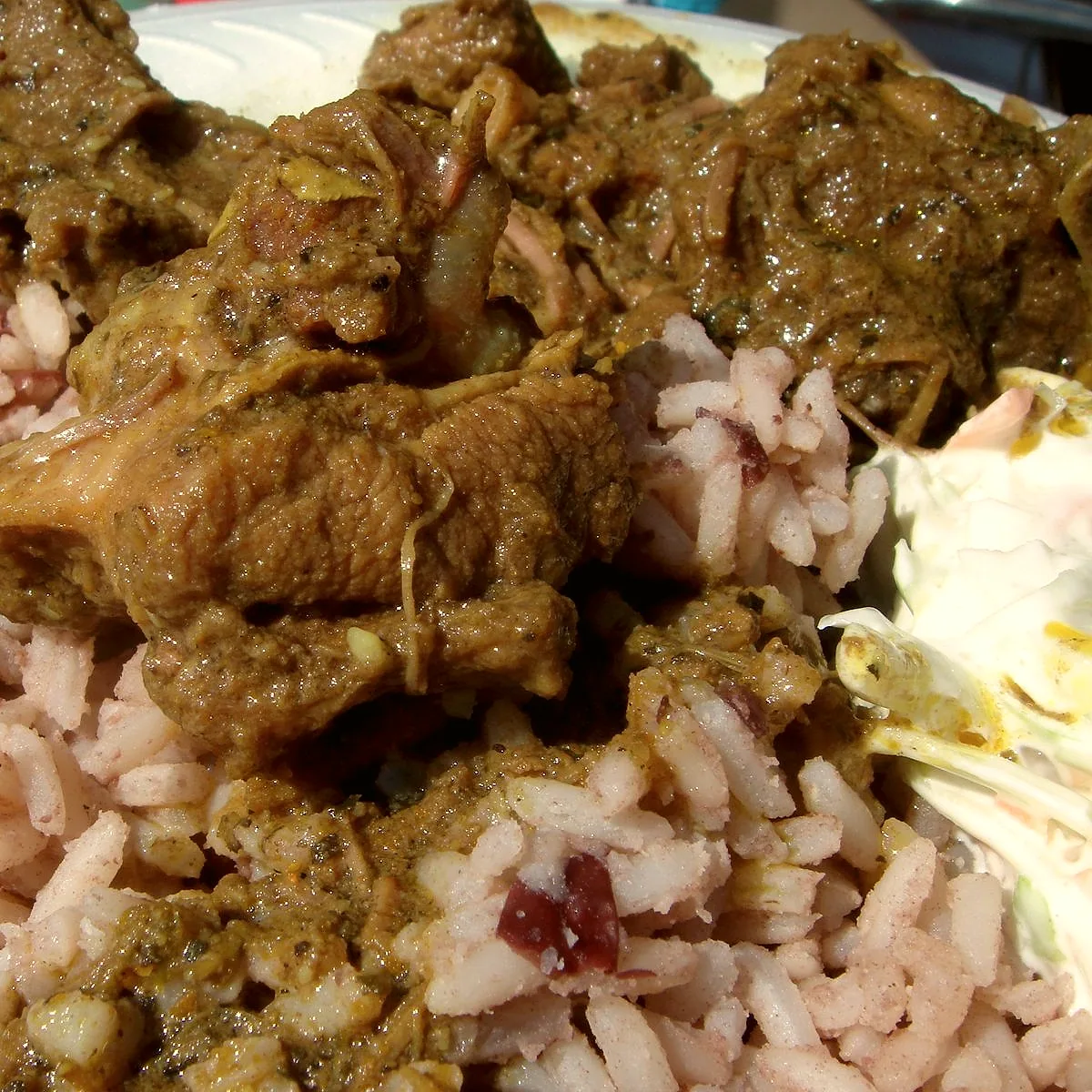

CC BY 2.0. Cropped and colour-adjusted for this site.
Method
Combine the 8 g ground turmeric, 6 g ground cumin, 6 g ground coriander, 3 g fenugreek seeds, 3 g ground allspice, 3 ½ garlic cloves (18 g) and 15 g fresh ginger into a paste and rub it all over the 1.4 kg goat.
Cover and refrigerate the goat for 12h.
Heat the 30 ml vegetable oil in a heavy pot over a high heat and brown the goat on all sides in batches, for 12m in total, then return all the meat to the pot with the 150 g yellow onion, 2 spring onions (30 g), 3 g fresh thyme, 8 g scotch bonnet, 8 g fine sea salt and 2 g ground black pepper.
Browning the goat in the same spices it was marinated in, rather than wiping them off first, toasts the curry powder directly in fat and deepens its flavour before any liquid goes in.
Pour in the 300 ml coconut milk and 300 ml water, bring to a simmer, then cover and cook at a bare simmer for 1h 30m, until the meat is tender enough to pull from the bone.
Common pitfallGoat is a working muscle and stays tough if rushed; the braise needs the full time at a bare simmer for the collagen to break down; boiling hard toughens the meat instead of tenderising it.
Stir in the 300 g potato and continue simmering, uncovered, for 20m, until the potato is tender and the sauce has thickened. Discard the whole scotch bonnet before serving.
Curry goat's ingredients name its history directly: goat, a meat common across the Caribbean, cooked in a curry powder that has no precolonial place there at all. Between 1834 and 1917, nearly one and a half million Indians emigrated as indentured labourers to British colonies after the abolition of slavery left plantations short of workers, and some thirty-six thousand of them were brought to Jamaica specifically [1]. They carried their cooking with them, and curry (the technique and the blended spice mix behind it) is the clearest survival of that migration in Jamaican food today [2].
What reached Jamaica was not simply transplanted. Most Indo-Caribbean labourers came from northeastern and central India, and once in the Caribbean they found few of the ingredients their cooking assumed were available: no curry leaves, no familiar greens, no easy substitute for the chillies grown at home. Scotch bonnet (blisteringly hot, thin-walled and locally abundant) took the place of the chillies used on the subcontinent, and coconut milk, a Caribbean staple in its own right, became the braising liquid [1]. Goat itself is a departure too: curry in most of the subcontinent is built on whatever meat, pulse or vegetable is at hand rather than on goat specifically, and its centrality here is a Caribbean choice as much as an Indian one.
Despite people of Indian descent making up only a small fraction of Jamaica's population, curry goat has become one of the island's most widely eaten dishes, served at parties and family gatherings alongside rice and peas [1]. It is often named, informally, as Jamaica's second dish after ackee and saltfish [2], and versions of it (under names including goat curry) are cooked across Guyana, Trinidad and Tobago, Suriname and Belize, each shaped by the same history of indenture and adaptation [2].
Sources
- How Indian Curry Acquired Its Caribbean Flavour, Scroll.inCovers the 1834–1917 indenture migration, the number of Indian labourers who arrived in Jamaica, and the substitution of scotch bonnet and local greens for ingredients unavailable in the Caribbean.
- How Curry Goat Became a Caribbean Classic, The JuggernautTraces curry goat's roots in Indian indentureship and its spread and renaming across the wider Caribbean.