Indian · British · Main Course
Chicken Tikka Masala
Yoghurt-marinated chicken, seared hard and finished in a spiced, buttery tomato and cream sauce.
Not the same asChicken tikka (The marinated, grilled chicken alone, without the tomato and cream sauce that defines the masala.)Butter chicken (A related but separate North Indian dish with a milder, less acidic sauce; tikka masala is generally spicier and more heavily tomato-forward.)
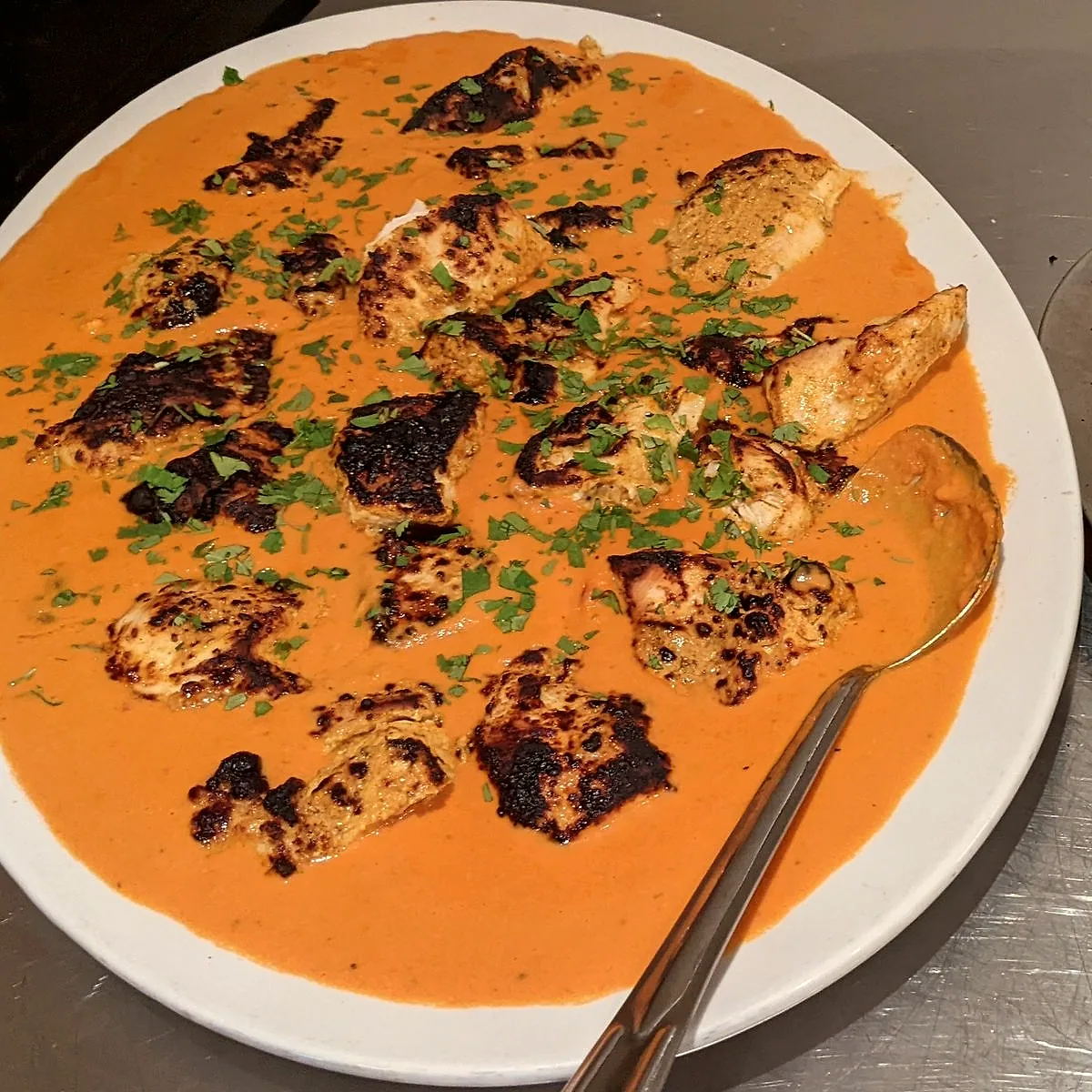

CC BY-SA 4.0. Cropped and colour-adjusted for this site.
Method
Combine the 700 g chicken thigh with the 150 g yoghurt, the 15 g freshly squeezed lemon juice, the 3 garlic cloves (15 g), the 15 g fresh ginger, the 6 g Kashmiri chilli powder, the 3 g ground turmeric, the 4 g ground cumin and the 3 g fine sea salt. Cover and refrigerate for 2h.
Melt the 20 g ghee in a wide pan and cook the 200 g white onion over a medium heat for 15m, stirring occasionally, until soft and turning golden.
Stir in the 2 garlic cloves (10 g), the 10 g fresh ginger, the 4 g Kashmiri chilli powder, the 3 g ground cumin, the 4 g ground coriander, the 1 g ground cinnamon, the 5 cardamom pods (2 g) and the 10 cloves (1 g), and cook for 4m, until fragrant.
Add the 400 g tinned tomatoes, the 30 g tomato purée and the 3 g fine sea salt, breaking the tomatoes up, and simmer for 20m, until thickened and no longer watery.
Lift the chicken from its marinade, shaking off the excess, and sear in the 30 g ghee in a very hot pan for 12m, turning occasionally, until charred at the edges and cooked through.
Searing the marinated chicken hot and fast, separately from the sauce, gives it the charred edges the dish is named for; simmering it directly in the sauce from raw would steam it instead.
Blend the tomato sauce until smooth, return it to the pan and stir in the 120 g double cream. Add the seared chicken and simmer gently for 12m, until the chicken is coated and heated through. Scatter over the 10 g fresh coriander to serve.
Common pitfallAdding the cream over high heat can cause it to split against the acidity of the tomatoes. It goes in once the sauce has come down to a gentle simmer, off any hard boil.
The most widely repeated origin story places chicken tikka masala's invention at the Shish Mahal, a restaurant opened in Glasgow's west end in 1964 by Ali Ahmed Aslam, a chef who had emigrated from what was then British India as a child [1][2]. By his own account, a customer complained in the 1970s that a plate of chicken tikka was too dry, and Aslam improvised a sauce (yoghurt, cream and spices worked into tinned tomato soup) to answer the complaint [1][2]. It is a good story, and it is the one told most often, but neither account treats it as settled: one source crediting Aslam with the invention still concedes that "the origin of the dish is not certain," and the other sets the Shish Mahal story directly beside a documented earlier recipe rather than presenting it alone [1][2].
The strongest documented counter-claim predates the Shish Mahal itself. A recipe for "Shahi Chicken Masala," close enough to be treated as a forerunner, appears in Balbir Singh's cookbook from 1961, three years before Aslam's restaurant opened at all [2]. That alone does not settle the matter, since a printed antecedent and the popular dish now served under this name are not necessarily the same lineage, but it does mean the Glasgow story cannot be the whole account.
The dispute was serious enough to be tested formally. A Glasgow member of parliament sought European Union Protected Designation of Origin status for chicken tikka masala as a specifically Glaswegian invention, comparable to the protection held by Melton Mowbray pork pies, and the bid failed [2]. What is not in question is the dish's adopted home: it became, by one well-known 2011 survey, Britain's single most popular restaurant dish [2], an adaptation of South Asian cooking to British taste that British curry houses, wherever the recipe first came from, made unmistakably their own.
Sources
- Ali Ahmed Aslam, WikipediaOn Aslam's biography, his account of inventing the dish at the Shish Mahal, and the article's own acknowledgement that the origin "is not certain."
- The Inventor of the Chicken Tikka Masala Has Died, EuronewsOn the counter-claim from Balbir Singh's 1961 cookbook, and the unsuccessful bid for EU Protected Designation of Origin status as a Glasgow dish.