Thai · Main Course
Pad Thai
Soaked rice noodles fried hard in a tamarind, palm sugar and fish sauce caramel, with tofu, egg and dried shrimp.
Also known asKuai tiao phat thai · Thailand
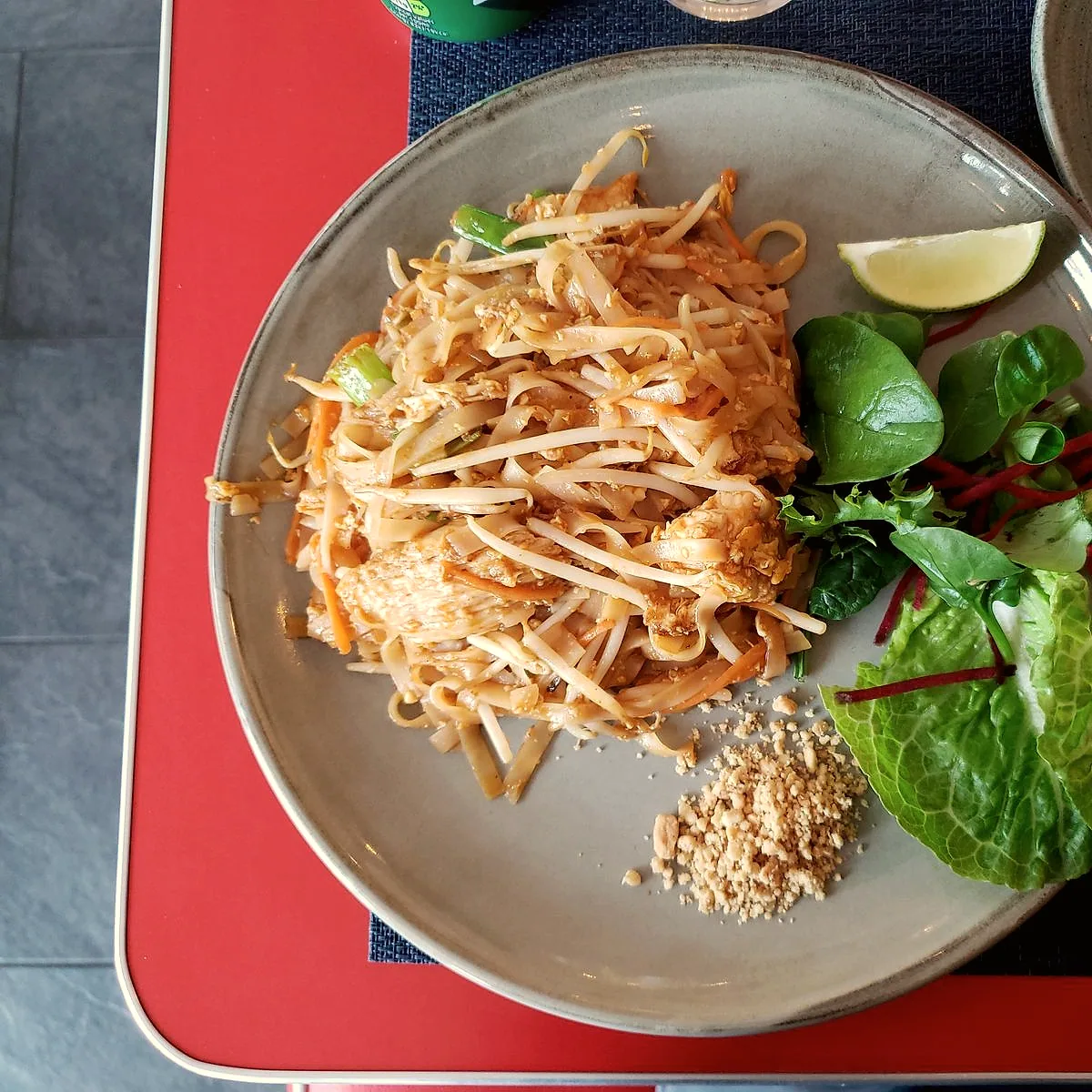

CC0. Cropped and colour-adjusted for this site.
Method
Cover the 180 g rice noodles with plenty of cold water and leave them for 45m, until they are white, pliable and limp but still firm enough to snap. Drain them and leave them to drip dry.
The noodles are soaked in cold water and never boiled. They finish cooking in the wok in the sauce, which is where they take up their flavour; a noodle that arrives already cooked has nothing left to absorb and breaks up instead.
Break the 40 g tamarind into the 80 ml water, hot from the kettle, and work it apart with your fingers until it has dissolved into a thick brown liquid; push it through a sieve and throw away the fibre. Set it over a low heat with the 45 g palm sugar and the 45 ml fish sauce and simmer for 8m, until it thickens to a loose syrup that coats a spoon. It should read sour first, then sweet, then salt.
The sauce is reduced to a syrup before it goes near the wok. Adding tamarind, sugar and fish sauce separately floods the pan, and the noodles stew in the time it takes the liquid to cook off.
Everything from here happens faster than it can be prepared, so prepare it all now and set it beside the stove in the order it goes in: the 3 garlic cloves (15 g), the 20 g preserved radish, the 15 g dried shrimp, the 120 g firm tofu, the beaten 2 eggs (100 g), the 80 g bean sprouts and the 30 g garlic chives. Take 10m over it.
Heat a wok until a drop of water skitters and vanishes. Add the 30 ml peanut oil, then the tofu, and fry without moving it much until the faces are gold. Add the garlic, the preserved radish and the dried shrimp and stir for 4m, until the garlic smells sweet and the shrimp have crisped.
Add the drained noodles and pour the sauce down the side of the wok. Toss and lift for 4m, keeping the heat high, until the noodles have drunk all the liquid, turned a deep russet and started to catch in places. They should be tender with a little resistance left at the centre.
Common pitfallA cool or crowded pan is the usual failure. The noodles need to fry, not simmer, and a domestic burner will only manage two servings at a time; doubling the recipe means cooking it twice.
Push the noodles to one side of the wok, pour the egg into the space and leave it alone for a moment to set at the edges. Break it up, then fold it through the noodles over 2m.
Throw in the 80 g bean sprouts, the 30 g garlic chives and the 20 g roasted peanuts and toss for 2m, no longer, or the sprouts go limp. Turn out onto two plates and serve at once with the 40 g bean sprouts, the 10 g garlic chives, the 20 g roasted peanuts, the 2 g chilli flakes and the 1 lime (70 g) alongside.
Pad thai is young, and unusually well documented for it. Half its name is Chinese: kuai tiao is a Teochew word for rice noodles, and the full form, kuai tiao phat thai, means those noodles fried Thai-style, a construction that only makes sense if the dish was already understood as a Thai treatment of something foreign [1]. The technique is Chinese stir-frying, carried to Siam by southern Chinese migrants; the tamarind, palm sugar, fish sauce and chilli are what was done to it locally [3].
What turned it into a national dish was policy. Field Marshal Plaek Phibunsongkhram, prime minister from 1938, issued twelve cultural mandates: the first, on 24 June 1939, renamed Siam as Thailand, and the fifth, that November, instructed citizens to eat food made from Thai produce [2]. Flooding wrecked the rice crop of the Chao Phraya delta in 1942, and the government answered by promoting noodles, distributing carts and recipes through the Public Welfare Department under the slogan that noodles were your lunch [4][1]. A study of the period reads the whole exercise as the deliberate Thai-ization of Chinese kway teow under that government [5].
Whether the state also invented the dish is a separate question, and the popular answer overstates the record. The story of a national recipe competition that produced pad thai circulates widely; Phibun's own son, interviewed by Gastronomica, remembered it being cooked in the family home before it became policy and could not say who devised it [3][4]. The promotion is documented in detail. The invention is not.
What is not in doubt is the shape of the dish: one sauce carrying sour, sweet and salt together, noodles fried hard enough to catch on the pan, and the last adjustments left to the person eating it (lime, chilli and peanuts arrive on the side rather than in the wok) [1].
Sources
- Pad thai, WikipediaOn the name, its Teochew root, the wartime noodle campaign, and the argument that the dish came from Thai Chinese cooks.
- Thai cultural mandates, WikipediaThe twelve Ratthaniyom with their dates, including the renaming of Siam and the instruction to eat Thai produce.
- Finding Pad Thai, Gastronomica 9:1, 2009Alexandra Greeley, on the dish's Chinese roots and on Phibun's son's recollection that it was cooked in the family home before it was government policy.
- The Invention of Pad Thai, Priceonomics, 2015Alex Mayyasi, drawing on Gastronomica, on the Public Welfare Department's noodle campaign and on the competing accounts of who devised the dish.
- Pad Thai: the Thai-ization of Chinese food and the Thai nationalism project by the Phibunsongkhram government, National Identities 26(5), 501–519, 2024Peer-reviewed study of the nationalist policies that localised kway teow. Abstract consulted; the full text is behind a paywall.