Burmese · Soup
Mohinga
Catfish simmered until it falls apart, built into a thick, lemongrass-scented broth over soft rice noodles, and finished with boiled egg and crisp garnishes.
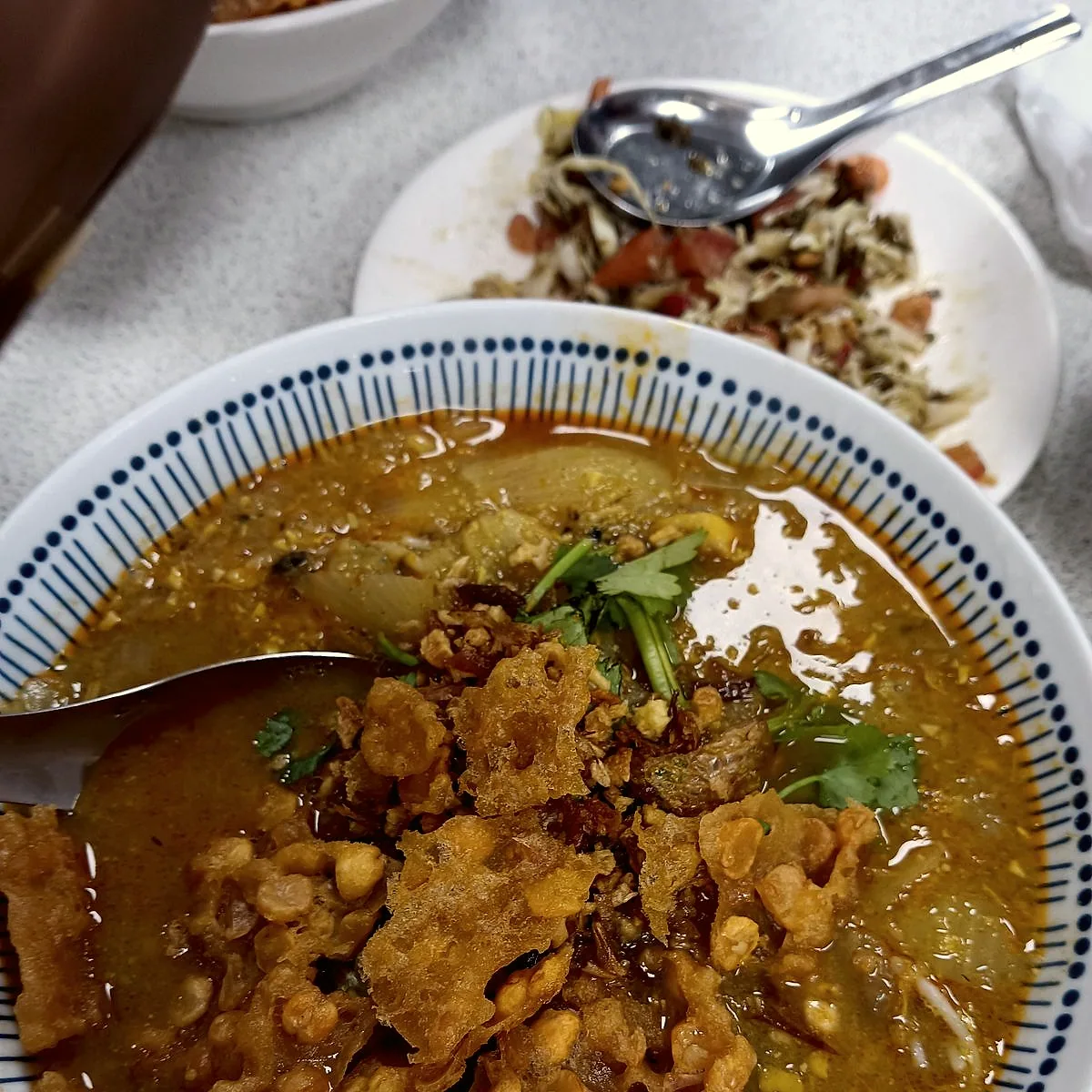
.jpg)
CC BY-SA 4.0. Cropped and colour-adjusted for this site.
Method
Gently poach the 500 g catfish in the 1.6 L water at a bare simmer for 20m, until it flakes easily. Lift the fish out, flake it into large pieces discarding any bones, and reserve the poaching liquid.
Common pitfallBoiling the catfish hard toughens it and clouds the poaching liquid. A gentle simmer keeps the flesh tender enough to flake apart by hand and leaves a cleaner stock to build the broth on.
Cover the 300 g rice noodles with warm water and leave to soak for 20m, until pliable.
Heat the 45 g vegetable oil in a large pot and fry the 150 g yellow onion, 4 garlic cloves (20 g) and 15 g fresh ginger until softened. Add the 20 g lemongrass, 4 g ground turmeric, 4 g chilli flakes and 15 g dried shrimp and cook for 12m, until fragrant.
Pour in the reserved poaching liquid along with the 100 g dried yellow split peas. Simmer for most of 40m, until the peas have fully broken down. Whisk the 30 g gram flour with a little of the hot broth to a smooth paste, stir it back in, then return the flaked catfish to the pot with the 25 ml fish sauce and 8 g fine sea salt and simmer gently for the remaining time, until thickened to the consistency of a loose gravy.
The split peas and toasted gram flour are what give mohinga its body; the broth is thickened by what dissolves into it during the long simmer rather than by any separate roux or cornflour slurry.
Drop the soaked noodles into a pot of boiling water and cook for 4m, until just tender, then drain.
Divide the noodles between bowls, ladle the hot broth over the top, and finish each bowl with the 4 eggs (200 g), a squeeze of the 20 ml fresh lime juice and the 10 g fresh coriander. This takes 6m.
Mohinga is the closest thing Myanmar has to a national dish: a thick, lemongrass-scented fish and rice-noodle soup eaten overwhelmingly at breakfast [1][2]. Few households make it themselves; it is bought instead from the street vendors and cafés that compete over it in every town, each with a loyal following for their own version [2]. It is also cooked differently almost everywhere it is eaten: the Irrawaddy Delta, Bago and Upper Myanmar each keep their own version, thickened, seasoned and finished slightly differently while remaining recognisably the same soup [1][3].
Its early written history, as far as it can be traced in English-language sources, is thin. Wikipedia's account, drawing on Burmese-language research, dates the dish's earliest mention to a verse by the poet U Ponnya during the Konbaung dynasty, Myanmar's last royal house, and holds that no formal mohinga recipe survives in the royal cookbooks that recorded other, more prestigious court dishes of the same period. This is taken by at least one Burmese historian as a sign the dish began as ordinary, market-stall cooking rather than anything grander. That account could not be independently confirmed against an English-language source for this entry, so it is reported here as Wikipedia's account rather than as a settled fact.
What is not in question is the noodle underneath it. Rice vermicelli predates mohinga by a long way (equipment for fermenting rice and producing noodles has been found from the much earlier Pyu city-states), so the dish inherited its starch from a far older regional tradition rather than inventing one [1][2].
Sources
- Mohinga, WikipediaCovers the Konbaung-era poetic references, historian Khin Maung Nyunt's conclusion about the dish's commoner origins, and regional variation.
- Burmese Food and Cuisine: An Introduction, Great British ChefsIndependent food-journalism account confirming mohinga's status as Myanmar's national breakfast dish, its garnishes, and its being bought from street vendors rather than cooked at home.
- Five Mohinga Recipes You Should Know: Exploring Regional Differences, Insight MyanmarIndependent nonprofit publication on Myanmar culture, covering how mohinga's thickener, broth and protein vary by region while remaining recognisably the same soup.