Gulf · Main Course
Kabsa
Chicken browned with warm whole spices and tomato, then basmati simmered in the same pot until it has drunk up every drop of the spiced stock.
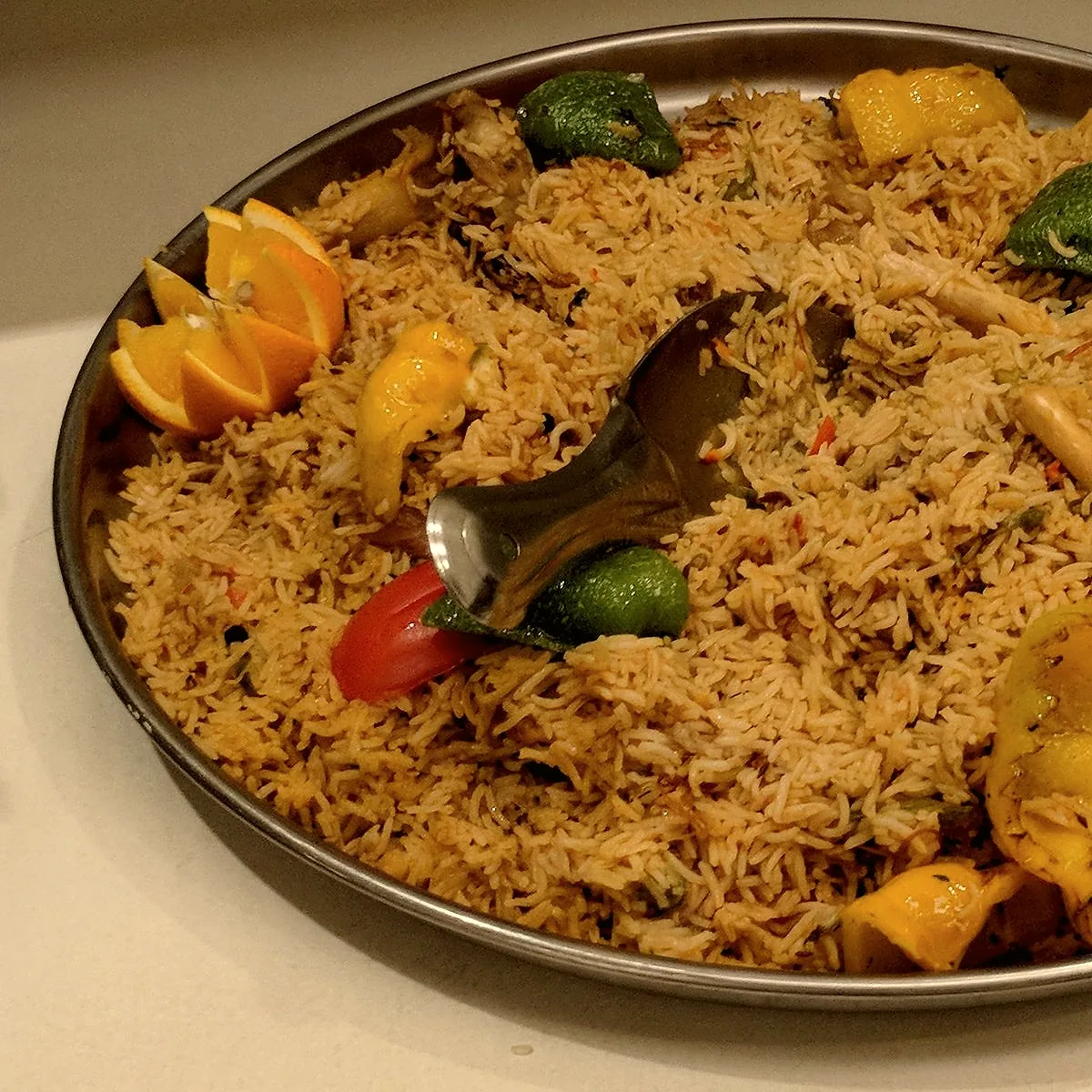

CC BY-SA 3.0. Cropped and colour-adjusted for this site.
Method
Melt half of the 40 g ghee in a heavy pot over a high heat and brown the 700 g chicken thigh on all sides, working in batches if needed so it colours rather than steams. This takes 10m. Lift out and set aside.
Common pitfallCrowding the pot steams the chicken instead of browning it, and kabsa loses most of its savour without that base of browned meat and fond to build the stock on.
Add the remaining ghee to the pot with the 200 g yellow onion and cook until soft, then add the 3 garlic cloves (15 g), 5 cardamom pods (2 g), 4 cloves (0.4 g), 1 cinnamon stick (3 g), 2 bay leaves (0.4 g), 2 g ground black pepper, 3 g ground cumin, 4 g sweet paprika and the 10 g fine sea salt. Cook briefly until fragrant, then stir in the 200 g tinned tomatoes, breaking it down into the onion. Spend 10m building the base.
Return the browned chicken to the pot, pour over the 700 ml water and bring to a simmer. Cover and cook gently for 30m, until the chicken is cooked through and tender. Lift the chicken out and keep it warm; strain and reserve the spiced stock.
While the chicken simmers, fry the 100 g yellow onion in a little oil until deep golden, then set aside. Toast the 30 g almonds in the same pan until golden. This takes 10m in total.
Rinse the 400 g basmati rice and add it to the reserved stock in the pot, along with the 30 g raisins. Bring back to a simmer, then cover tightly and cook over the lowest heat for 20m, undisturbed, until the stock is fully absorbed and the rice is tender.
The rice is cooked in the strained, fat-flecked stock the chicken simmered in rather than in plain water, so the pot's spicing carries straight through into every grain instead of sitting only on the surface.
Let the rice rest off the heat, still covered, before fluffing it with a fork. Spread it on a platter, set the chicken on top, and scatter over the fried onion and toasted almonds. This takes 10m.
Kabsa's own name records its method rather than its history: it comes from the Arabic root k-b-s, "to press" or "to squeeze," for the way meat, rice and spices are cooked tightly together in one pot [1]. Where that method itself began is genuinely contested. One account holds it as a Bedouin dish, built by desert tribes out of whatever rice, meat and spice were on hand; a second traces it to Yemeni mandi, the older tradition of meat and rice cooked together in an earth oven; a third, more surprising claim connects it to Spanish paella by way of Andalusian cooking. None of these is treated as settled, and Wikipedia presents all three side by side as competing theories rather than choosing between them [1].
The Yemeni connection has independent support: kabsa's roots are traced to Yemen and to mandi specifically by more than one source, which places kabsa within a wider Arabian Peninsula family of rice-and-meat dishes distinguished mainly by technique and regional spicing rather than by separate origins [2]. That same family stretches east as well: kabsa is described as sharing "culinary DNA" with the Persian- and Indian-descended pilaf tradition that also produced dishes such as biryani, built on similar principles of rice cooked in a well-spiced stock [2].
Whatever its beginning, kabsa's standing as a national dish is a recent, deliberate designation rather than an ancient one: Saudi Arabia's Ministry of Culture named it as part of the country's promoted culinary heritage in 2021, formalising a status that regional practice had already given it across the Gulf [1].
Sources
- Kabsa, WikipediaSets out three competing theories of kabsa's origin (Bedouin, Yemeni-mandi and Andalusian-paella) without settling between them, gives the Arabic root k-b-s ("to press"), and notes the 2021 Saudi Ministry of Culture heritage initiative.
- Kabsa — The Dish at the Heart of Saudi Cuisine, Saudi TimesIndependently traces kabsa's roots to Yemen and to Yemeni mandi, notes the paella theory, and places kabsa alongside Persian- and Indian-descended pilafs on shared culinary ground.