Canadian · Main Course
Tourtière
A double-crust pastry pie of spiced minced pork and beef, bound with mashed potato and baked until the crust is deep gold.
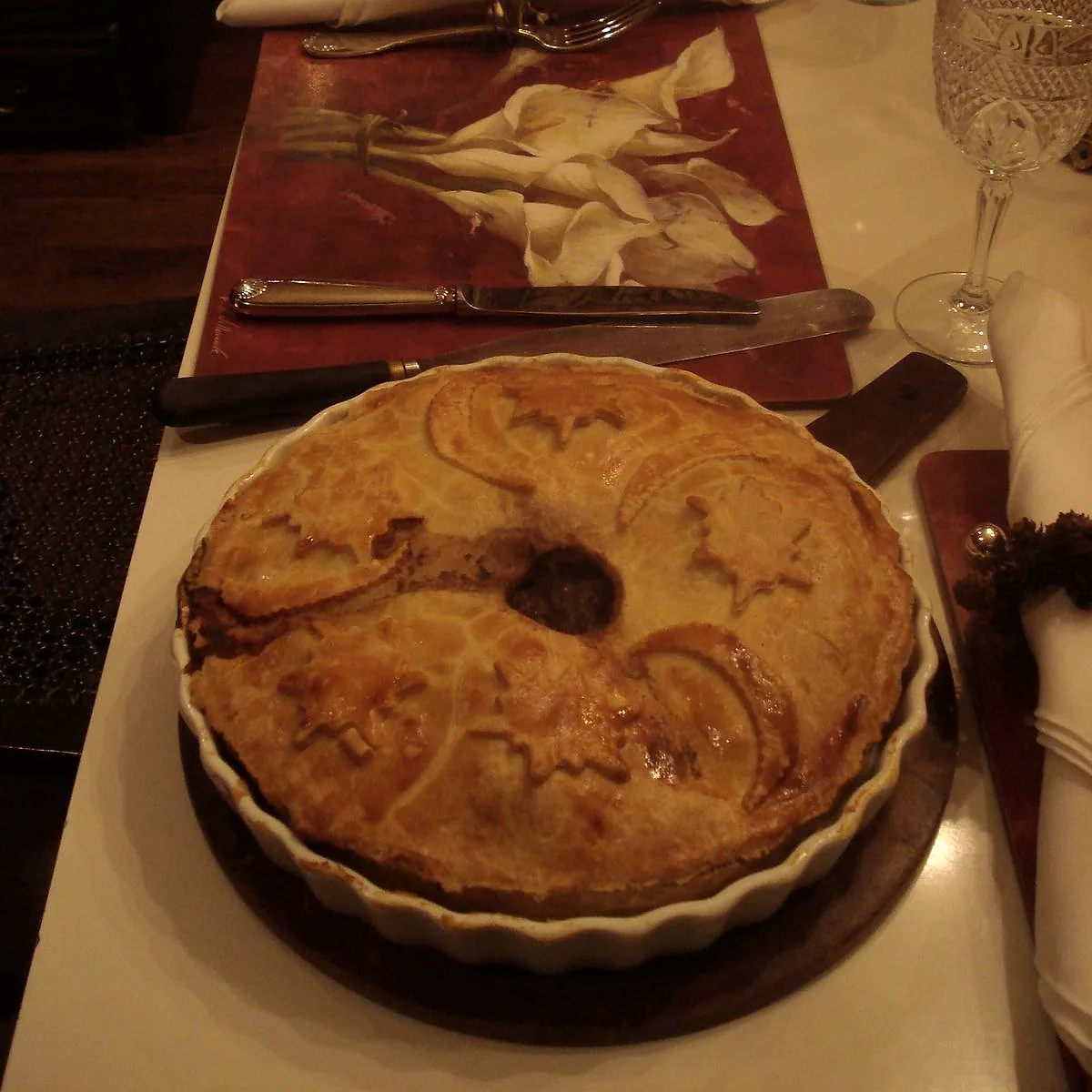

CC BY 2.0. Cropped and colour-adjusted for this site.
Method
Rub the 100 g lard and the 50 g unsalted butter into the 300 g plain flour and the 5 g fine sea salt until the mixture looks like coarse crumbs, then mix in the 90 g water just until the dough comes together. Divide in two, one piece slightly larger, flatten into discs and wrap.
Chill the pastry for 45m.
Cook the 500 g pork mince and the 250 g beef mince in a wide pan over a medium heat, breaking them up, until no longer pink. Add the 150 g yellow onion, the 2 garlic cloves (10 g) and the 150 g potato, then the 150 g chicken stock, the 2 g ground cinnamon, the 10 cloves (1 g), the 1 g ground nutmeg, the 5 g fine sea salt and the 2 g ground black pepper. Simmer for 30m, until the potato has broken down and the mixture holds together.
The diced potato is cooked directly into the meat rather than added as a separate mash, so it breaks down and binds the filling into slices rather than leaving it loose and crumbly once cut.
Spread the filling on a tray and leave to cool for 20m.
Common pitfallFilling a pastry case with hot filling melts the fat in the crust before it reaches the oven, and the base turns soggy rather than short. The filling needs to come down close to room temperature first.
Roll out the larger disc of pastry and line a pie dish. Fill with the cooled filling, roll out the second disc for the lid, seal the edges and cut a small vent. Brush with the ½ eggs (20 g).
Bake at 190 °C for 45m, until the crust is deep golden.
The story holds that early versions of tourtière were stuffed with tourte, the French name for the passenger pigeon, a bird so abundant in early Canada that it was easy to catch and simple to justify putting in a pie [2]. It is a tidy story, and it is not the only one on offer. The simpler competing explanation is that tourte is an old French word for pie, and a dish baked in a tourtière (the deep pan the word originally named) eventually took the pan's name for itself, the way a casserole is named for its pot rather than its contents [1][3]. Neither theory has been definitively settled, and a museum's account of the dispute treats both explanations as still genuinely open rather than one having won out over the other [3].
What is on firmer ground is the pie's association with French settlement along the Saint Lawrence from the 1600s, and its place at the centre of Quebec's Christmas Eve réveillon, a late feast held after midnight mass, long enough established among French-speaking Catholics to be a fixture of the season rather than a novelty [2]. Its first appearance in print is later: a recipe using pork, mutton and veal appears in La cuisinière canadienne, a cookbook from 1840 [2].
The pie was never one fixed recipe, and still is not. The version from Saguenay–Lac-Saint-Jean is made with cubed rather than ground meat, cooked slowly in a deep dish with potatoes and a thicker crust, quite different from the finely ground, cinnamon-and-clove-seasoned filling more familiar outside that region [1][3]. What holds across the regional versions is less a recipe than an occasion: a spiced meat pie, however it is filled, timed to the one night of the year built around staying up for it.
Sources
- Tourtière, WikipediaOn the disputed etymology, with language specialists favouring the baking-vessel explanation over the passenger-pigeon theory.
- Meat Pie Magic: The History of Tourtière, Canadian Food FocusOn the passenger-pigeon origin story, the pie's first cookbook appearance in La cuisinière canadienne (1840), and its role in Quebec's réveillon.
- Tourtière, Sidney Museum and ArchivesOn the two competing name theories, and on the Lac-Saint-Jean regional version made with cubed rather than ground meat.