Caribbean · Soup
Soup Joumou
Beef and pumpkin simmered into a thick, orange broth with cabbage, carrot, potato, plantain and macaroni: Haiti's Independence Day soup, eaten every first of January.
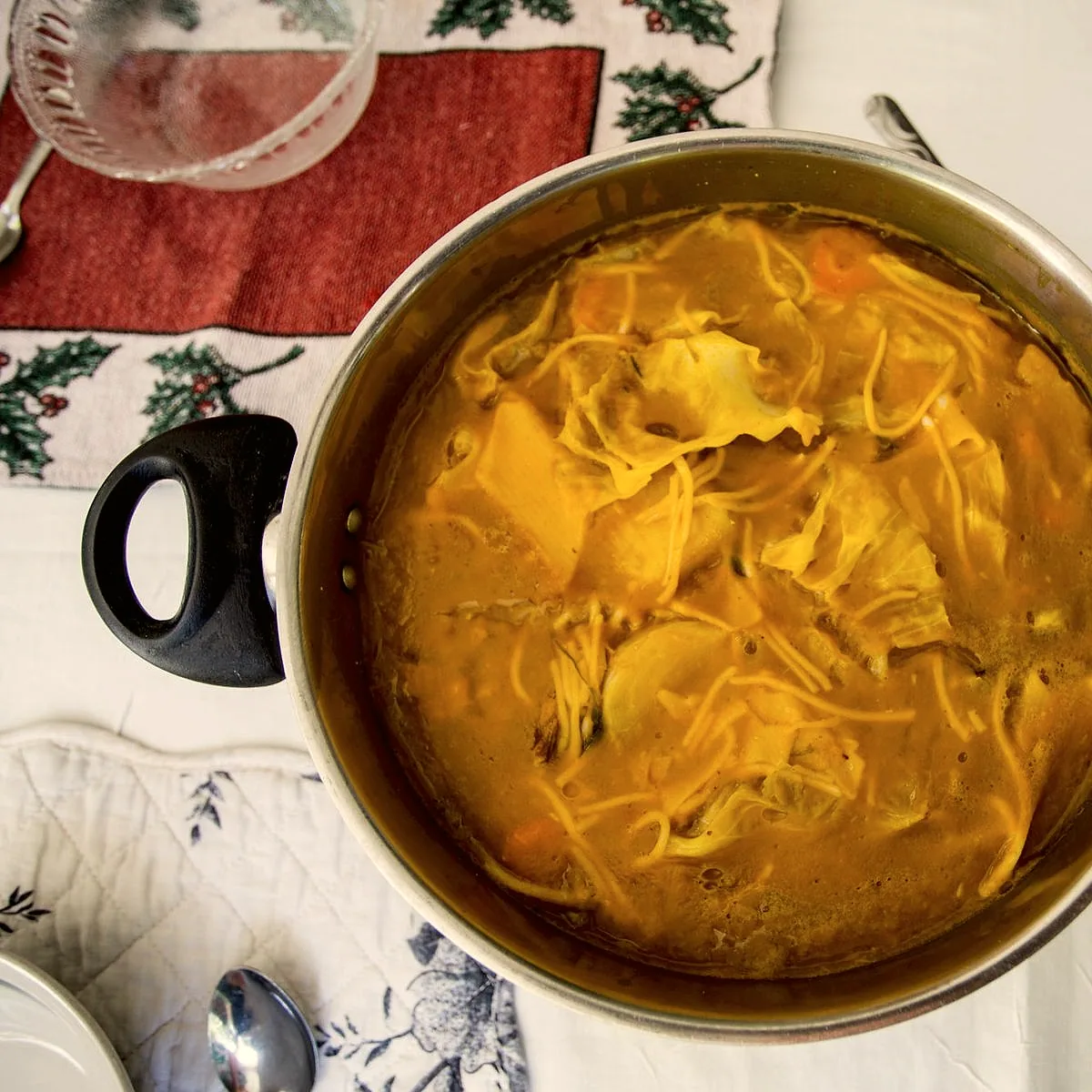

CC BY-SA 4.0. Cropped and colour-adjusted for this site.
Method
Rub the 500 g beef brisket with the 30 ml fresh lime juice, 3 garlic cloves (15 g), 100 g white onion, 1 ½ spring onions (20 g), 2 g fresh thyme and 10 g flat-leaf parsley, and leave to marinate for 1h.
Brown the marinated beef in a large pot over a high heat for 15m.
Add the 2.2 L water, 5 cloves (0.5 g), 4 g scotch bonnet and 20 g tomato purée. Bring to a simmer and cook for 1h, until the beef is tender.
Meanwhile, boil the 500 g pumpkin in a separate pot of water until completely soft, about 30m.
Drain the pumpkin, reserving a little of its cooking water, and blend to a smooth purée. This takes about 5m.
Boiling the pumpkin separately and blending it before it joins the beef broth is what gives soup joumou its characteristic thick, orange body; added in chunks it would simply fall apart into the broth unevenly instead of thickening it throughout.
Remove the scotch bonnet from the beef broth and stir the pumpkin purée into the pot until fully combined. This takes about 5m.
Add the 150 g carrot, 150 g white cabbage, 60 g celery, 200 g potato, 150 g green plantain, 20 g unsalted butter, 8 g fine sea salt and 1 g ground black pepper. This takes about 5m.
Simmer for 30m, until the vegetables are tender.
Stir in the 100 g macaroni. This takes about 3m.
Common pitfallAdding the macaroni too early leaves it badly overcooked and starchy by the time the soup is served; it needs only its own cooking time once everything else is already tender.
Simmer for a further 12m, until the pasta is tender.
Adjust the seasoning and serve hot. This takes about 5m.
Soup joumou carries a history that is unusually well documented for a dish's founding story, because the history in question is not a kitchen anecdote but a nation's. During French colonial rule, the pumpkin, or giraumon, that gives the soup its name and its body was grown by enslaved Africans, and the soup made from it was a delicacy reserved for the colonists who enslaved them. The people who grew it and cooked it were forbidden from eating it themselves [1] [2].
That prohibition ended when Haiti's independence did. Haiti declared itself independent from France on January 1, 1804, following the uprising that began in 1791 and became the only successful slave revolt in history to found a nation, and Haitians have marked that date every year since by eating the soup that had been denied them [2] [1]. The dish's meaning was built into the act of eating it: a food withheld under slavery, claimed as the first thing eaten in freedom, and repeated every New Year's Day since as a direct, edible memory of that claim [1].
The soup's significance has since been formally recognised beyond Haiti itself. In 2021, UNESCO added joumou soup to its Representative List of Intangible Cultural Heritage of Humanity, Haiti's first inscription on that list, citing not only the dish itself but the communal way it is made: women managing the cooking, children preparing ingredients, artisans making the pots it is cooked in, and farmers growing the vegetables that go into it [1].
Soup joumou is still, above all, a dish tied to a specific day rather than a general one: it constitutes the first meal of the year, eaten on the anniversary of independence more than as an everyday soup [1] [2]. Haitian families living outside Haiti keep the same custom; PBS Food describes one such family, in the United States, preparing the soup every January the first as a way of staying connected to their roots [2].
Sources
- Joumou soup, UNESCO Intangible Cultural HeritageThe official inscription record stating that joumou soup was originally reserved for slave owners, that Haitians took ownership of it on gaining independence from France, and that it was added to the Representative List of Intangible Cultural Heritage of Humanity in 2021, Haiti's first inscription on that list.
- The Rich History of Soup Joumou, PBS FoodIndependently corroborates that the soup was once a delicacy reserved for enslavers and forbidden to the enslaved, and that Haitians began the tradition of eating it every Independence Day after winning independence from France on January 1, 1804.