Levantine · Main Course
Shawarma
Chicken thigh marinated in yoghurt, garlic and warm spice, stacked on a spit, shaved and rolled in pita with tahini sauce.
Not the same asDöner Kebap (The Ottoman dish that shawarma descends from. Döner is Turkish, usually lamb and beef, and marinated in yoghurt and paprika without shawarma's cumin, turmeric and cinnamon.)Tacos al Pastor (The Mexican descendant of shawarma, carried there by Lebanese migrants and rebuilt around pork, achiote and pineapple.)
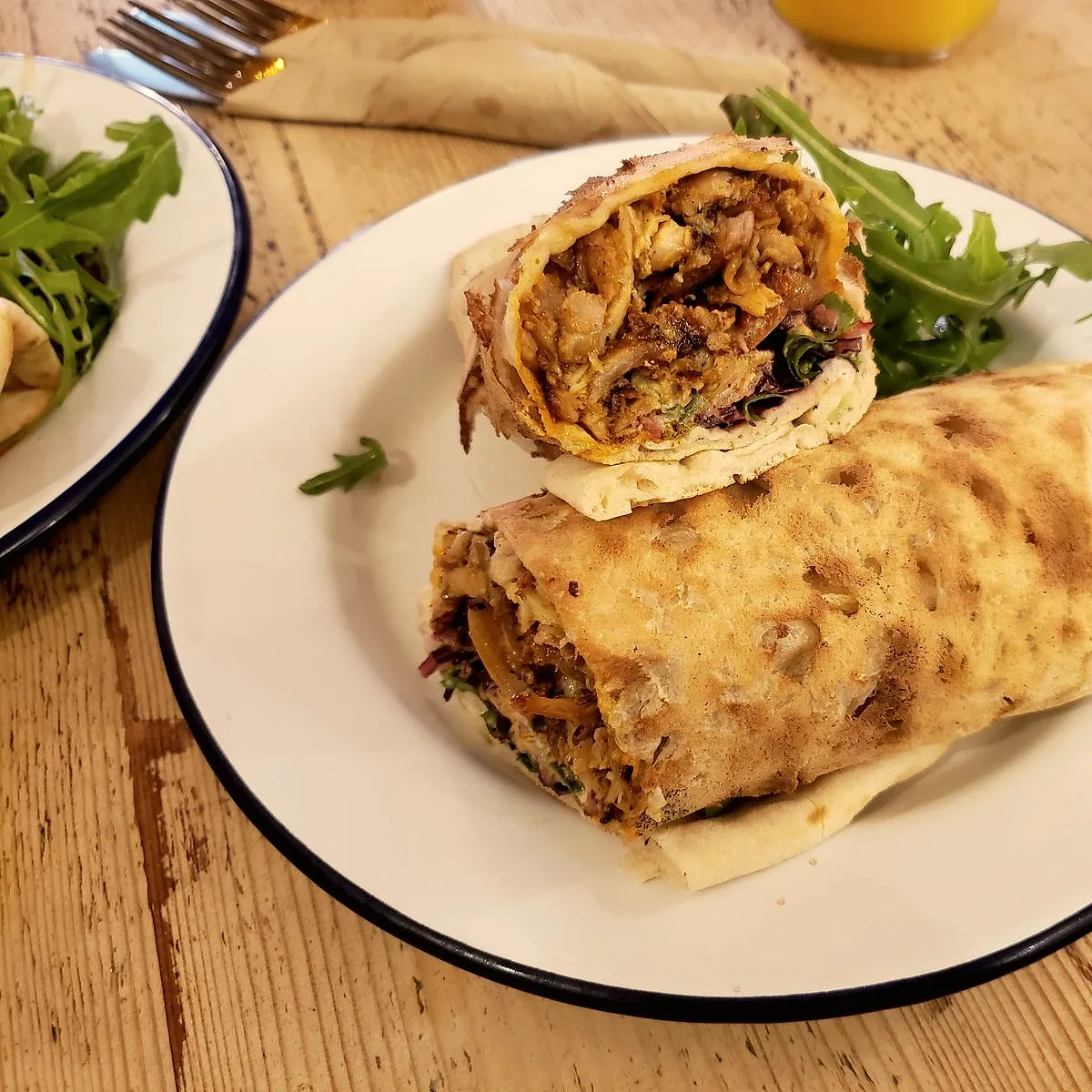

CC0. Cropped and colour-adjusted for this site.
The same dish, adapted. Every quantity, time and figure below changes with the version.
Method
Trim the 400 g chicken thigh of any excess fat and slice it thinly.
Combine the 80 g yoghurt, 10 ml extra-virgin olive oil, 20 ml freshly squeezed lemon juice, 2 garlic cloves (10 g), 4 g ground cumin, 4 g sweet paprika, 2 g ground turmeric, 1 g ground cinnamon, 2 g ground black pepper and 8 g fine sea salt, add the sliced chicken and turn to coat every piece. Cover and marinate, refrigerated, for 4h.
The yoghurt does more than season the chicken; its acidity tenderises the thigh meat enough to stay moist through the long roast a spit needs to build a crisp outer layer.
Thread the marinated chicken tightly onto a vertical skewer, pressing each layer down onto the last, building an even, dense cylinder with no gaps.
Whisk the 80 g tahini with the 30 ml freshly squeezed lemon juice and 1 garlic clove (5 g). It will seize into a stiff, grainy paste before it does anything else. Keep whisking and add the 60 ml water in a thin stream until it loosens into a smooth, pourable sauce. Season with the 2 g fine sea salt.
Roast the stacked chicken close to a vertical heat source, turning it steadily, for 55m, until the outer surface is deeply browned and the centre is cooked through with no pink remaining.
Common pitfallRoasting the stack too fast scorches the outside before the layers beneath cook through. A steady, moderate heat lets each turn crisp the surface without racing ahead of the centre.
Shave the roasted chicken downward off the spit in thin ribbons for 5m.
Warm the 120 g pita bread briefly over direct heat until soft and pliable.
Spread the tahini sauce over the warm pita, fill with the shaved chicken, 70 g ripe tomatoes, 40 g white onion and 5 g flat-leaf parsley, and roll it closed.
Method
Trim the 400 g lamb leg of any large pieces of sinew and slice it thinly against the grain.
Whisk the 20 ml extra-virgin olive oil, 20 ml red wine vinegar, 2 garlic cloves (10 g), 4 g ground cumin, 4 g sweet paprika, 1 g ground cinnamon, 2 g ground black pepper and 8 g fine sea salt together, add the sliced lamb and turn to coat every piece. Cover and marinate, refrigerated, for 4h.
Thread the marinated lamb tightly onto a vertical skewer, pressing each layer down onto the last, building an even, dense cylinder with no gaps.
Whisk the 80 g tahini with the 30 ml freshly squeezed lemon juice and 1 garlic clove (5 g). It will seize into a stiff, grainy paste before it does anything else. Keep whisking and add the 60 ml water in a thin stream until it loosens into a smooth, pourable sauce. Season with the 2 g fine sea salt.
Roast the stacked lamb close to a vertical heat source, turning it steadily, for 1h, until the outer surface is deeply browned and crisp and the centre is cooked through with no pink remaining.
Common pitfallLamb carries more fat than chicken thigh, so flare-ups are common. Keep the heat steady rather than fierce, or the outer layer chars before the fat has a chance to render and self-baste the stack.
Shave the roasted lamb downward off the spit in thin ribbons for 5m.
Warm the 120 g pita bread briefly over direct heat until soft and pliable.
Spread the tahini sauce over the warm pita, fill with the shaved lamb, 70 g ripe tomatoes, 40 g white onion and 5 g flat-leaf parsley, and roll it closed.
Shawarma is a name, not a separate invention. It is the Levantine Arabic rendering of the Turkish çevirme, "turning", the same word that gave Greek its gyros; both are regional names for the vertical spit developed in the 19th-century Ottoman Empire and carried, along with the technique, wherever Ottoman territory reached [1]. The word is attested in English by 1895, when an Egyptian Arabic–English dictionary translated it as "rich stew, roast meat" [1].
What distinguishes shawarma from döner is where it settled rather than how it began: Levantine cooks built their own version around lamb or chicken layered with a spice mix of cumin, cardamom, cinnamon and allspice rather than döner's paprika and oregano, and it became, and remains, the everyday street food of Damascus, Beirut and the cities around them.
Shawarma's migration did not stop at the Mediterranean. Beginning in the late 19th century, tens of thousands of people left Ottoman Lebanon and Syria for Mexico, escaping conscription and searching for work, and by the 1930s their restaurants were serving shawarma there too [2]. Their Mexican-born children later adapted it: the food historian Jeffrey Pilcher describes how, in the 1960s, "they take the technology that they grew up with in these Lebanese restaurants, the vertical rotisserie — but instead of using lamb, they use pork" [2], seasoning it with chillies and achiote and serving it on corn tortillas instead of pita. That dish became tacos al pastor, a taco whose cooking method is a shawarma spit wearing a different name for the third time.
Sources
- Shawarma, WikipediaCovers the Turkish etymology, the 19th-century Ottoman origin shared with döner and gyros, and the 1895 dictionary attestation of the word.
- Thank the Ottoman Empire for the taco al pastor, PRX — The WorldQuotes food historian Jeffrey Pilcher on the Lebanese migration to Mexico and the shawarma-to-al-pastor transition.