Caribbean · Soup
Sancocho Dominicano
Beef, chicken and pork simmered into a single broth with yam, cassava, potato, pumpkin and both green and ripe plantain: the Dominican Republic's everyday and holiday stew alike.
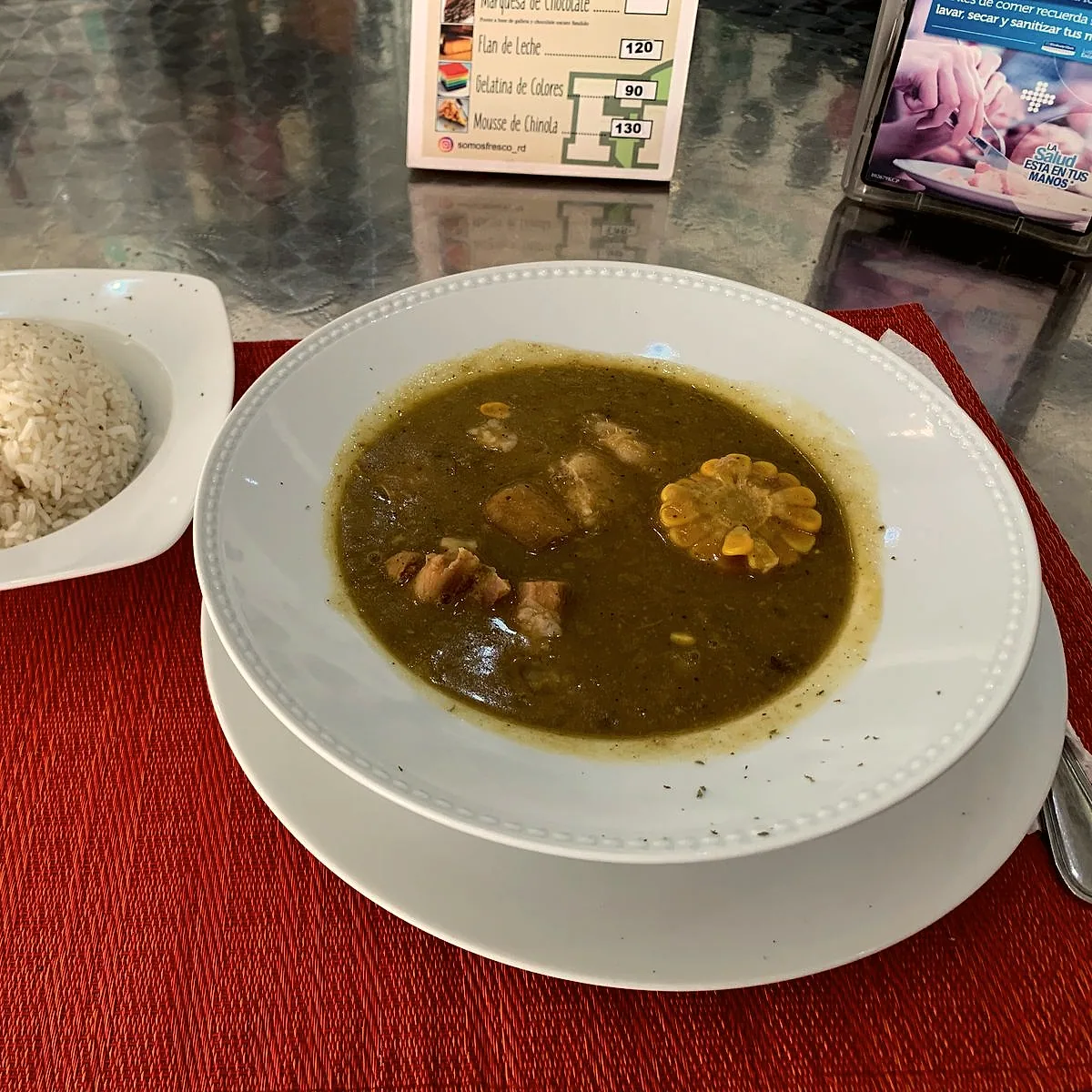

CC BY-SA 4.0. Cropped and colour-adjusted for this site.
Method
Toss the 350 g chuck, 350 g chicken thigh and 250 g pork shoulder with the 80 ml sour orange, 2 garlic cloves (10 g) and 2 g oregano, and leave to marinate for 1h.
Brown the marinated meats in a large pot over a high heat, in batches if needed, for 15m.
Return all the meat to the pot with the 100 g white onion, 70 g green pepper, 2 garlic cloves (10 g), 2 L water and 8 g fine sea salt. Bring to a simmer and cook for 1h, skimming occasionally, until the meats are tender.
Common pitfallSimmering the meats too hard rather than gently toughens them well before they have had time to grow tender; a bare, steady simmer works better than a rolling boil.
Add the 250 g yam, 250 g raw cassava, 200 g potato, 200 g pumpkin, 200 g corn and 200 g green plantain. This takes about 5m.
Simmer for 30m, until the root vegetables are tender.
Add the 150 g ripe plantain. This takes about 3m.
Adding the ripe plantain well after the root vegetables, rather than with them, keeps it from disintegrating into the broth before everything else is tender, while still giving it enough time to soften and lend its sweetness.
Simmer for a further 15m, until the ripe plantain is tender but still holding its shape.
Stir in the 15 g fresh coriander and 1 g ground black pepper, adjust the salt, and serve. This takes about 5m.
Sancocho's ancestry runs back through Spain before it ever reaches the Caribbean. Culinary historians trace the stew to cocido, itself thought to descend from adafina, a meat-and-chickpea stew Spain's Sephardic Jewish community prepared in advance of the Sabbath, when cooking was forbidden. One theory holds that sancocho specifically, cocido reworked with African influence, was first cooked not in Spain but in the Canary Islands, off the coast of northwest Africa, before Spanish colonisation carried it on to the Americas [1].
What the dish became in the Dominican Republic owes at least as much to Taíno and African contributions as to its Spanish base. European staples like chickpeas gave way to indigenous ingredients (yuca, yautía, auyama squash and other roots the Taíno already grew), while enslaved Africans brought their own cooking knowledge and, on one telling of the dish's history, its very origin as an everyday meal [1] [2]. Williams College scholar Nelly A. Rosario describes this bleaker account directly: a widely held belief traces sancocho to slavery itself, when scraps thrown to livestock troughs were little different from what was tossed to the slave quarters, and the dish later came to mean a "plantation stew," pieced together by enslaved people and others with little else from whatever crops a neighbour happened to have [2].
The dish that history produced is built from a long-simmered broth, a mix of starchy roots and whatever meat is on hand, and its logic follows from that: the stew, not any single ingredient in it, is the point.
Sources
- Sancocho, Encyclopædia BritannicaTraces sancocho's descent from cocido, itself following the Sephardic Sabbath stew adafina, notes a theory that sancocho was first cooked with African influence in the Canary Islands, and describes the incorporation of Taíno ingredients such as yuca, yautía and auyama squash once the dish reached the Americas.
- Feasting on Sancocho Before Night Falls: A Meditation, Callaloo (Johns Hopkins University Press), vol. 30, no. 1Williams College scholar Nelly A. Rosario's essay sets out a bleaker, commonly held belief that sancocho's origins lie in slavery, when there was little difference between scraps thrown to livestock troughs and what was tossed to the slave quarters, and describes it later becoming a "plantation stew" pieced together from whatever a neighbour's crops provided.