Andean · Snack
Salteñas
Slightly sweet baked pastries filled with a chicken, potato and pea stew set into a jelly with gelatine, so it bakes back into the juicy filling Bolivia's salteña is named for.
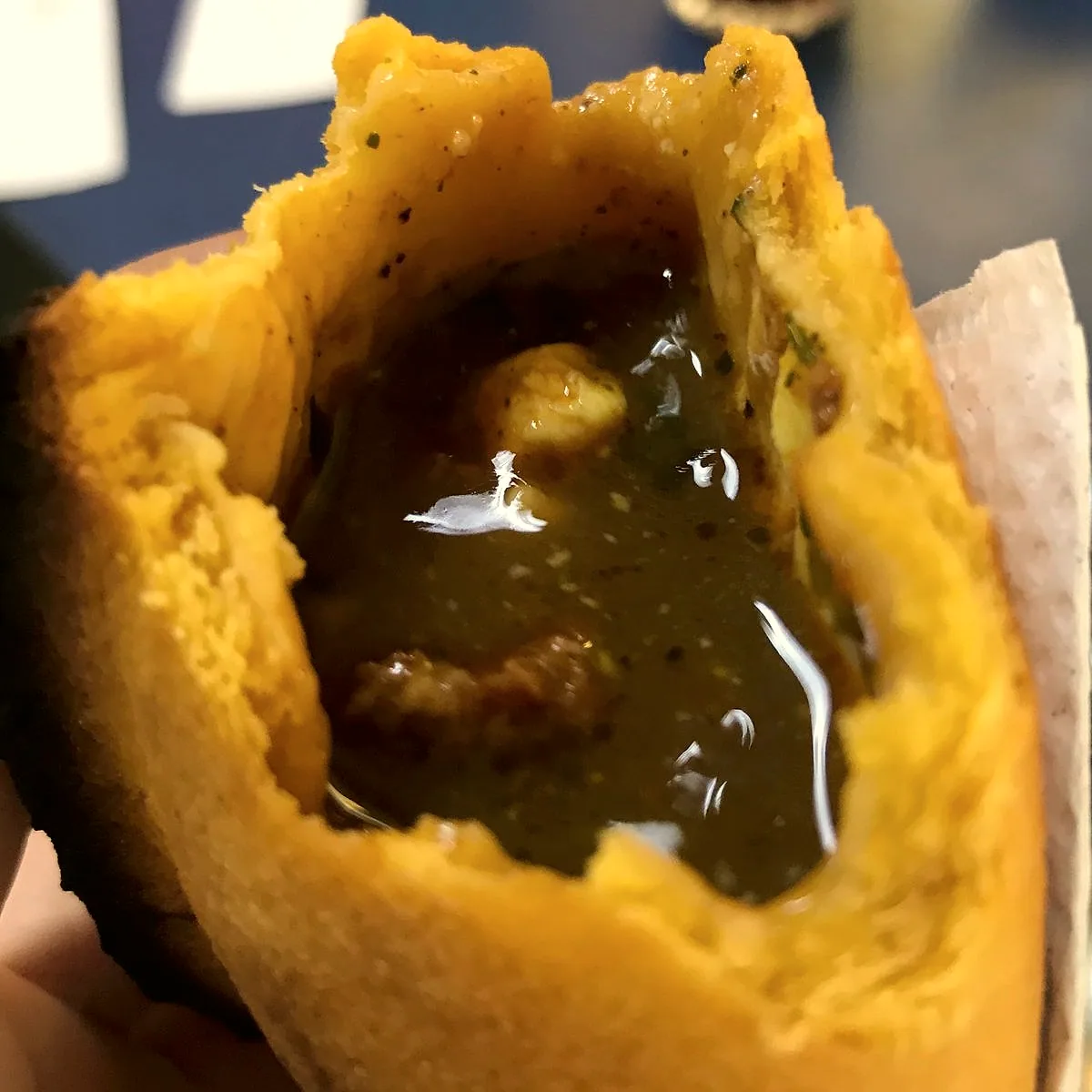

CC BY-SA 4.0. Cropped and colour-adjusted for this site.
Method
Cook the 100 g white onion and 1 ½ garlic cloves (8 g) in a pan over a medium heat until soft, then add the 400 g chicken thigh, 200 g potato, 100 g peas, 350 ml chicken stock, 4 g sweet paprika and 2 g ground cumin. Simmer for 20m, until the chicken is cooked through and the potato is tender.
Bloom the 10 g powdered gelatine in a little of the hot liquid, then stir it back into the filling until fully dissolved. This takes about 5m.
Setting the stew into a firm jelly with gelatine before it goes anywhere near the dough is what lets a genuinely liquid filling be sealed inside pastry by hand; without it, the stock would simply leak out during shaping.
Refrigerate the filling for 4h, until it has set into a firm jelly.
Combine the 400 g plain flour, 20 g caster sugar, 4 g achiote and 6 g fine sea salt, then work in the 100 g unsalted butter and 130 ml water to form a smooth, firm dough. This takes about 12m.
Cover the dough and leave it to rest for 20m.
Roll out the dough and cut into rounds. Place a spoonful of the set filling on each round along with a little of the 30 g raisins, 30 g green olives and 2 eggs (100 g), then fold the dough over and pinch the edges into a tight, sealed braid. This takes about 25m in total.
Common pitfallA dough seal that is not pinched tightly and evenly shut lets the filling's melted jelly leak out during baking, which both dries out the salteña and can burn onto the tray.
Bake at 200 °C for 25m, until deep golden and the filling inside has melted back to a hot, juicy liquid.
The story told most often about the salteña is a tidy one: Juana Manuela Gorriti, an Argentine writer exiled from the province of Salta after her father's political defeat, is said to have taken up street food to survive, fusing a Spanish pastry shell with Andean ingredients into a juicy empanada that customers began asking for by her adopted nickname, "la salteña" ("the woman from Salta") [1].
The trouble is that the documentary record does not cooperate with this story, and the story's own biggest promoter is also on record undermining it. Bolivian traditionalist Antonio Paredes Candia is the writer most responsible for popularising the Gorriti tale, but historian Beatriz Rossells has since directly refuted it: Gorriti's own 1890 cookbook contains no salteña recipe at all, and by Rossells's reading, none of the three Argentine empanada recipes it does contain include chilli or potato, the two ingredients that make a salteña a salteña [3] [2]. More damaging still to the legend, a recipe manuscript compiled in 1776 by Doña Josepha de Escurrechea in Potosí (the only colonial-era recipe book known to survive in Bolivia) already describes empanadas built on potato and ají, well over half a century before Gorriti was even born [3] [2].
What the legend gets right, even if the invention story is false, is the name's origin, and even that is not fully settled: Rossells traces "salteña" to around 1830, plausibly to Doña Corina Pueyrredón, a Salta-born woman selling broth-filled empanadas in Potosí, rather than to Gorriti specifically [3]. Either way, the empanada itself was almost certainly already a Bolivian dish before any exile from Salta arrived to lend it a name [2] [1]. A false inventor and a real namesake turn out to be different questions entirely, and the salteña's popular history has mostly answered the wrong one.
Sources
- From Survival Food to Street Vendor Icon, Razorback Reporter, University of ArkansasSets out the popular legend of Juana Manuela Gorriti, exiled from Salta, selling the salteña as street food out of poverty, and the name's origin in customers asking for "an empanada from la salteña."
- Salteña, WikipediaStates that historians, including Antonio Paredes Candia, regard the Gorriti-invention story as a legend without documentary basis, cites Josepha de Escurrechea's 1776 Potosí recipe book as evidence that ají-and-potato empanadas predate Gorriti, and notes that Gorriti's own cookbook lacks these ingredients.
- La 'salteña' no es de Salta, Correo del Sur (Sucre, Bolivia)Independently reports historian Beatriz Rossells's refutation of the Gorriti legend popularised by Antonio Paredes Candia, quoting her finding that Gorriti's own 1890 cookbook contains no salteña recipe and that none of Gorriti's three Argentine empanada recipes include chilli or potato, and dates the Escurrechea manuscript to 1776 and the "salteña" name to around 1830.