Caribbean · Main Course
Ropa Vieja
Skirt steak braised until tender, shredded into fine strands, and simmered in a sofrito of peppers, onion, tomato, olives and capers.
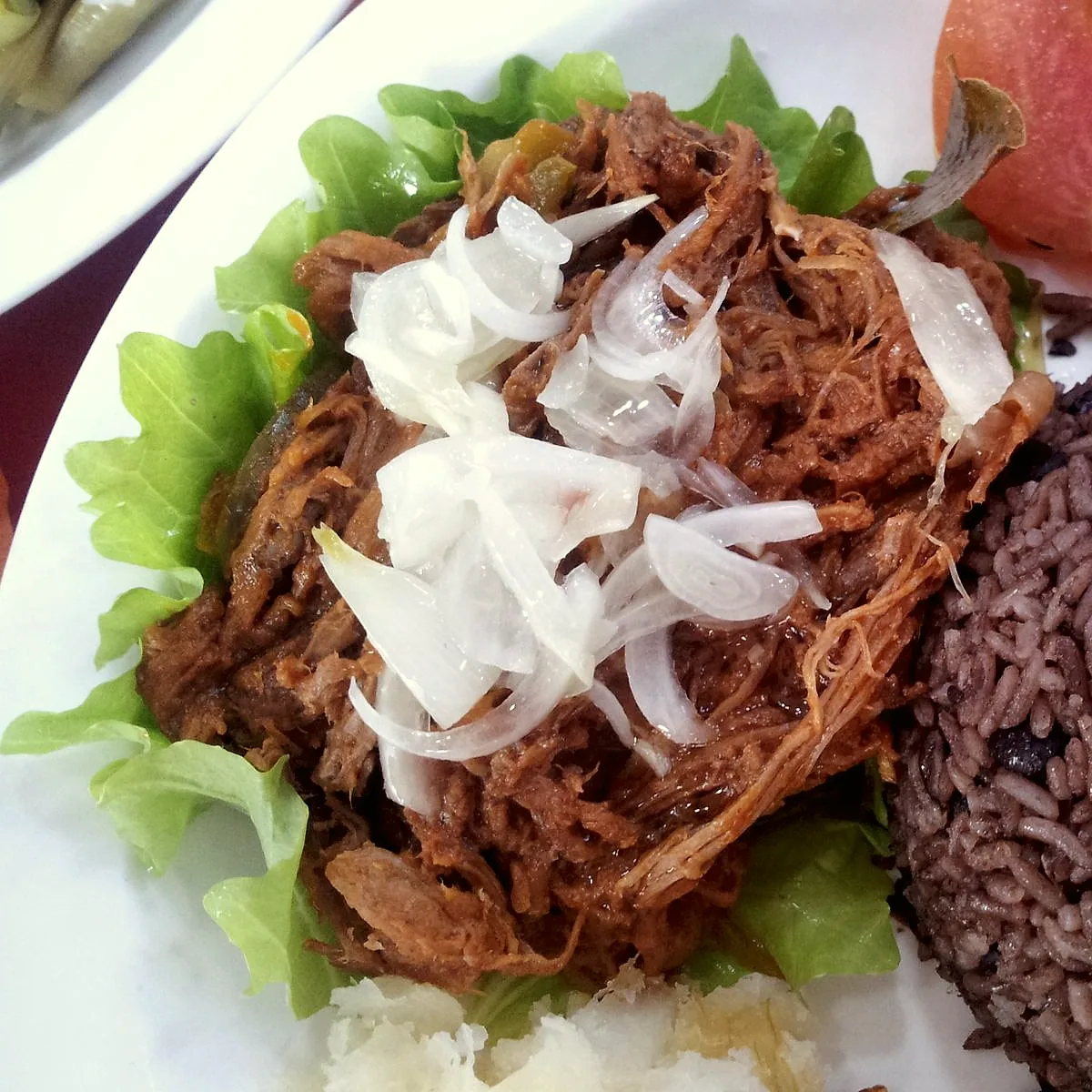

Public domain. Cropped and colour-adjusted for this site.
Method
Put the 900 g skirt steak in a pot with the 600 ml beef stock and 2 bay leaves (0.4 g), bring to a simmer, then cover and cook at a bare simmer for 2h 30m, until fully tender.
Common pitfallSkirt steak is a working muscle with a lot of connective tissue, and it stays tough if the braise is rushed; it needs the full time at a bare simmer to become tender enough to pull apart by hand.
Lift the beef out, reserving the braising liquid, and pull it apart into fine strands with two forks for 15m. Discard the bay leaf.
Pulling the beef with the grain, once it is fully tender, is what gives ropa vieja its characteristic fine, ragged strands; cutting it with a knife instead produces chunks rather than the shredded texture the dish is named for.
Meanwhile, heat the 25 ml extra-virgin olive oil in a wide pan and cook the 120 g white onion, 80 g green pepper, 80 g red pepper and 3 garlic cloves (15 g) for 10m, until softened.
Stir the 250 g tinned tomatoes, 3 g ground cumin, 2 g oregano, 8 g fine sea salt and 2 g ground black pepper into the sofrito, then add the shredded beef with enough of the reserved braising liquid to keep it moist. Simmer for 25m, then stir in the 40 g green olives and 10 g capers just before serving.
Ropa vieja carries a folk legend rather than a documented inventor: a poor man, unable to afford meat for his family, is said to have shredded his own clothes into a pot and prayed over it, and the story goes that his prayer turned the cloth into meat and vegetables enough to feed everyone at the table [1] [2]. The tale explains the name rather than the technique: what the meat looks like, pulled into fine, ragged strands, resembles a pile of old clothes far more literally than it resembles any miracle.
The traceable history runs through Spain rather than through the legend. Ropa vieja's roots are usually placed with the Sephardic Jewish communities of the Iberian Peninsula, whose religious prohibition on cooking during the Sabbath meant a stew had to be started the night before and left to cook itself through; the technique found particular favour in the Canary Islands, where it was popularised before Canarian emigration carried it across the Atlantic [1]. The dish is first recorded as having appeared in Cuba in 1857 [2], after which it took on the sofrito of peppers, onion and tomato that distinguishes the Cuban version from its Spanish and Canarian relatives.
The dish's place in Cuba today is more complicated than its status as a national favourite suggests. A 1963 law restricting the sale and slaughter of cattle, introduced to protect the country's herd, has instead made beef scarce and tightly controlled for decades, and cattle numbers fell by around thirty percent by 2015 [2]. What tourists and the Cuban diaspora eat as ropa vieja is, as a result, a considerably more everyday meal outside Cuba than it now is for most Cubans on the island [2].
Sources
- The History of Ropa Vieja, Cuba's Hearty, Beloved Dish, Travel NoireTraces the dish's roots to Sephardic Jewish overnight Sabbath cooking in Spain, its Canarian popularisation, and the folk legend behind its name.
- History of Cuba's Famous Dish Ropa Vieja, Latin PostDates the dish's appearance in Cuba to 1857 and describes the 1963 Cuban law restricting cattle sales that has since limited ordinary Cubans' access to beef.