Yemeni · Main Course
Mandi
Spiced lamb suspended over a pot of basmati and slow-cooked together so the meat's own juices drip down and season the rice as it steams.
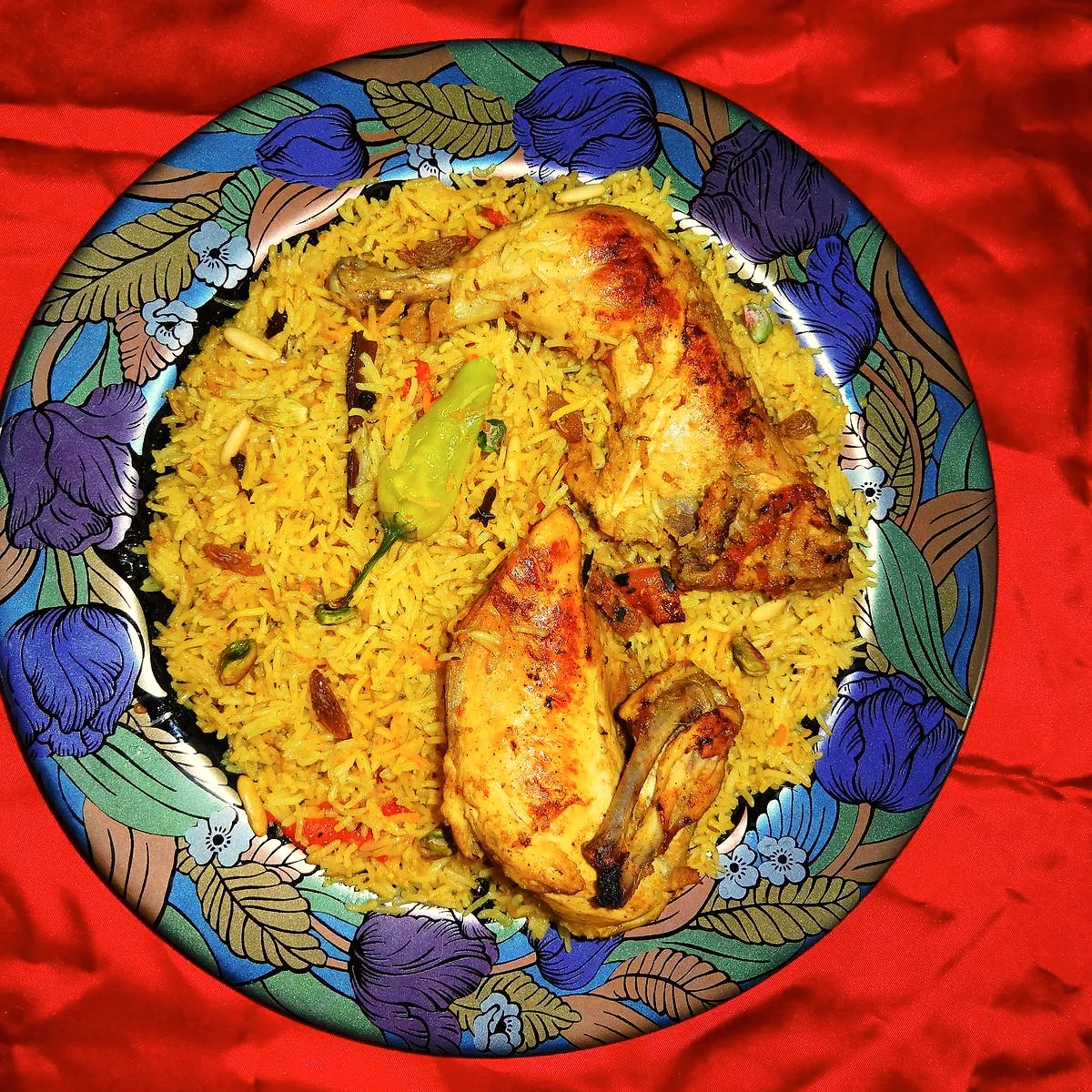

CC0. Cropped and colour-adjusted for this site.
Method
Combine the 550 g lamb leg with the 100 g yoghurt, 4 garlic cloves (20 g), 15 g fresh ginger, 3 g ground turmeric, 4 g ground cumin, 2 g ground black pepper, 4 g sweet paprika and the 8 g fine sea salt, turning the pieces to coat them evenly. This takes 15m.
Cover and refrigerate the lamb for 2h, so the yoghurt and spices work into the meat.
Melt the 30 g ghee in a heavy pot with a tight-fitting lid and cook the 150 g yellow onion until soft. Add the 7 ½ cardamom pods (3 g), 4 cloves (0.4 g), 1 cinnamon stick (3 g), 2 bay leaves (0.4 g), the 6 g fine sea salt and the 650 ml water, and bring to a simmer. Rinse the 350 g basmati rice and stir it in. This takes 10m.
Set a wire rack or trivet inside the pot, just above the level of the rice, and arrange the marinated lamb on it in a single layer. Cover the pot tightly and cook over the lowest possible heat for 1h 30m, undisturbed, until the lamb is completely tender and the rice below has absorbed the stock and the meat's dripping juices.
The lamb is never buried in the rice, only held above it, so its fat and juices baste the grains from above while the meat itself cooks by dry, enclosed heat. It is the mechanism a pit oven achieves with a hanging rack, adapted here to a covered pot on the stove.
Lift out the rack of lamb and set it aside, covered. Nestle a small heatproof bowl into the rice, put a piece of very hot lit charcoal into it, and pour a little ghee over the coal so it smokes at once. Cover the pot immediately and let the smoke steep through the rice for 8m, then lift out the bowl and any spent coal.
Common pitfallLeaving the bowl of smoking ghee in too long turns the rice bitter rather than fragrant. A short, sealed rest is enough to carry the smoke through without scorching it.
Fluff the smoked rice, spread it over a platter, and set the lamb on top. This takes 10m.
Mandi's name is a description of what the pit oven does to the meat rather than a place name: it comes from the Arabic nada, "dew," for the moist, almost falling-apart texture the technique produces [1]. Both sources that discuss its origin place the dish in Hadhramaut, the region of eastern and southern Yemen that gives the wider governorate its name, and from there its spread across the Arabian Peninsula and beyond followed the region's own long history as a stop on the incense and spice trade routes that also carried myrrh, frankincense and coffee [2].
The technique behind mandi (meat suspended above rice inside a sealed pit or clay oven, cooking by the trapped heat and dripping its juices down onto the grains) is also among the better-documented parts of this whole family of Arabian rice dishes. Food historian Nawal Nasrallah has pointed to a recipe for pit-roasted whole lamb in a thirteenth-century Aleppan cookbook that closely resembles the modern zarb variant of the technique, and the Palestinian ethnographer Tawfiq Canaan described a "hermetically closed," cave-like pit oven used for the same purpose as early as 1927 [1]. Neither source claims this as mandi's own point of invention rather than a record of the same underlying pit-cooking method being used across the region; what the citations establish is the age and spread of the technique rather than a single origin for the dish that carries mandi's specific name today.
From Hadhramaut, mandi travelled with Yemeni traders and migrants across the Gulf, and in the twentieth century specifically with Yemeni communities who settled in Hyderabad's Barkas neighbourhood, carrying the dish into a city already known for its own biryani tradition [1].
Sources
- Mandi (food), WikipediaCites food historian Nawal Nasrallah on a thirteenth-century Aleppan cookbook recipe for pit-roasted lamb resembling the modern zarb variant, and Palestinian ethnographer Tawfiq Canaan's 1927 description of a sealed, cave-like pit oven.
- Food trails — the rich history of Yemeni cuisine, The NationalUAE newspaper feature independently naming Hadhramaut as mandi's home region and situating it within Yemen's long history as a spice-trade hub connecting Indian, East African and Mediterranean culinary influences.