Central Asian · Main Course
Lagman
Hand-pulled wheat noodles in a peppery lamb, tomato and pepper broth, the Uyghur noodle dish carried across Central Asia along the old Silk Road trade routes.
Also known asLaghman · Central Asia
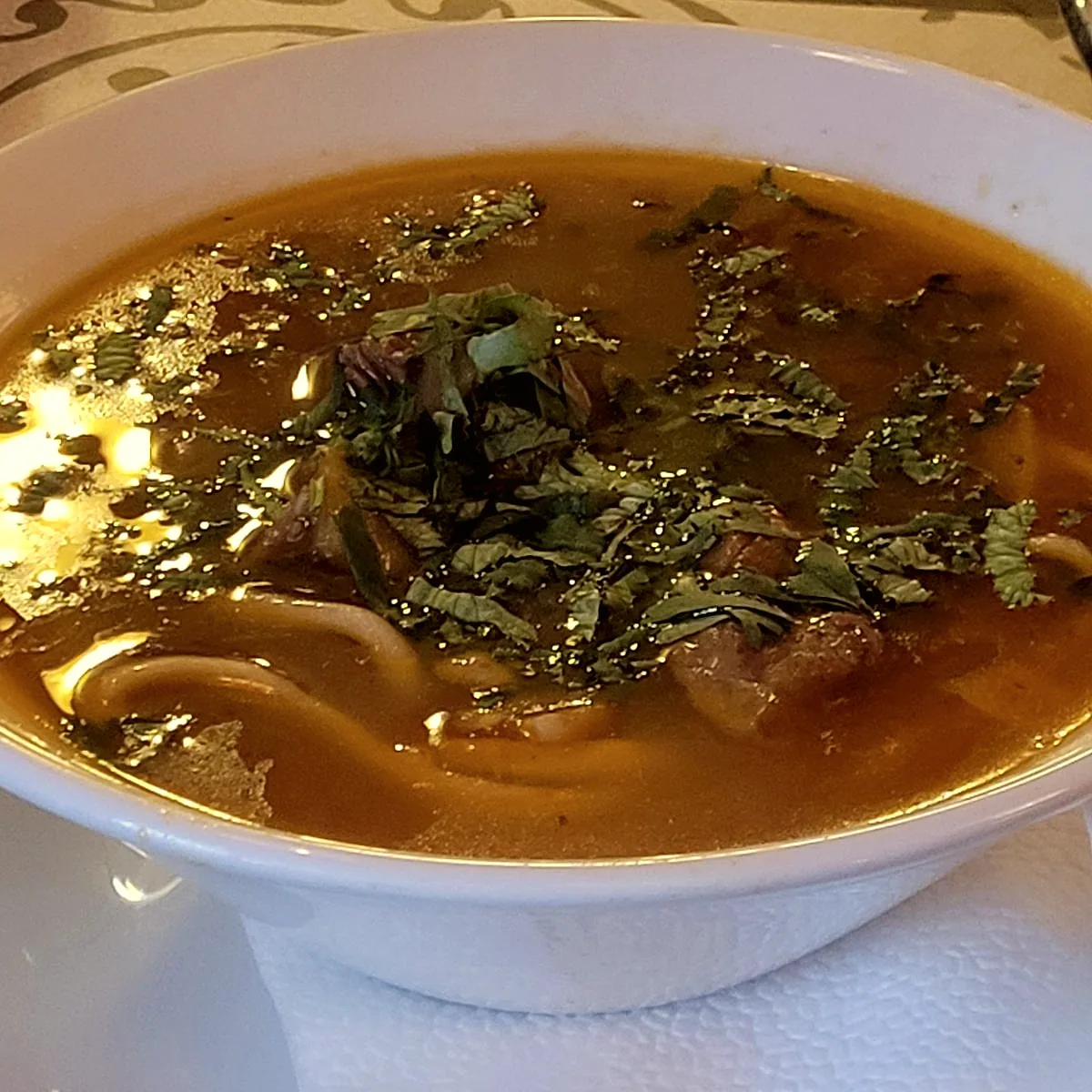

CC BY 4.0. Cropped and colour-adjusted for this site.
The same dish, adapted. Every quantity, time and figure below changes with the version.
Method
Combine the 350 g bread flour, 150 ml water and 5 g fine sea salt in a bowl and bring together into a firm dough, kneading for 10m until smooth.
Rub the dough all over with the 20 g vegetable oil, cover, and leave it to rest for 40m, so the gluten relaxes fully.
Divide the rested dough into pieces and stretch each by hand into a long, even strand, doubling and re-stretching as needed until noodle-thin. Boil in plenty of salted water until just tender, working for 15m in total, then drain.
Resting the dough under oil relaxes the gluten enough that it can be stretched by hand into long strands rather than snapping back. It is the same principle behind other hand-pulled wheat noodles, and the reason the dough is never kneaded stiff.
Heat the 30 g vegetable oil in a wok or wide pan over a high heat and stir-fry the 350 g lamb leg for 8m, until browned. Lift out and set aside.
In the same pan, fry the 150 g yellow onion, 3 garlic cloves (15 g) and 10 g fresh ginger until fragrant. Stir in the 4 g whole cumin and 4 g chilli flakes, then the 200 g ripe tomatoes and 30 g tomato purée, and cook until the tomato has broken down. Add the 150 g red pepper, 100 g green pepper, 100 g carrot and 80 g celery, return the browned lamb to the pan, then pour in the 800 ml beef stock and the 8 g fine sea salt. Simmer for 25m, until the vegetables are tender but still have bite.
Common pitfallThe peppers and celery go in after the tomato has already broken down, not at the start. Added too early, they overcook and lose the crunch that lagman's sauce is built to keep.
Divide the noodles between bowls, ladle the lamb and vegetable sauce over the top, and scatter with the 10 g fresh coriander and 1 spring onion (15 g). This takes 5m.
Method
Combine the 350 g bread flour, 150 ml water and 5 g fine sea salt in a bowl and bring together into a firm dough, kneading for 10m until smooth.
Rub the dough all over with the 20 g vegetable oil, cover, and leave it to rest for 40m, so the gluten relaxes fully.
Divide the rested dough into pieces and stretch each by hand into a long, even strand, doubling and re-stretching as needed until noodle-thin. Boil in plenty of salted water until just tender, working for 15m in total, then drain well.
Heat half of the 45 g vegetable oil in a wok over a high heat and stir-fry the 350 g lamb leg for 8m, until well browned and starting to crisp at the edges. Lift out and set aside.
Heat the remaining 45 g vegetable oil in the same wok and fry the 150 g yellow onion, 3 garlic cloves (15 g) and 10 g fresh ginger until fragrant. Add the 4 g whole cumin and 4 g chilli flakes, then the 200 g ripe tomatoes and 30 g tomato purée, and cook until the tomato has broken down. Add the 150 g red pepper, 100 g green pepper, 100 g carrot and 80 g celery and stir-fry over a high heat for 15m, until the vegetables are tender but still crisp.
Return the lamb to the wok along with the drained noodles, the 150 ml beef stock and the 8 g fine sea salt. Toss everything together over a high heat for 6m, until the noodles are coated and lightly caught at the edges. Scatter with the 10 g fresh coriander and 1 spring onion (15 g) to serve.
Common pitfallToo much liquid at this stage steams the noodles soft instead of letting them fry against the hot wok. The stock here is only a splash, just enough to loosen the sauce, not enough to make a broth.
Lagman's name gives away where its technique came from before any dish history does. Uyghur läghmän is not a native Turkic word (Turkic vocabulary does not begin with the sound l), and linguists studying the term trace it to a Chinese source, most likely 撈麵 (lāomiàn, mixed noodles) rather than the better-known 拉麵 (lāmiàn, pulled noodles) it is often assumed to echo. Either way, the pulling technique behind the noodle is a borrowing from northern Chinese noodle cookery, absorbed into Xinjiang's Uyghur kitchens and then made distinctly their own in taste and preparation [2][1].
That borrowing looks more recent than the term's confident, ancient-sounding reputation suggests. The specific word läghmän does not appear in Middle Turkic sources, nor in an eighteenth-century Qing-era Turkic dictionary, and its earliest documented use comes only from early-twentieth-century fieldwork among Uyghur speakers [2]. The dish itself, built as it now is around tomatoes and peppers (both New World crops that could not have reached Xinjiang before the sixteenth century at the earliest), is necessarily a more modern combination than "ancient Silk Road noodle" origin stories tend to imply [2].
From Xinjiang, lagman travelled with Uyghur and Dungan communities across Central Asia along Silk Road trade routes, becoming a staple as far as Kazakhstan and Kyrgyzstan (where Wikipedia records it as a national dish of those local minorities) and settling into the everyday cooking of Uzbekistan, Tajikistan, Turkmenistan and neighbouring regions, each adding its own vegetables and spicing [1][3]. The soupier, broth-forward version and the drier, stir-fried version served over the same hand-pulled noodles are both part of that same regional spread rather than a split with any single point of origin: a dish carried far enough, by enough different hands, that its preparation splintered well before its name did [3].
Sources
- Laghman (food), WikipediaCovers the dish's Uyghur origin in Xinjiang, its spread across Central Asia as a national dish of local Uyghur and Dungan communities, and regional variations.
- Pulled Noodles: Uyghur läghmän and Mandarin lāmiàn, Language Log (University of Pennsylvania)Linguists' discussion of läghmän as a Chinese loanword into Uyghur, its likely source term, and the absence of the word from earlier Turkic dictionaries.
- Lagman: The History and Culture of the Central Asian Noodles, SRAS (School of Russian and Asian Studies)Study-abroad organisation's overview of lagman's spread via Uyghur and Dungan communities along Silk Road trade routes, and its regional variation across Central Asia.