Bangladeshi · Main Course
Kacchi Biryani
Raw, yoghurt-marinated goat and whole potatoes sealed under parboiled rice and finished entirely in the steam of one covered pot, in the Old Dhaka style.
Also known asDhakai kacchi · Dhaka
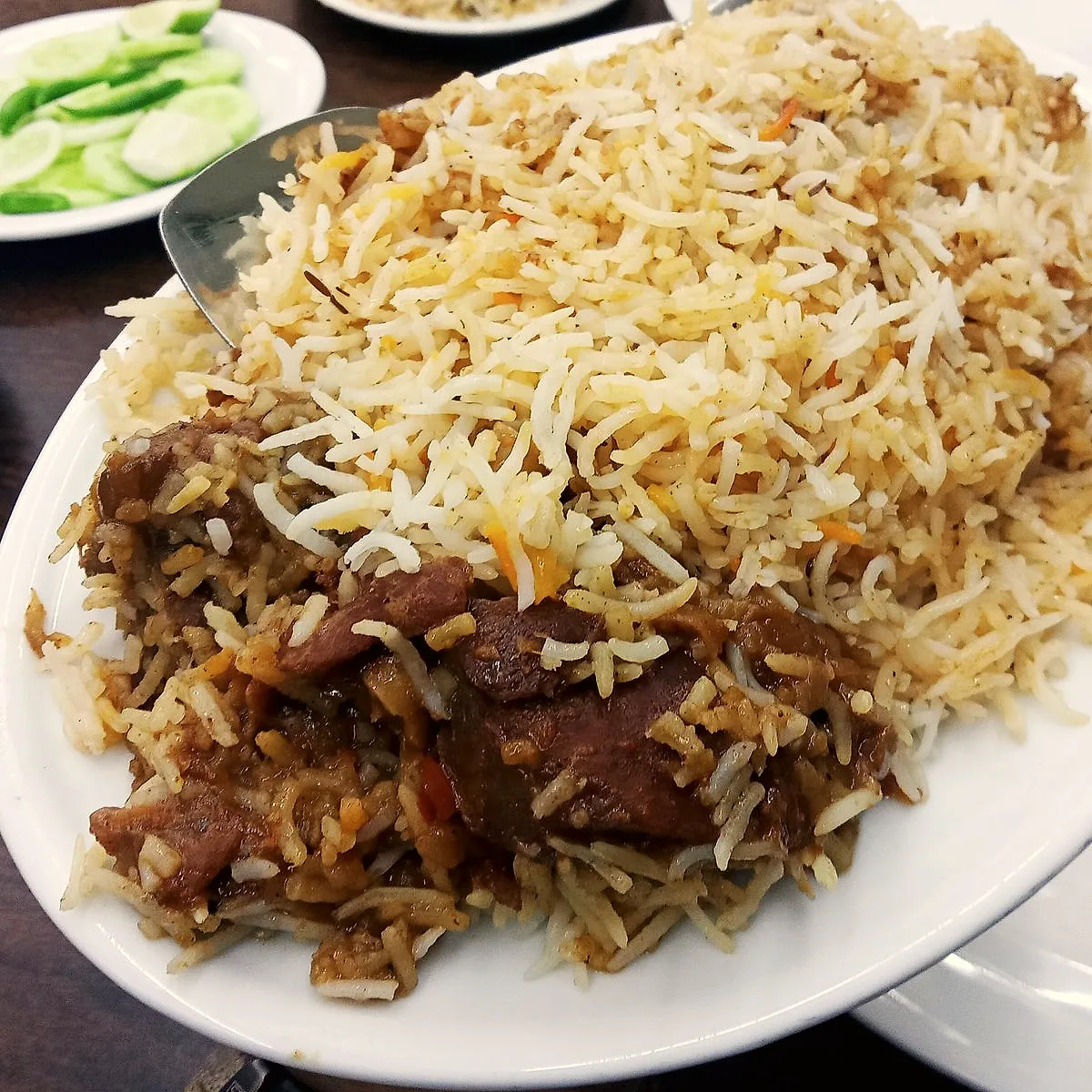
.jpg)
CC BY 4.0. Cropped and colour-adjusted for this site.
Method
Heat half of the 60 g ghee in a wide pan and fry the 80 g yellow onion and 120 g yellow onion together over a medium heat, stirring often, for 15m, until deep golden-brown. Lift out and drain, keeping the two portions separate.
Combine the 700 g goat, 300 g potato, 200 g yoghurt, 20 g fresh ginger, 4 garlic cloves (20 g), 3 g ground turmeric, 6 g chilli flakes, 15 ml freshly squeezed lemon juice, the 8 g fine sea salt and the fried 80 g yellow onion in a large bowl, working the marinade into the meat and potatoes by hand for 12m.
Cover the bowl and refrigerate for 4h, so the yoghurt and spice work fully into the meat before it goes anywhere near heat.
Rinse the 400 g basmati rice until the water runs clear, then bring the 2.2 L water to the boil with the 12 g fine sea salt, the 12 ½ cardamom pods (5 g), 2 cinnamon sticks (6 g), 10 cloves (1 g) and 2 bay leaves (0.4 g). Add the rinsed rice and boil for 12m, until the grains are still firm at the core, then drain.
Common pitfallRice cooked through at this stage turns to mush once it steams again over the meat. It only needs to be parboiled to about seven-tenths done, still firm at the core, so it finishes correctly during the sealed dum cook.
Spread the marinated goat and potatoes in an even layer across the base of a heavy, wide pot. Mound the drained rice on top, then scatter over the fried 120 g yellow onion. Bloom the 0.3 g saffron in the warm 30 ml water, stir in the 8 ml rose water, and drizzle it over the rice along with the remaining 60 g ghee. Seal the lid tightly, sealing the rim with a strip of dough or a double layer of foil if it does not fit snugly. This takes 15m.
The whole potatoes go in raw with the meat, not parboiled separately. This is a distinctive feature of Dhaka's kacchi against other regional biryanis, where they finish in the same trapped steam as the goat and pick up its spice and fat as they cook.
Set the sealed pot over the lowest possible heat, ideally on top of a heat diffuser, and leave it completely undisturbed for 1h. The meat and potatoes cook through entirely in the steam trapped under the seal.
Break the seal away from the heat and let the biryani rest briefly before turning it out, working from the bottom up so the rice, goat and potato come together in each portion. This takes 5m.
Dhaka's kacchi biryani is usually told as an accident of politics rather than an invention. When the Mughals made Dhaka the provincial capital of Bengal in 1610, the officials and Subahdars posted there came disproportionately from Lucknow, and they brought their own cooks with them [1]. Those cooks carried the kacchi method (raw, marinated meat sealed under raw rice and finished entirely by steam in one pot), a technique itself built on the Persian dum, sealed-pot cookery that had reached the Indian subcontinent generations earlier [2].
What happened next is the part of the story that makes Dhaka's version distinct. Lucknow kept developing: over the following centuries its kitchens moved toward pakki biryani, in which the meat is at least partly cooked before it meets the rice, valued for its consistency and its more delicate use of saffron and rose water [2]. Dhaka, removed from that evolving centre, is said to have kept cooking the older kacchi method largely as it was received, so that what is eaten in Old Dhaka today is closer to seventeenth-century Awadhi technique than to what Lucknow itself now serves [2][1].
Biryani's still deeper ancestry is unsettled, and the sources disagree with each other rather than converging on one account: it is variously traced to Timur's fourteenth-century invasions, to nineteenth-century Awadhi court cooks under Nawab Wajid Ali Shah, and to Central Asian Chagatai cooking carried in from Tajikistan and Uzbekistan [1]. None of this affects what is specific to Dhaka: a dish that began as elite, Persian-descended court cooking and only slowly widened out, so that it is now the centrepiece of the Old Dhaka wedding table as much as of its street-side biryani houses [1].
Sources
- Kacchi Biryani: From Conquerors' Table to Wedding Staple, The Business StandardCovers the 1610 Mughal move of the Bengal capital to Dhaka, the Lucknowi officials and cooks who followed, and the competing theories of biryani's deeper origin.
- The Biryani Excavation, The Daily StarTraces the Persian dum technique behind kacchi biryani and describes Dhaka's version as having stayed close to seventeenth-century Awadhi practice while Lucknow's own cooking moved on.