Caribbean · Snack
Jamaican Beef Patty
A turmeric-yellow, shortening-rich pastry crimped around spiced ground beef and baked until crisp. It is Jamaica's hand pie, one patty to a serving.
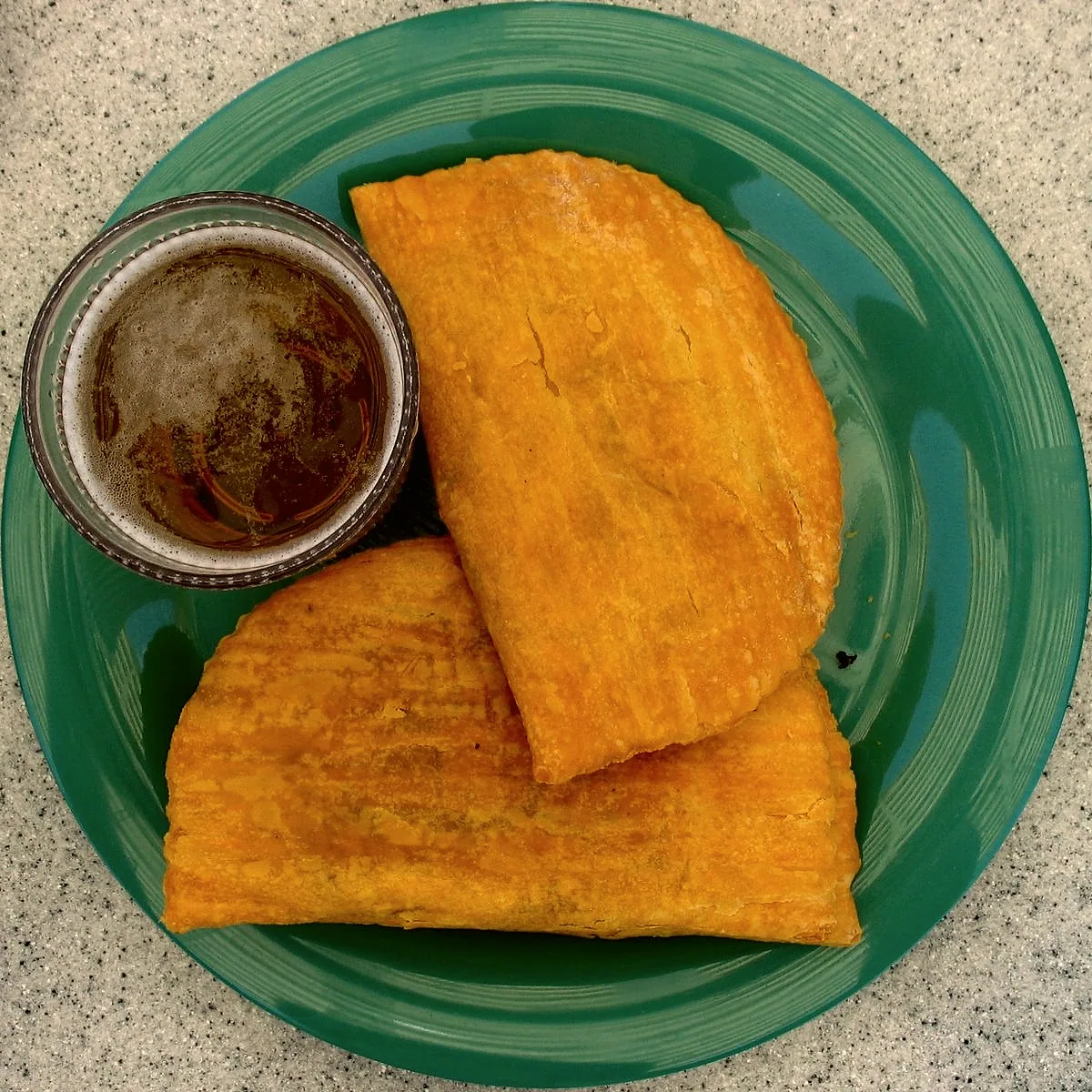

CC BY-SA 2.0. Cropped and colour-adjusted for this site.
Method
Whisk the 400 g plain flour, 6 g ground turmeric and 3 g fine sea salt together, then rub in the 200 g vegetable shortening until the mixture looks like coarse crumbs. Add the 120 ml water and bring together into a firm dough without overworking it. This takes about 10m.
Common pitfallOverworking the dough or letting the shortening soften develops gluten and melts the fat that should stay in solid pieces, both of which flatten the pastry's texture instead of leaving it short and flaky.
Wrap the dough and refrigerate for 30m.
Heat the 15 ml vegetable oil in a pan over a medium heat and cook the 100 g white onion, 2 garlic cloves (10 g), 1 ½ spring onions (20 g), 4 g scotch bonnet and 2 g fresh thyme until softened. Add the 400 g beef mince and cook, breaking it up, until browned. Stir in the 2 g ground allspice, 30 g dried breadcrumbs, 100 ml beef stock, 2 g fine sea salt and 1 g ground black pepper and simmer until the liquid is absorbed. This takes about 20m in total.
Spread the filling on a tray and leave to cool for 15m, until close to room temperature.
Filling the pastry with hot beef melts the shortening before the patties reach the oven, so the filling needs to cool close to room temperature first to keep the crust flaky rather than greasy.
Roll out the pastry and cut into rounds. Spoon the cooled filling onto one half of each round, fold over and crimp the edges firmly to seal. This takes about 20m.
Bake at 200 °C for 30m, until the pastry is puffed and deep golden.
The pastry shell owes its shape to Britain, not the Caribbean. "Patty" shares its root with "pasty," "pasta" and "pâté," and the hand pie itself descends from the Cornish pasty brought to Jamaica during the colonial period, alongside Spanish-introduced empanadas as a second European influence on the form [1] [2]. What went inside, and the colour of the crust around it, are where Jamaica made the dish its own: enslaved African cooks adapted the pastry with local and imported ingredients, and turmeric brought by the Indian spice trade (later reinforced by indentured Indian labourers who arrived after emancipation) gave the crust the yellow colour that identifies a Jamaican patty at a glance [1] [2].
The patty's most improbable chapter happened not in Jamaica but in Toronto. By the mid-1980s, patty shops (many founded by Chinese-Jamaican families who built the Tastee and Juici Patties chains into commercial institutions) were well established in Canada's large Jamaican community [1]. In February 1985, a federal food inspector argued that a pastry-wrapped product could not legally be called a "patty" under meat inspection rules, a challenge that provoked public protest from Toronto's Jamaican community until the Jamaican Consulate intervened and a compromise was reached: the product would be sold as a "Jamaican patty" [1] [2]. Toronto still marks February the twenty-third as Jamaican Patty Day in memory of the dispute [1] [2].
Sources
- Delicious and jam-packed with history, Canadian Museum of Immigration at Pier 21Traces the patty's roots to Cornish pasties and Spanish empanadas, its turmeric crust to the Indian spice trade, and Toronto's 1985 "Patty Wars" over the legal use of the word "patty," resolved by adopting the name "Jamaican patty."
- Out of Many, One Patty, Jamaican Museum & Cultural CenterCorroborates the Cornish pasty origin and turmeric-crust history, and independently describes the 1985 Toronto dispute over the word "patty" and its resolution as "Jamaican Patty Day."