Chinese · Main Course
Baozi
A soft, yeast-leavened wheat bun pleated shut around a savoury filling and steamed until puffed, here filled with seasoned pork.
Also known asBaoSteamed pork buns
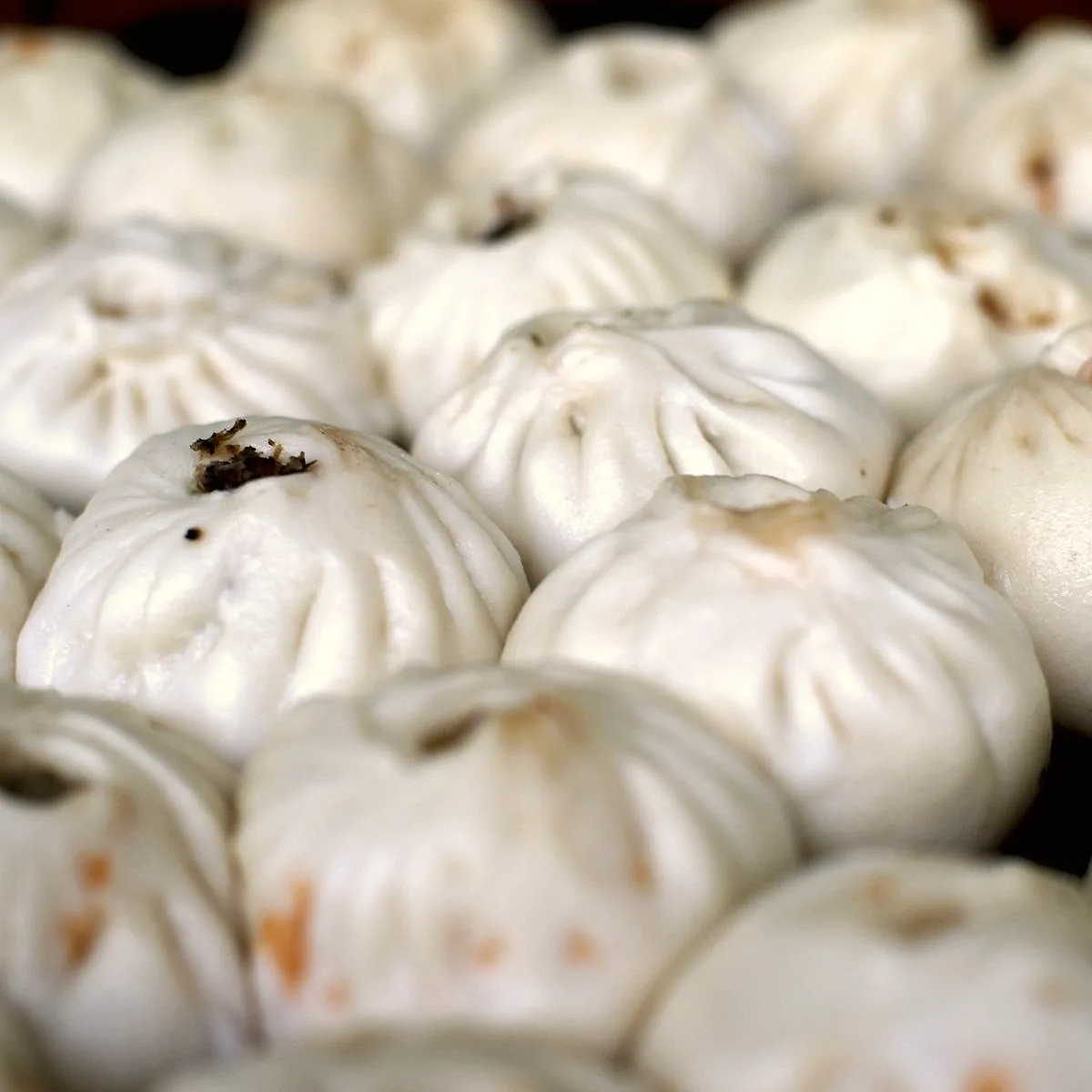

CC0. Cropped and colour-adjusted for this site.
The same dish, adapted. Every quantity, time and figure below changes with the version.
Method
Stir the 6 g dried yeast into the 260 ml water and set aside for 10m, until foamy.
Combine the 480 g plain flour, 50 g caster sugar and 5 g baking powder in a large bowl. Pour in the yeast mixture and the 15 ml vegetable oil and bring together into a shaggy dough.
Turn the dough out onto the 20 g plain flour and knead for 10m, until smooth, elastic and no longer tacky.
Return the dough to the bowl, cover and leave to prove somewhere warm for 1h, until roughly doubled in size.
Meanwhile, combine the 400 g pork mince, 10 g fresh ginger, 2 ½ spring onions (40 g), 20 ml light soy sauce, 15 g oyster sauce, 15 ml Shaoxing wine, 10 ml toasted sesame oil, 1 g ground white pepper and 3 g fine sea salt in a bowl and stir hard in one direction until sticky and cohesive.
Stirring the filling with the liquid seasonings added gradually rather than all at once lets the mince absorb them fully, so the filling stays juicy without pooling liquid inside the bun as it steams.
Knock the dough back and roll it into a log, then divide it into even pieces. Roll each piece into a round, thicker at the centre than at the rim, spoon filling into the middle, and pleat the edge closed around it, twisting to seal at the top. Set each bun on a small square of baking paper.
Cover the shaped buns loosely and leave to prove for a further 20m, until visibly puffed.
Arrange the buns in a steamer basket with space between each to allow for expansion, and steam over gently simmering water for 14m, until risen and firm, and the filling is cooked through. Turn off the heat and let the steam settle briefly before lifting the lid.
Common pitfallLifting the lid before the steamer has fully cooled lets a rush of cold air hit the buns, and they collapse and wrinkle on one side. Turn off the heat and let the steam settle for a minute before uncovering.
Method
Stir the 6 g dried yeast into the 260 ml water and set aside for 10m, until foamy.
Combine the 480 g plain flour, 50 g caster sugar and 5 g baking powder in a large bowl. Pour in the yeast mixture and the 15 ml vegetable oil and bring together into a shaggy dough.
Turn the dough out onto the 20 g plain flour and knead for 10m, until smooth, elastic and no longer tacky.
Return the dough to the bowl, cover and leave to prove somewhere warm for 1h, until roughly doubled in size.
Meanwhile, toss the 350 g napa cabbage with the 4 g fine sea salt and leave to stand for 15m, then squeeze it firmly by the handful to press out as much water as possible.
Salting the cabbage and squeezing it dry before it goes anywhere near the other filling ingredients is what keeps a vegetable filling from turning the dough soggy as it steams, since cabbage otherwise releases a large amount of water once heated.
Combine the squeezed cabbage with the 200 g firm tofu, 20 g dried shiitake mushrooms, 60 g carrot, 8 g fresh ginger, 2 spring onions (30 g), 20 ml light soy sauce, 15 ml toasted sesame oil, 1 g ground white pepper and 2 g fine sea salt in a bowl and mix well.
Knock the dough back and roll it into a log, then divide it into even pieces. Roll each piece into a round, thicker at the centre than at the rim, spoon filling into the middle, and pleat the edge closed around it, twisting to seal at the top. Set each bun on a small square of baking paper.
Cover the shaped buns loosely and leave to prove for a further 20m, until visibly puffed.
Arrange the buns in a steamer basket with space between each to allow for expansion, and steam over gently simmering water for 12m, until risen and firm to the touch. Turn off the heat and let the steam settle briefly before lifting the lid.
Baozi and mantou share one origin story. Both trace back to the same legendary steamed bun, said to have been invented filled with meat and shaped like a human head, and both were once covered by the single term mantou [2]. The two only became separate dishes later: by the tenth century, during the Song dynasty, mantou had narrowed to mean a plain, unfilled bun, while the stuffed version took on the name baozi and developed as a dish in its own right [1] [2].
That split has held ever since. Where mantou is eaten as bread, alongside a meal, baozi is the meal: a bun built specifically to carry a filling, sealed with a twisted pleat at the top rather than left plain, and steamed until the wrapper turns glossy and slightly translucent over the seam. It became especially popular across northern China, where wheat rather than rice is the staple grain, and travelled from there into the rest of the country and, with the Chinese diaspora, well beyond it [2].
The filling is where regional and household variation shows itself most: pork with ginger and spring onion is the everyday standard, but a vegetable filling built on cabbage, mushroom and tofu is just as long-established, particularly in Buddhist vegetarian cooking and during periods of fasting. Both versions keep the same soft, faintly sweet dough and the same pleated, top-knotted shape that distinguishes a baozi from a jiaozi or a wonton at a glance.
Sources
- Baozi, WikipediaDates the emergence of "baozi" as a distinct term to the Song dynasty and describes the tenth-century split from mantou.
- Take a Bao — The Steamed Buns of China, Great British ChefsCovers the same terminological split and baozi's rise as a filled dish distinct from mantou.