Chinese · Main Course
Sichuan Hot Pot
A málà broth of doubanjiang, dried chilli and Sichuan pepper kept at a simmer on the table, into which thinly sliced meat and vegetables are cooked piece by piece.
Also known asHuoguo
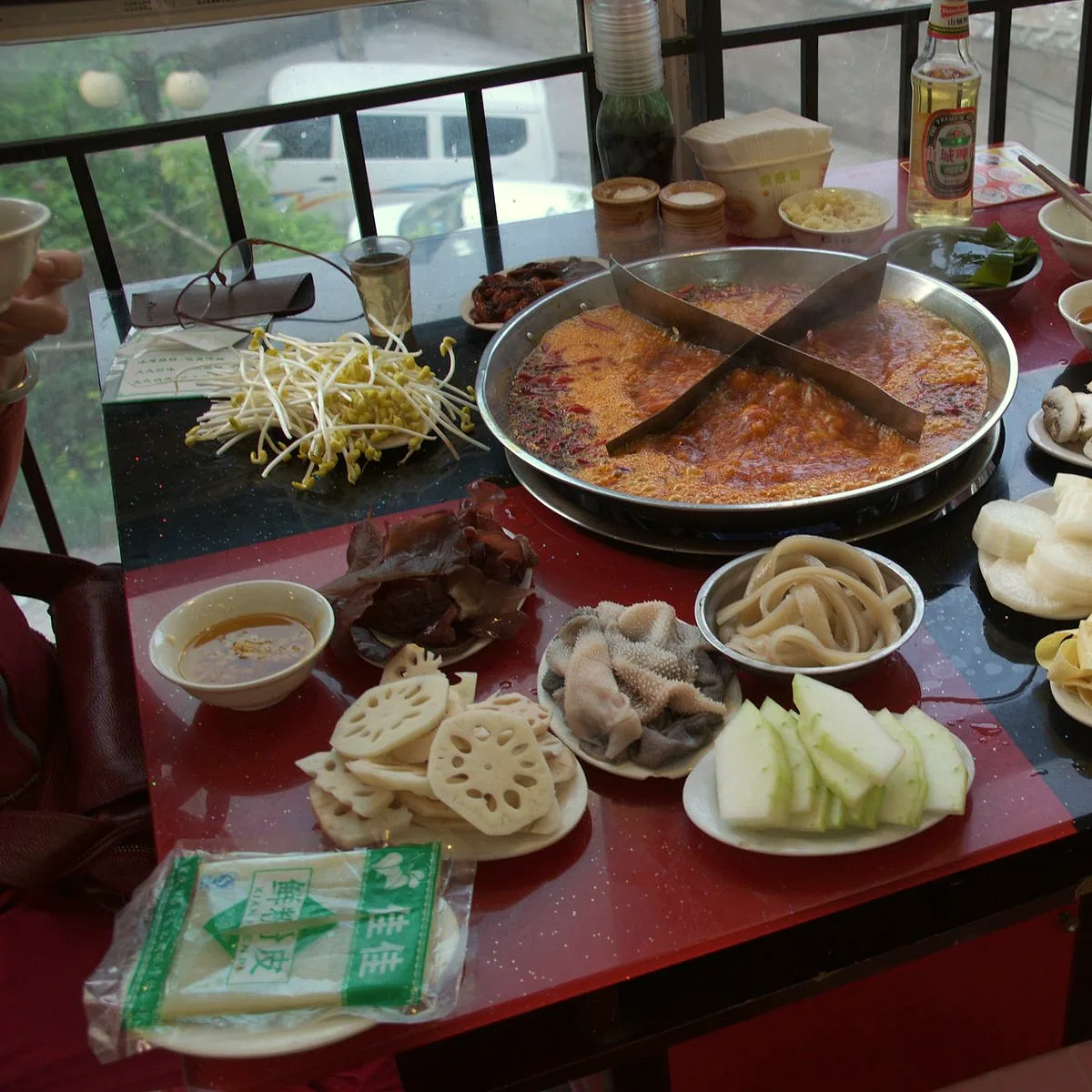

CC BY-SA 3.0. Cropped and colour-adjusted for this site.
Method
Heat the 40 ml vegetable oil in a large pot over medium heat and fry the 60 g doubanjiang, 10 dried chillies (20 g) and 12 g whole Sichuan pepper for 8m, until the oil turns red and fragrant. Add the 4 garlic cloves (20 g), 20 g fresh ginger and 3 g whole star anise and stir briefly.
Frying the doubanjiang and dried chilli in oil before any liquid is added is what draws out their red colour and toasts their flavour; added straight into stock, the same ingredients taste flat and raw by comparison.
Pour in the 1.2 L chicken stock and stir in the 15 g rock sugar. Bring to a simmer and cook gently for 20m, then transfer to a tabletop burner.
Meanwhile, combine the 40 ml toasted sesame oil and 2 garlic cloves (10 g) in small individual bowls for dipping.
Arrange the 250 g flank steak, 200 g pork belly, 200 g firm tofu, 250 g napa cabbage, 150 g mushrooms and 150 g dried wheat noodles on plates around the pot, ready for cooking at the table.
Keep the broth at a steady simmer on the tabletop burner. Add the ingredients in small batches, cooking each briefly in the broth until done, over 30m in total, and dip each piece in the sesame-and-garlic sauce before eating.
Common pitfallMeat sliced too thick stays tough even after a long dip in the broth. Slicing it paper-thin, ideally while still slightly frozen, is what lets each piece cook through in the seconds it takes to swirl through the pot.
Hot pot's usual origin story is set at the water's edge rather than in a kitchen. Along Chongqing's Chaotianmen wharf, one of the busiest river crossings in the city, boatmen and porters are said to have taken the cheap offal cuts left over from the butcher (tripe, liver, stomach) and boiled them in a shared pot of chilli and Sichuan pepper, a broth spiced heavily enough to disguise the strong flavour of the meat and warm workers through a damp, cold winter on the river [2] [1].
The practice moved off the docks and into the city gradually. Street vendors known as "stick-stick men" carried broth and ingredients through Chongqing's streets on bamboo poles, selling hot pot to pedestrians directly over open flames rather than at a fixed stall [2]. By the 1920s the trade had settled into Chongqing's Jiangbei district, where dockworkers bought and boiled beef tripe together, splitting the cost of the broth and paying only for what they personally ate out of it. A restaurant is said to have later formalised the dish, turning a workers' meal into something eaten by choice rather than necessity, though no precise date for that step is well attested.
What survives from that origin is less the exact cuts of meat than the broth's whole reason for being so aggressively seasoned: chilli and Sichuan pepper were practical before they were a matter of taste, covering the flavour of poor-quality meat and offal and giving workers something to warm them against a damp climate. A modern pot, built on better cuts and richer stock, is still seasoned to the same málà (numbing and hot) formula that started as a way of making do.
Sources
- Chongqing hot pot, WikipediaOn the Jiangbei dockworkers of the 1920s cooking beef tripe and offal in a shared pot, and its later move into restaurants as a formal dish.
- Chongqing Hot Pot, iChongqingOn the Chaotianmen wharf origin story and the "stick-stick men" who carried broth and ingredients through the streets to sell to pedestrians.