Tunisian · Breakfast · Main Course
Shakshuka
Eggs poached in a tomato and pepper sauce cooked down until the oil separates out of it.
Also known asChakchouka · Maghreb
Not the same asMenemen (The Turkish dish of eggs with tomato and green pepper, in which the eggs are stirred through into a soft scramble rather than left whole in the sauce.)
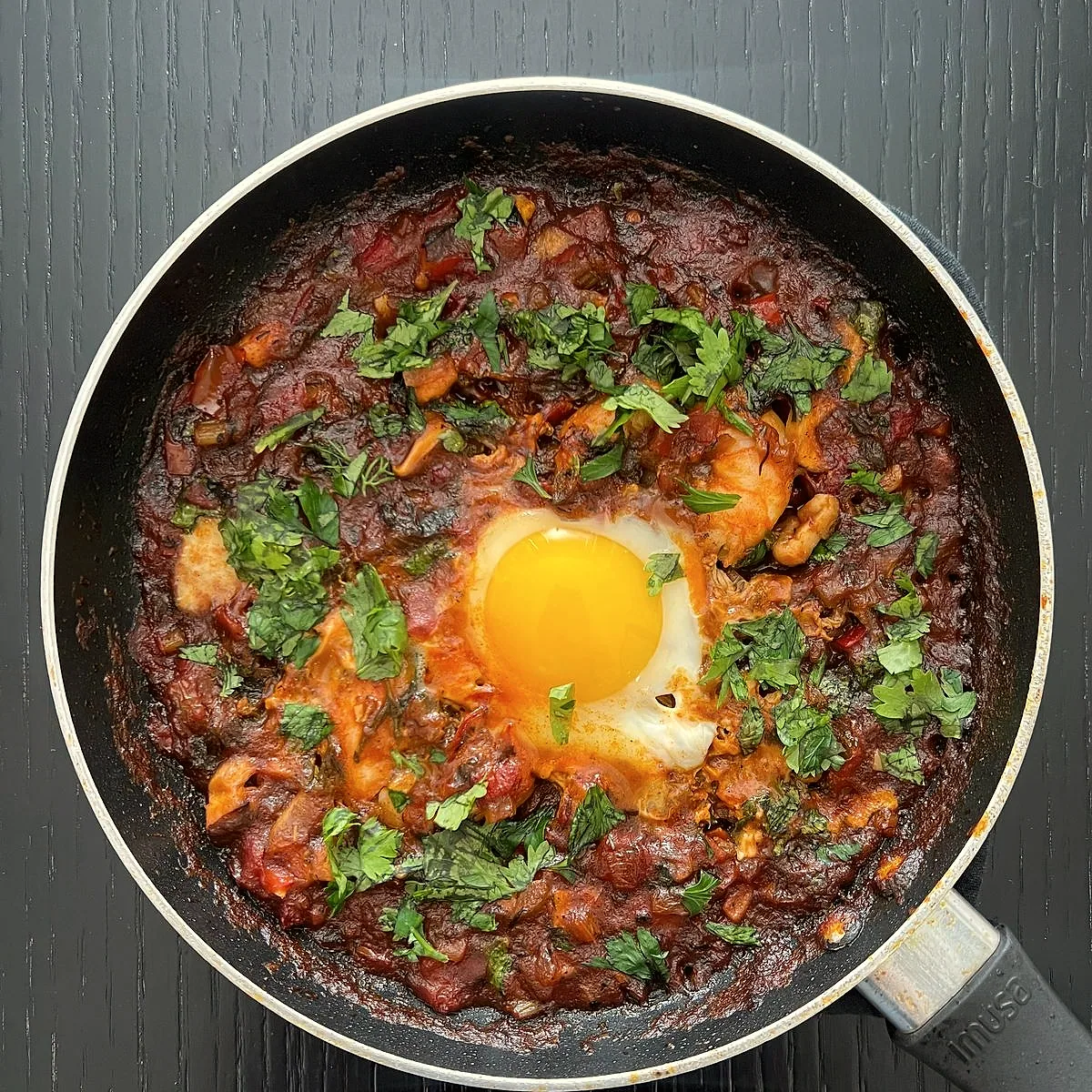

CC BY-SA 4.0. Cropped and colour-adjusted for this site.
Method
Warm the 35 ml extra-virgin olive oil in a wide, shallow pan over a low flame and add the 150 g yellow onion and the 180 g red pepper. Cook them for 18m, turning them over occasionally, until both have collapsed to softness and the pepper has begun to slump against the pan. They should take almost no colour.
Add the 2 ½ garlic cloves (12 g), the 2 g caraway seed, the 3 g ground cumin, the 5 g sweet paprika and the 1 g chilli flakes, and stir them through the hot oil for 2m, until the paprika has darkened a shade and the pan smells of spice rather than of raw powder.
The spices go into the hot oil rather than into the tomatoes. Their flavour compounds are fat-soluble and barely move in water, which is why a spoonful stirred into the sauce at the end tastes dusty.
Crush the 400 g tinned tomatoes in your hand as they go into the pan, add the 5 g fine sea salt and the 1 g ground black pepper, and simmer for 20m. It is done when the sauce has darkened to brick, the oil has separated out around the edge, and a spoon dragged across the base leaves a channel that fills in slowly.
The sauce has to be finished before the eggs go in. Once they are set into it the pan cannot be cooked any further without ruining them, so a thin sauce at that point stays thin.
Push a well down to the base of the pan for each egg with the back of a spoon and slide the 4 eggs (200 g) in one at a time. Season the tops, put a lid on and cook over the lowest heat you can hold for 9m, until the whites have turned opaque and firm and the yolks still shift when the pan is nudged.
Common pitfallToo much heat under the pan sets the whites into rubber before the yolks have warmed. The eggs go into wells pushed down to the base of the pan, with a lid on and the flame as low as it goes.
Take the pan off the heat and leave it to stand for 3m; the whites finish setting on residual heat while the yolks do not. Tear the 8 g fresh coriander over the top and bring the pan to the table.
The name is the dish cooking. Shakshuka comes from a Maghrebi Arabic verb, shakshaka, which the Oxford English Dictionary glosses as to bubble, to sizzle, to be mixed up or beaten together; in Tunisian and Algerian usage the noun simply means a mixture [1]. English took it in the nineteenth century through French, as chakchouka [1].
Whatever its age, the dish cannot be very old. Neither tomatoes nor peppers existed in North Africa before Spanish and Portuguese ships brought them from the Americas, and they were not established around the Mediterranean until the sixteenth and seventeenth centuries [2]. What preceded them was a much older Amazigh habit of stewing whatever vegetables were in season, into which eggs were eventually broken [2].
Where it belongs is contested, and the earliest European notices are contested in themselves: a French source calls chakchouka Tunisian in 1894, a newspaper lists it among Egyptian foods in 1896, and a European account calls it Turkish in 1899 [2]. Gil Marks derives it from the Turkish şakşuka and has it travelling west with the Ottomans; Anthony Buccini and Noah Sienna instead place shakshuka, menemen, piperade and ratatouille in one family of western Mediterranean vegetable stews with a common ancestry rather than a single point of origin [1]. The food historian Rafram Chaddad credits it most directly to Tunisia and to the Amazigh [2].
The last part of the story is better documented than the first. Shakshuka arrived in Israel with Maghrebi Jewish migration in the 1950s (it had no prior place in Palestinian or Levantine cooking), reached Israeli restaurant menus in the 1990s, and travelled from there onto brunch menus everywhere [1]. The dish is North African. Its fame is not.
Sources
- Shakshouka, WikipediaOn the Maghrebi Arabic etymology by way of the Oxford English Dictionary, Gil Marks's Ottoman derivation, the Buccini and Sienna counter-reading, and the dish's route to Israel.
- The History of Shakshuka: Who Really Owns This Dish?, Eats HistoryCollects the earliest European references (Tunisian in 1894, Egyptian in 1896, Turkish in 1899) and Rafram Chaddad's attribution to Tunisia and the Amazigh.