Nepali · Main Course
Momo
A Nepali dumpling of spiced minced meat gathered into a pleated pouch and steamed, eaten plain or set in a sesame-tomato broth.
Not the same asMomo (Tibetan) (A closely related dumpling from the same family, usually filled with yak or beef and served without the sesame-tomato jhol that distinguishes the Nepali dish's soup version.)
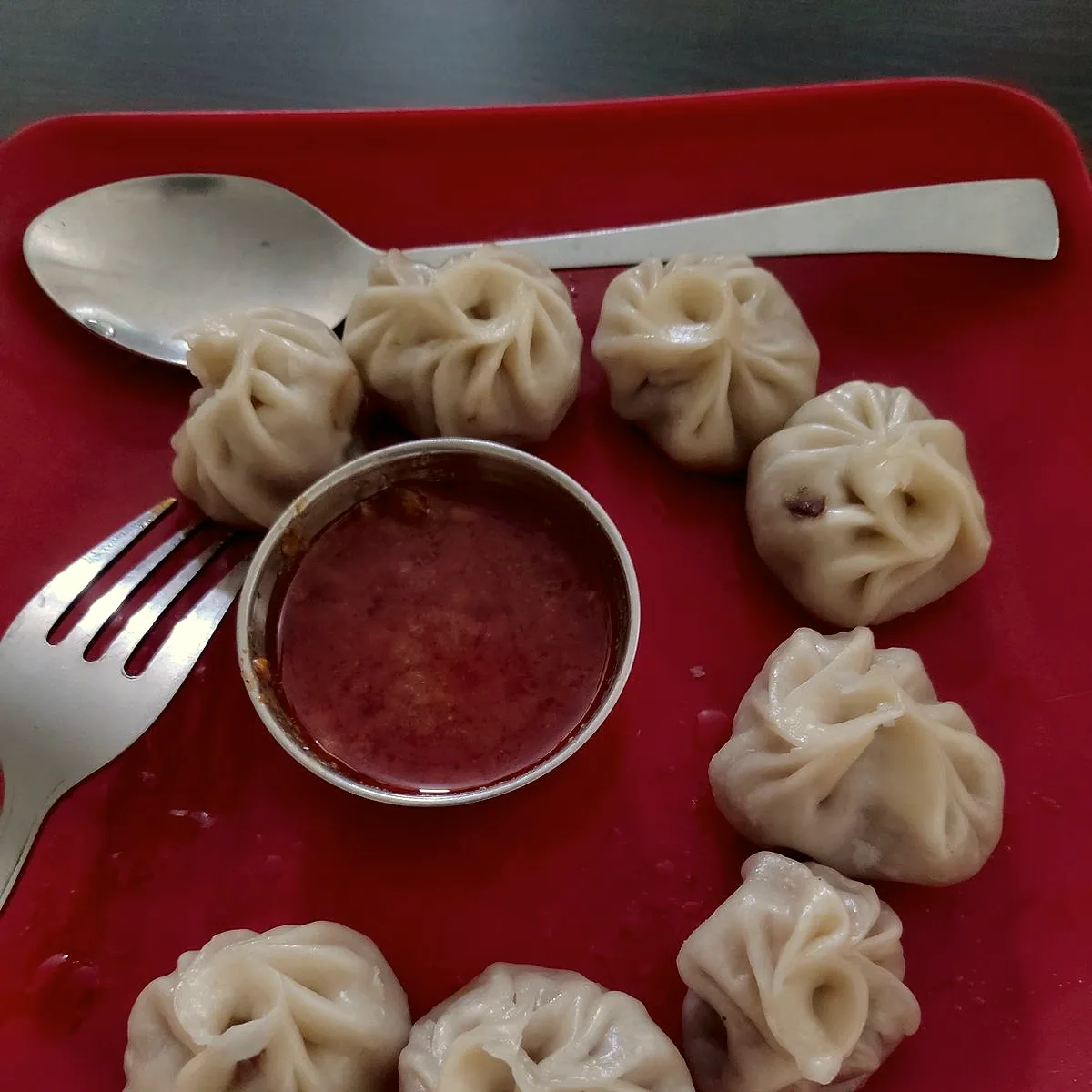

CC BY-SA 4.0. Cropped and colour-adjusted for this site.
The same dish, adapted. Every quantity, time and figure below changes with the version.
Method
Combine the 260 g plain flour, 140 ml water and 3 g fine sea salt in a bowl and bring together into a firm dough, then turn it out and knead for 8m until smooth.
Cover the dough and rest it for 30m at room temperature, until it has relaxed and no longer springs back when pressed.
Meanwhile, combine the 300 g beef mince, 120 g white onion, 2 ½ garlic cloves (12 g), 10 g fresh ginger, 2 spring onions (30 g), 15 g fresh coriander, 3 g ground cumin, 2 g ground black pepper, 10 ml toasted sesame oil and 5 g fine sea salt in a bowl and mix by hand until evenly combined and slightly sticky.
Beef stands in here for the buffalo mince momo are traditionally made with in Nepal, which is not a food USDA publishes nutrition data for; beef is the common substitute outside the region and elsewhere in the region's own restaurants.
Roll the rested dough into a log and pinch off small, even pieces, keeping the rest covered. Roll each piece with the 20 g plain flour underneath into a thin round about 7 cm across, thicker at the centre than at the rim. Spoon filling into the middle of each round, then gather the edge up around it in fine pleats, twisting them together at the top to seal the pouch shut.
Common pitfallPleats gathered too loosely let the twisted top spring open in the steamer, so the filling's juices leak out into the basket instead of staying inside the pouch.
Set the momo into a well-oiled or lined steamer basket, leaving space between each, and steam over rapidly boiling water for 15m, until the wrappers turn glossy and the filling is cooked through.
Method
Combine the 260 g plain flour, 140 ml water and 3 g fine sea salt in a bowl and bring together into a firm dough, then turn it out and knead for 8m until smooth.
Cover the dough and rest it for 30m at room temperature, until it has relaxed and no longer springs back when pressed.
Meanwhile, combine the 300 g beef mince, 120 g white onion, 2 ½ garlic cloves (12 g), 10 g fresh ginger, 2 spring onions (30 g), 15 g fresh coriander, 3 g ground cumin, 2 g ground black pepper, 10 ml toasted sesame oil and 5 g fine sea salt in a bowl and mix by hand until evenly combined and slightly sticky.
Roll the rested dough into a log and pinch off small, even pieces, keeping the rest covered. Roll each piece with the 20 g plain flour underneath into a thin round about 7 cm across, thicker at the centre than at the rim. Spoon filling into the middle of each round, then gather the edge up around it in fine pleats, twisting them together at the top to seal the pouch shut.
Set the momo into a well-oiled or lined steamer basket, leaving space between each, and steam over rapidly boiling water for 15m, until the wrappers turn glossy and the filling is cooked through.
Meanwhile, warm the 10 ml toasted sesame oil in a pan and cook the 1 ½ garlic cloves (8 g) and 6 g fresh ginger until fragrant. Add the 250 g ripe tomatoes and 2 g chilli flakes and cook, stirring occasionally, until the tomatoes collapse and turn jammy. Stir in the 20 g tahini and 200 ml water, season with the 3 g fine sea salt and simmer for 20m, then blend until smooth and stir in the 10 ml fresh lime juice.
Blending the tomatoes only after they are cooked through, rather than raw, is what keeps the jhol from tasting sharp; the acidity mellows as the tomatoes break down in the pan.
Ladle the jhol into bowls, set the steamed momo into it and scatter over the 5 g fresh coriander.
Momo is generally traced to Tibet and understood to have reached Kathmandu through the Newar traders of the Kathmandu Valley, who carried on an extensive trade with Lhasa from as early as Nepal's Licchavi period and are held to have brought the recipe home with them [1]. No written record fixes when this happened. As one Kathmandu chef quoted on the dish's history put it, what survives is "oral history, trade memory and social clues" rather than a documented date [1].
That account is not the only one in circulation. A popular legend credits the seventh-century Nepali princess Bhrikuti with carrying momo to Tibet in the opposite direction, as part of her marriage into the Tibetan court, while other historians hold that dumplings reached the Tibetan plateau from China under the Mongols in the thirteenth century and travelled to Nepal from there [2]. The three stories do not agree on either the period or the direction of travel, and none is treated as settled.
Trade between Nepal and Tibet continued into the twentieth century until China's annexation of Tibet closed the border in the 1960s and ended the Newar trading presence in Lhasa, by which point momo was already established across the Kathmandu Valley [1]. Nepali cooks are credited with the dish's two most distinctive departures from the Tibetan original: working more spice into the filling, and jhol momo, in which the dumplings are served sitting in a thin, spiced broth rather than alongside a separate dipping achar [1][2].
Sources
- A History of Momo, the Dumpling That Defines Nepali Cuisine, Smithsonian MagazineSets out the Newar-trader account of momo's arrival, the absence of written documentation, and the Tibet-Nepal border closure of the 1960s.
- Momo (food), WikipediaCovers the competing Bhrikuti-legend and Mongol-era accounts of the dish's origin, and the distinction between achar-dipped and jhol-served momo.