Afghan · Main Course
Kabuli Pulao
Basmati steamed over lamb and its own spiced stock, finished under a tangle of caramelised carrot, raisins and nuts. Afghanistan's national dish.
Also known asQabili palaw · Afghanistan
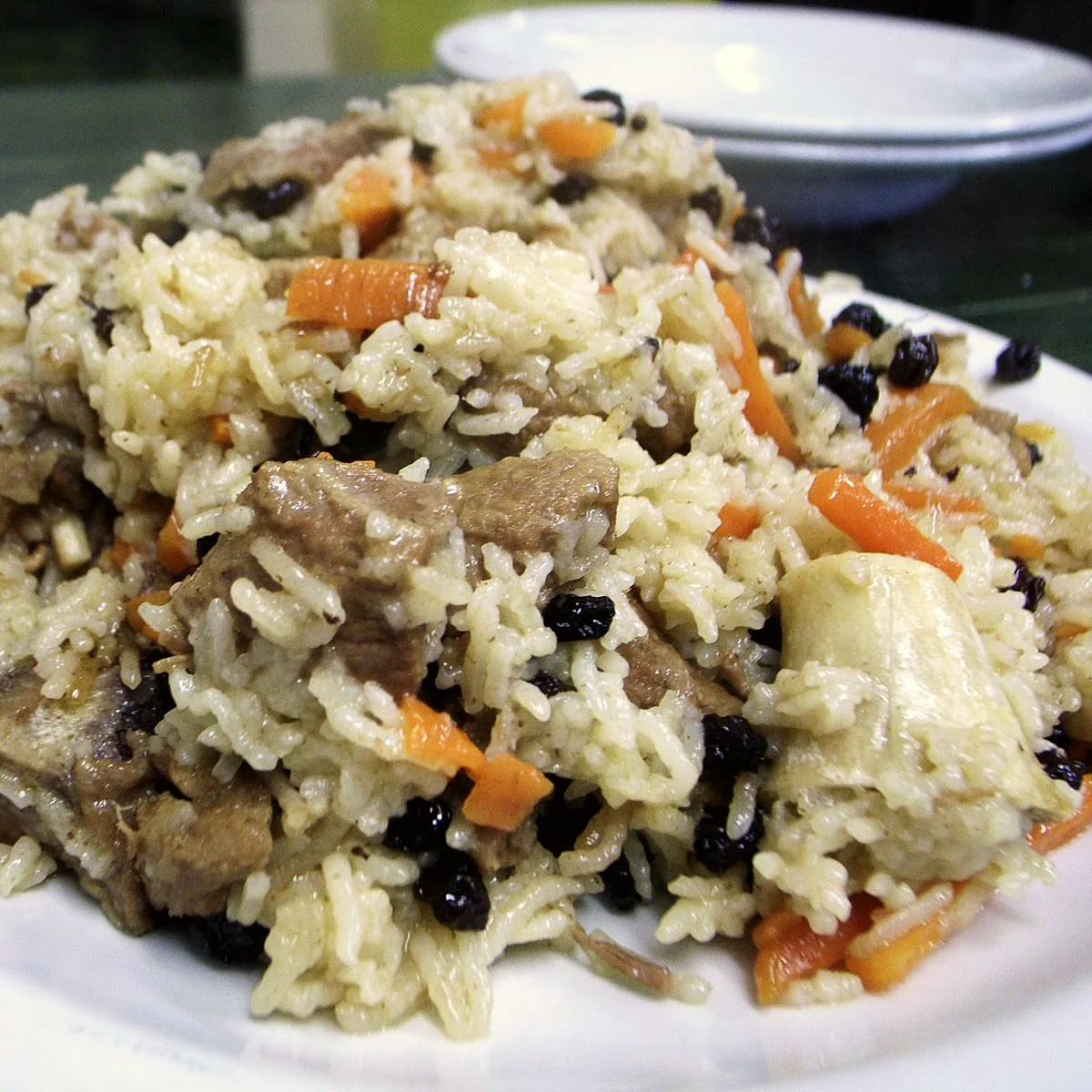
_with_lamb_-_Afghanistan_-_04272008.jpg)
CC BY 2.0. Cropped and colour-adjusted for this site.
Method
Melt the 25 g ghee in a heavy pot and brown the 450 g lamb leg on all sides over a high heat. Add the 200 g yellow onion and cook until softened, then stir in the 3 garlic cloves (15 g), 4 g whole cumin, 7 ½ cardamom pods (3 g), 4 cloves (0.4 g), 1 cinnamon stick (3 g) and 2 bay leaves (0.4 g), and cook briefly until fragrant. This takes 10m in total.
Add the 10 g fine sea salt and the 900 ml water, bring to a simmer, cover, and cook gently for 1h, until the lamb is completely tender. Lift the lamb out and keep it warm; strain and reserve the stock.
While the lamb simmers, cook the 300 g carrot in a dry pan over a medium heat with the 15 g caster sugar, tossing often, for 12m, until glossy and lightly caramelised at the edges but still with some bite. Stir through the 50 g raisins, 15 g almonds and 15 g raw pistachios in the last minute and set aside.
Common pitfallCarrot cooked past a glossy sear turns soft and loses the contrast the topping is meant to give against the rice. It wants colour and a little chew left in it, not a full braise.
Rinse the 380 g basmati rice until the water runs clear, then boil it in the reserved stock for 8m, until the grains are still firm at the core. Drain, reserving any stock still left.
Return the lamb to the base of the pot. Mound the parboiled rice on top, drizzle over any remaining stock, cover tightly, and steam over the lowest heat for 30m, undisturbed, until the rice is fully tender.
The rice finishes over the lamb rather than beside it, absorbing the last of the meat's own stock as it steams. This is the same undisturbed, sealed-pot principle behind the region's other layered pilafs, adapted here to a stock built with lamb rather than saffron and butter alone.
Spread the rice and lamb onto a platter and scatter the caramelised carrot, raisin and nut topping evenly over the top. This takes 10m.
The name most English speakers know this dish by is itself a source of confusion. Despite being called Kabuli pulao, the dish is not believed to have originated in Kabul at all; the fuller record places its beginning near Afghanistan's northern border with Uzbekistan, inside a much older regional tradition of rice cooked with meat and stock that likely reaches back as far as Bactrian times [1]. An early written trace of the qabili style of pilaf (the name most likely comes from Persian, rather than from Kabul the city) appears in a Persian cookbook from 1521, Ali Bavarchi's Kar-nama, among the oldest surviving cookbooks in the language [1].
A separate, more local telling puts the dish's rise squarely in the city its common name points to. On this account, Kabuli palau was created by the wealthy families of Kabul itself, who could afford to dress plain rice with caramelised carrot, raisins and nuts (expensive additions at the time), and only later, as prosperity spread more widely through Afghan society, did the dish become common enough to need renaming, taking the name Qabili palau from the Dari word for "well accomplished," a nod to the skill needed to balance its flavours [2]. The two accounts do not agree on where the dish itself began, even as they agree closely on what its name has meant and on the luxury ingredients (carrot, raisins, nuts) that mark it out from a plainer pilaf.
The same qabili style of pilaf is known by other names across the wider region it grew out of: as osh palov in Uzbekistan, and, carried by Central Asian émigré communities, as "Bukhari rice" in parts of Saudi Arabia, after the Uzbek city of Bukhara [1].
Sources
- Kabuli pulao, WikipediaStates that despite the name the dish did not originate in Kabul but near the northern Afghan-Uzbek border, traces the Qabili name to Persian, and cites an early qabili pilaf recipe in Ali Bavarchi's 1521 manuscript Kar-nama.
- Afghanistan's National Dish — Kabuli Palau, Afghan Culture UnveiledWritten by Afghan-American food writer Humaira Ghilzai; independently attributes the dish's creation to Kabul's wealthy families, who could afford to enrich rice with carrot, raisins and nuts, and explains the Qabili name as Dari for "well accomplished."