Caribbean · Main Course
Jerk Chicken
Chicken marinated in scotch bonnet, allspice and thyme, charred hard over direct heat, then finished through gently in the oven.
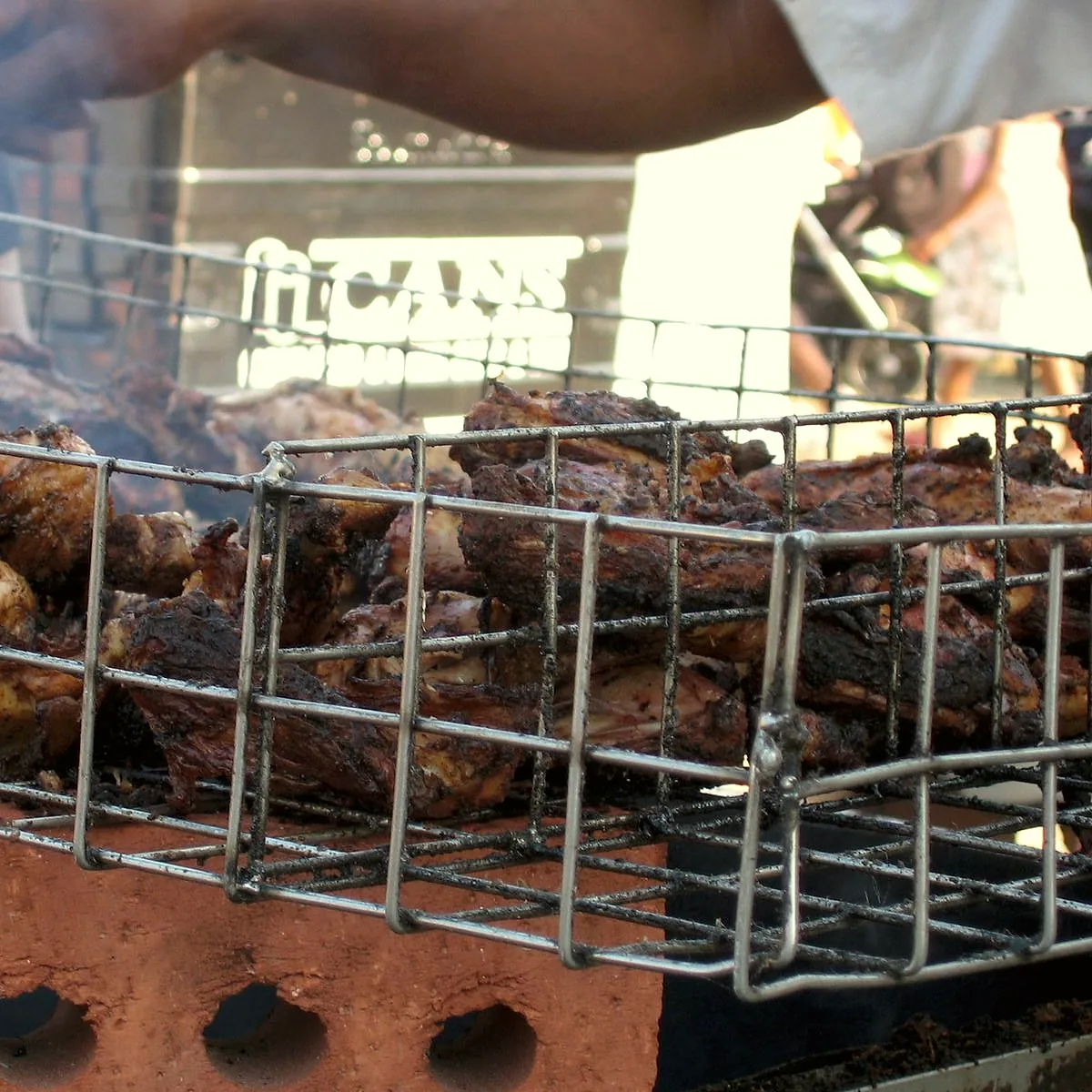

CC BY-SA 3.0. Cropped and colour-adjusted for this site.
The same dish, adapted. Every quantity, time and figure below changes with the version.
Method
Blend the 20 g scotch bonnet, 8 g ground allspice, 4 g fresh thyme, 3 garlic cloves (15 g), 10 g fresh ginger, 2 spring onions (30 g), 30 ml light soy sauce, 20 g light brown sugar, 30 ml fresh lime juice, 30 ml vegetable oil, 1 g ground nutmeg, 1 g ground cinnamon, 6 g fine sea salt and 2 g ground black pepper to a smooth paste.
Rub the paste all over the 1.2 kg bone-in, skin-on chicken, working it under the skin where possible, then cover and refrigerate for 12h.
Sear the chicken over direct high heat on a grill or ridged grill pan for 12m, turning occasionally, until the surface is well-blackened in patches on all sides.
Charring the chicken hard over direct heat first, before it goes into the oven to finish, is what gives jerk chicken its blackened, slightly bitter crust; a milder heat throughout leaves the skin merely browned.
Transfer the chicken to a tray and finish in an oven preheated to 180 °C for 35m, until the thickest pieces are cooked through and the juices run clear.
Common pitfallPulling the chicken as soon as the crust looks done leaves the thickest pieces undercooked near the bone; the oven finish needs the full time regardless of how dark the surface already is.
Method
Blend the 20 g scotch bonnet, 8 g ground allspice, 4 g fresh thyme, 3 garlic cloves (15 g), 10 g fresh ginger, 2 spring onions (30 g), 30 ml light soy sauce, 20 g light brown sugar, 30 ml fresh lime juice, 30 ml vegetable oil, 1 g ground nutmeg, 1 g ground cinnamon, 6 g fine sea salt and 2 g ground black pepper to a smooth paste.
Rub the paste all over the 1.2 kg bone-in, skin-on chicken, working it under the skin where possible, then cover and refrigerate for 12h.
Light a bed of charcoal or split pimento wood and let it burn down to steady, smouldering embers, banking them to one side of the grill for indirect heat, for 30m.
Common pitfallGreen or freshly cut pimento wood smokes too hard and turns the chicken acrid; the wood needs to be dried and burned down to steady embers before the chicken goes anywhere near it.
Set the chicken on the side of the grill away from the embers, cover, and smoke over the low, indirect heat for 2h 30m, turning occasionally, until the skin is deeply darkened and the thickest pieces are cooked through.
Burning split pimento wood down to smouldering embers, rather than an open flame, is what gives this version its low, sweet smoke; a hot, flaming fire scorches the skin before the smoke has done its work.
Jerk began as a way of not being found. Maroons (Jamaicans who escaped slavery and built independent communities in the island's mountainous interior) could not risk a visible fire giving away their position to the search parties sent after them, so they devised a method of seasoning and cooking meat in an underground pit over dying embers, which produced heat without betraying smoke [2]. In their mountain settlements, escaped Africans and the island's surviving Taíno inhabitants exchanged food traditions and methods of preserving meat, and jerk is one product of that exchange rather than a technique either group carried whole from elsewhere [1].
The seasoning was built from what grew wild around the Maroons rather than from anything imported: pimento berries (allspice), salt and bird peppers, a small, fiery relative of the chillies used today, rubbed into wild boar and wrapped in pepper elder leaves before it went into the pit [1]. Jamaican literary scholar Carolyn Cooper has described jerk as one of the clearest surviving markers of that fusion of African and Taíno culture on the island [1].
Once the Maroons no longer needed to hide, jerking moved back above ground, onto open grills, and the meat itself broadened from wild boar to pork, chicken and fish alike [2]. What survived the move outdoors is the principle rather than the concealment: pimento wood, burned for its low, fragrant smoke rather than a hot flame, is still what distinguishes jerk cooked to the traditional standard from jerk seasoning simply rubbed onto meat and grilled or roasted by other means.
Sources
- A Brief History of Jamaican Jerk, Smithsonian MagazineDescribes the Maroons' underground smokeless pit, their exchange of food traditions with surviving Taíno communities, and quotes Jamaican literary scholar Carolyn Cooper on jerk's cultural fusion.
- Jamaican Food — Explore Our Cuisine & Rich Culinary Traditions, Jamaica Information ServiceThe Jamaican government's own account of the Maroons devising smokeless jerking specifically to avoid revealing their location.