Argentine · Snack
Empanadas Argentinas
Hand-sealed pastries of wheat and lard filled with braised beef, baked until the crimped edge crisps; the everyday version comes from Salta, with a juicy, well-spiced filling.
Not the same asEmpanada de pino (The Chilean empanada is larger, made with a plainer beef and onion filling, always with a whole olive and a wedge of hard-boiled egg, and a different dough proportion.)
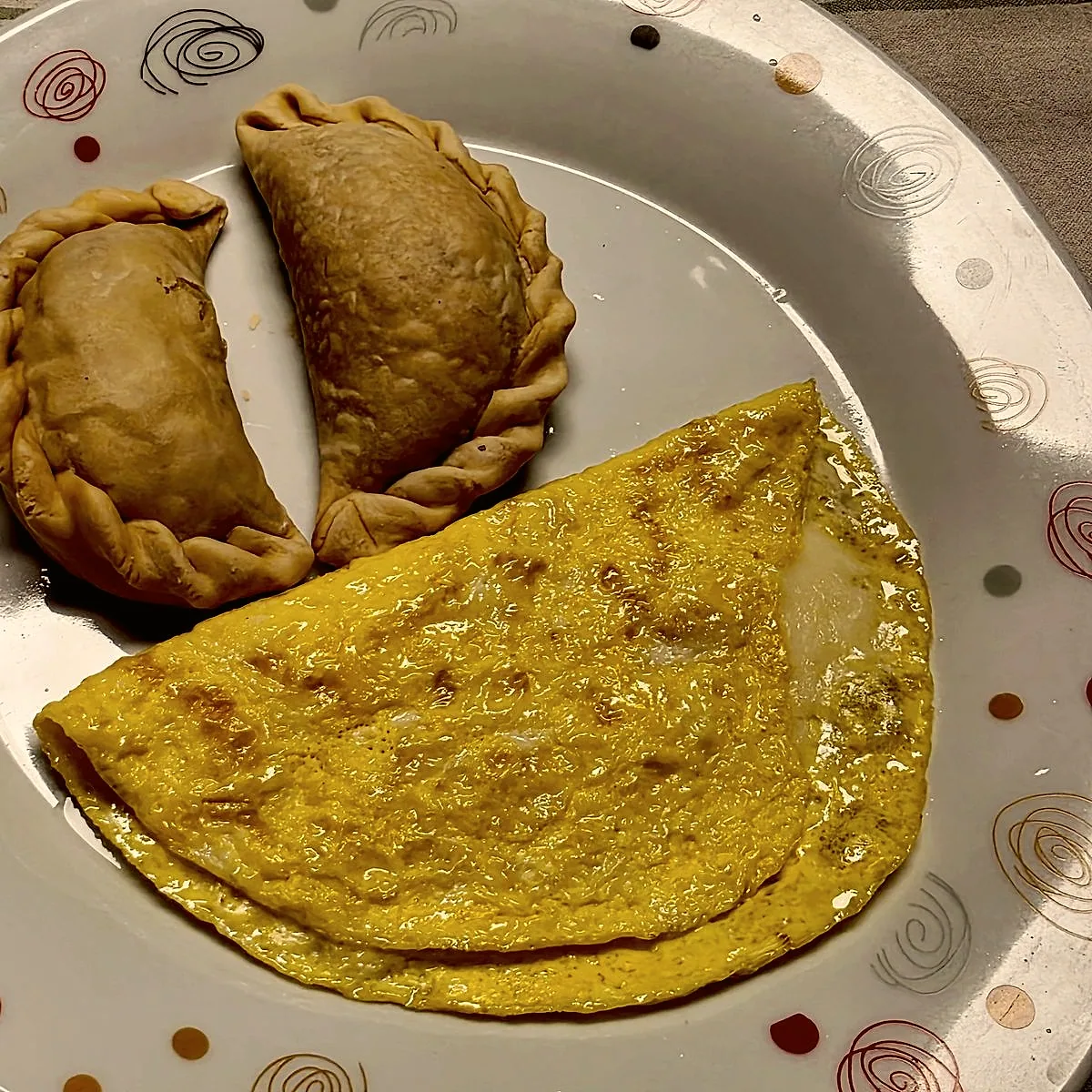

CC BY-SA 3.0. Cropped and colour-adjusted for this site.
The same dish, adapted. Every quantity, time and figure below changes with the version.
Method
Combine the 500 g plain flour and 6 g fine sea salt in a bowl. Add the melted 90 g lard and the 200 ml water, mixing until a smooth, firm dough comes together.
Wrap the dough and let it rest for 30m at room temperature.
While the dough rests, melt the 20 g lard in a wide pan and cook the 200 g white onion and 2 ½ spring onions (40 g) over a medium heat until soft. Add the 400 g chuck, 150 g potato, 3 g ground cumin, 4 g sweet paprika and 2 g chilli flakes, then stir in the 5 g beef bouillon powder dissolved in the 150 ml water. Season with the 4 g fine sea salt and 2 g ground black pepper and simmer for 35m, until the beef and potato are tender and the liquid has reduced to a thick, spoonable sauce rather than a dry mixture.
Spread the filling on a tray and cool completely, for 20m, before using.
A warm filling melts the lard in the dough on contact and makes the pastry impossible to seal cleanly. Cooling it fully first is what lets the crimped edge hold its shape in the oven.
Stir the 2 eggs (100 g) and 60 g green olives through the cooled filling.
Roll the dough thin and cut into rounds. Spoon filling onto one half of each round, fold over and press the edges together, then crimp the sealed edge by folding it over on itself in a repeating fold along its length.
Common pitfallOverfilling the rounds, or sealing them with wet or greasy fingers, is the usual reason an empanada splits open in the oven. The edge is pressed and folded dry, and the filling sits well clear of it.
Bake at 200 °C for 20m, until deep golden and crisp.
Method
Combine the 500 g plain flour and 6 g fine sea salt in a bowl. Add the melted 90 g lard and the 200 ml water, mixing until a smooth, firm dough comes together.
Wrap the dough and let it rest for 30m at room temperature.
While the dough rests, melt the 20 g lard in a wide pan and cook the 220 g white onion and 70 g red pepper over a medium heat until soft. Add the 420 g chuck, 5 g sweet paprika and 1 g ground cumin, season with the 4 g fine sea salt and 2 g ground black pepper, and cook for 25m, stirring often, until the beef is cooked through and the mixture is dry rather than saucy, with no free liquid left in the pan.
Common pitfallThis filling is meant to stay dry rather than saucy, unlike the juicier Salta style; adding stock or water to loosen it turns it into a different empanada. The dice of beef releases enough of its own moisture to bind the mixture on its own.
Spread the filling on a tray and cool completely, for 20m, before using.
Stir the 2 eggs (100 g) and 80 g green olives through the cooled filling.
Roll the dough thin and cut into rounds. Spoon filling onto one half of each round, fold over and press the edges together, then crimp the sealed edge by folding it over on itself in a repeating fold along its length.
Bake at 200 °C for 20m, until deep golden and crisp.
The empanada's earliest documented traces are Galician and medieval, well before any Spanish ship reached the Americas. A carving on the Pórtico de la Gloria at the cathedral of Santiago de Compostela, made by the sculptor Master Mateo around 1188, shows a man reaching for what historians read as an empanada as part of an allegory of gluttony. It is among the earliest known depictions of the pastry [2]. A generation or two later, the Cantigas de Santa María, compiled under Alfonso X of Castile around 1282, includes in its fifty-seventh song an anecdote about a thief who chokes on a stolen chicken empanada until he repents, putting the word and the dish solidly in circulation by the thirteenth century [1][2]. The documentary record only thickens from there: a monastery document from Oseira, dated 1226, records an empanada used to seal a private commercial transaction, and later monastic accounts from San Esteban de Ribas de Sil obliged tenants to deliver eel empanadas to the monks every August [2].
Spanish colonists brought the empanada to South America, where it split into distinct regional identities shaped by local ingredients rather than staying one dish. Argentina alone has a different empanada for nearly every province, and each region defends its own as the standard. Salta's version (small, juicy and spiced with ground chilli, its potato-and-beef filling known locally as recado and its particular fold called simbado) is closely associated with the northwest, and many Argentines treat it as the archetype of the older, spicier provincial style. Mendoza's version, further south and shaped by a drier, wine-country table, typically leaves out the potato and keeps the filling hand-diced and tightly reduced rather than sauced. Neither province has ever conceded the other's version is the "real" empanada, and the disagreement is itself part of Argentine food culture: an empanada, correctly made, tells you where its cook is from.
Sources
- Empanada, WikipediaCites the Cantigas de Santa María (c. 1282) as an early documented reference, and describes the Salta style's recado filling and simbado-style repulgue.
- La empanada románica, La Región (Xavier Castro)Galician newspaper column citing the historians J. M. Andrade and Serafín Moralejo on the Pórtico de la Gloria carving (c. 1188), the same cantiga 57 reference in the Cantigas de Santa María, and a 1226 Oseira monastery document recording an empanada used to seal a commercial transaction.