Turkish · Main Course
Döner Kebap
Layers of marinated lamb and beef stacked on a vertical spit, roasted against its own turning heat and shaved into a warmed flatbread.
Not the same asGyros (The Greek adaptation of the same vertical-spit technique, using pork or chicken and a marinade of lemon, garlic and oregano rather than döner's yoghurt and paprika.)Shawarma (The Levantine adaptation of the same technique, built on cumin, cinnamon and allspice rather than döner's yoghurt-and-paprika marinade.)
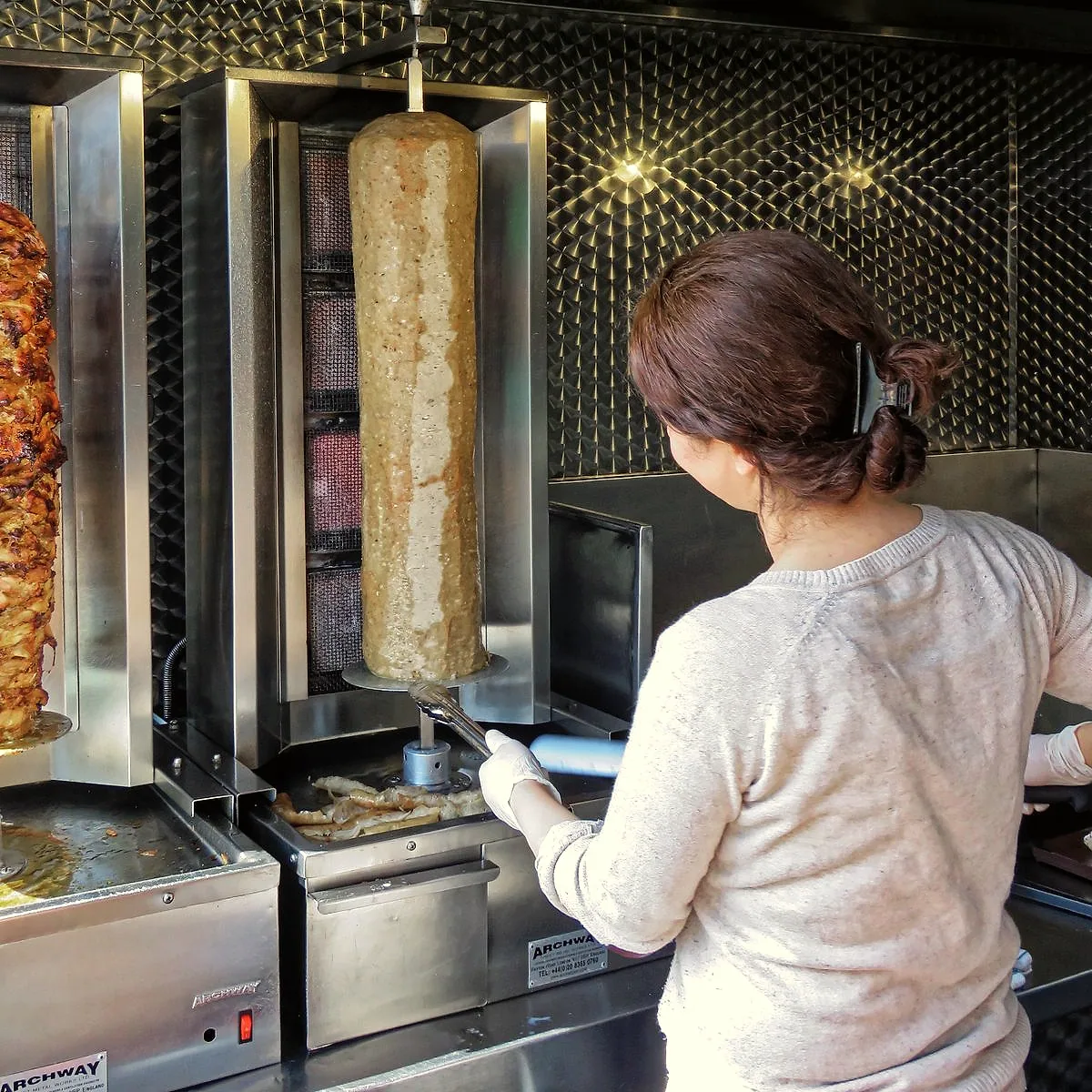

CC BY-SA 4.0. Cropped and colour-adjusted for this site.
The same dish, adapted. Every quantity, time and figure below changes with the version.
Method
Trim the 200 g lamb leg and 200 g beef of any sinew and slice both very thinly against the grain.
Combine the 90 g yoghurt, 10 ml extra-virgin olive oil, 2 garlic cloves (10 g), 4 g sweet paprika, 2 g oregano, 2 g ground black pepper and 8 g fine sea salt, add the sliced meat and turn to coat every piece. Cover and marinate, refrigerated, for 4h.
Thread the marinated slices tightly onto a vertical skewer, alternating lamb and beef and pressing each layer down onto the last, building an even, dense cylinder with no gaps.
Packing the slices into a tight, air-free cylinder is what lets the spit roast the meat evenly against its own weight rather than drying out loose pieces.
Roast the stacked meat close to a vertical heat source, turning it steadily, for 1h 15m, until the outer surface is deeply browned and crisp and the centre is cooked through with no pink remaining.
Common pitfallRoasting too far from the heat browns the outside before the centre is cooked. The spit works because the surface is close enough to the heat to crisp continuously as it turns.
Shave the roasted meat downward off the spit in thin ribbons for 5m.
Warm the 140 g lavash briefly over direct heat until soft and pliable.
Fill the warmed lavash with the shaved meat, 80 g ripe tomatoes, 50 g white onion and 30 g romaine, and roll it closed.
Method
Combine the 200 g beef mince, 200 g lamb mince, 2 garlic cloves (10 g), 4 g sweet paprika, 2 g oregano, 2 g ground black pepper, 8 g fine sea salt and the 60 g white onion. Work the mixture with your hands until it turns sticky and slightly emulsified: this is what holds it together once sliced.
Pack the mixture firmly into a loaf tin lined with baking paper, pressing out every air pocket and smoothing the top.
Pressing the mince into a dense, air-free loaf is what stands in for a spit's own compaction, so the baked meat holds together in clean slices instead of falling apart as loose crumbs. It is an honest adaptation, not a reproduction; no oven replicates the continuous open-flame char of a turning spit, which is what the pan-crisping step is for.
Cover the tin tightly with foil and bake for 55m, until the centre is cooked through with no pink remaining.
Common pitfallBaking the loaf uncovered dries it out before it is cooked through. Covering it traps the steam that keeps the mince moist while it sets.
Leave the loaf to rest in its tin for 15m; slicing it hot breaks it apart.
Turn the loaf out and slice it very thinly.
Sear the slices in a dry, very hot pan for 6m, until the edges crisp and char in patches.
Warm the 140 g lavash briefly over direct heat until soft and pliable.
Fill the warmed lavash with the crisped meat, 80 g ripe tomatoes, 50 g white onion and 30 g romaine, and roll it closed.
Meat roasted on a rotisserie is an old idea in Ottoman cooking. The earliest known depictions are two miniature paintings by an Istanbul artist, dated to between 1616 and 1620, showing a horizontal spit turned over an open fire [2]. The dish stayed horizontal for the next two centuries.
The vertical spit (the technique that defines döner as it is known today) is a 19th-century Bursa innovation, and even that is disputed. Family accounts credit İskender Efendi, who is said to have started roasting lamb upright at his father's restaurant in Bursa in the 1850s, but he may have been preceded by Hamdi Usta of Kastamonu, working around 1830 [1]. A photograph taken between 1853 and 1855 by the British photographer James Robertson shows an unidentified vendor already selling meat from a vertical spit, ahead of either man's claimed date [2]. Standing the spit upright let the fat baste the meat as it turned and let a cook build layers of different cuts rather than roasting one whole joint, and it is generally read as a space-saving move in crowded Istanbul kitchens [1].
The dish now eaten as a sandwich is a later and separate invention. Between 1960 and 1973 nearly a million Turkish workers migrated to West Germany, and it was among them, in Berlin, that döner met flatbread. Kadir Nurman is widely credited with selling the first flatbread filled with sliced döner meat from a stand at Zoo Station in 1972, a claim the Association of Turkish Döner Manufacturers formally endorsed in 2011 [2].
The vertical spit did not stay in Turkey. Greek refugees carried it to Greece in the 1920s, where it became gyros, and the technique separately reached the Levant as shawarma [1]. Lebanese migrants later carried shawarma to Mexico, where it was adapted again into tacos al pastor: three dishes descended from the same Ottoman spit, each shaped by the meat, marinade and bread of the kitchen it landed in.
Sources
- Doner kebab, WikipediaCovers the horizontal-to-vertical spit transition, the İskender Efendi and Hamdi Usta claims, and the migration into shawarma and gyros.
- What is doner kebab, and where should you eat it?, National GeographicCites food historian Mary Işın on the earliest depictions and dates the Berlin sandwich form to Kadir Nurman's 1972 stand.