Mexican · Main Course
Tacos al Pastor
Pork shoulder marinated in ancho chilli and achiote, stacked with pineapple on a vertical spit and shaved into small corn tortillas.
Not the same asShawarma (The Levantine dish that tacos al pastor descends from, by way of Lebanese migration to Mexico. Shawarma uses lamb or chicken in pita, without al pastor's achiote, chilli or pineapple.)Tacos árabes (An earlier, closer Puebla adaptation of shawarma that kept the pita-style bread and left out the achiote and pineapple that later defined al pastor.)
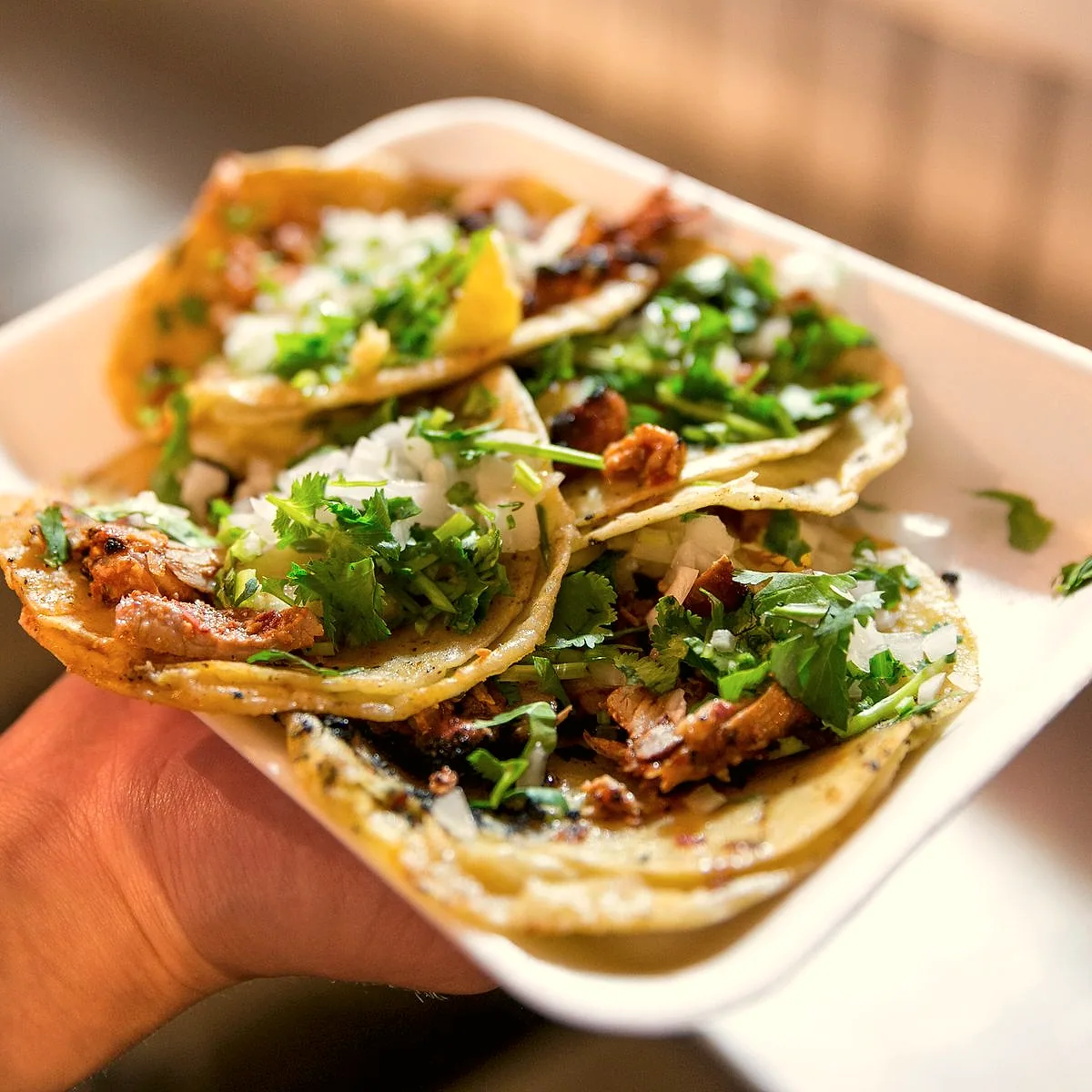
_Al_Pastor_Tacos.jpg)
CC BY 2.0. Cropped and colour-adjusted for this site.
Method
Cover the 15 g ancho chillies with just-boiled water and leave to soften for 20m, then drain.
Blend the softened chillies with the 15 g achiote, 3 garlic cloves (15 g), 30 ml red wine vinegar, 60 g pineapple, 3 g ground cumin, 2 g oregano, 2 g ground black pepper and 8 g fine sea salt to a smooth, brick-red paste.
Common pitfallBlending the rehydrated ancho with its soaking liquid still attached, unstrained, dilutes the paste and leaves the pork undercoloured. Drain the chillies before they go into the blender.
Coat the 500 g pork shoulder thoroughly in the paste. Cover and marinate, refrigerated, for 4h.
Thread the marinated pork tightly onto a vertical skewer, pressing each slice down onto the last, building an even, dense cone.
Setting pineapple above the stacked pork lets its juice drip down through the layers as they roast, which is where the sweetness in the meat comes from rather than from the marinade alone.
Roast the stacked pork close to a vertical heat source, turning it steadily, for 1h 5m, until the outer surface is deeply browned and the centre is cooked through with no pink remaining.
Sear the 160 g pineapple in a hot dry pan for 6m, until caramelised at the edges.
Shave the roasted pork downward off the spit in thin ribbons for 5m.
Warm the 200 g corn tortillas briefly over direct heat until soft and lightly charred, and double each one up.
Pile the shaved pork onto the doubled tortillas, top with the seared pineapple, 40 g white onion and 8 g fresh coriander, and serve with the 1 lime (67 g).
Al pastor's trompo (the vertical spit its pork is stacked on) is a shawarma spit that travelled twice. Beginning in the late 19th century, tens of thousands of people left Ottoman Lebanon and Syria for Mexico, escaping conscription and searching for work, and by the 1930s their restaurants were serving shawarma there, in pita, as lamb [2]. An intermediate dish, tacos árabes, kept that pita bread but had already appeared in Puebla by the 1930s [1].
The dish now called al pastor is a later, Mexican-born reworking of it. The food historian Jeffrey Pilcher describes the 1960s shift plainly: cooks "take the technology that they grew up with in these Lebanese restaurants, the vertical rotisserie — but instead of using lamb, they use pork" [2]. Pork was marinated in a paste of dried chillies and achiote rather than the original spice mix, and corn tortillas replaced pita [1]. The name itself is a fossil of the dish it replaced: al pastor means "in the style of the shepherd", a label that stuck even after the shepherd's lamb was gone [2].
Exactly when the pineapple arrived (now the dish's most recognisable feature) is not firmly dated in either account, and Puebla and Mexico City both claim the version now eaten worldwide. What both sources agree on is the sequence: an Ottoman technique, carried south by Levantine migration, adapted first into shawarma-in-pita and only later, a generation on, into the pork-and-pineapple taco known today [1].
Sources
- Al pastor, WikipediaCovers the Lebanese migration, the shift from lamb to pork, the Puebla origin, and the earlier tacos árabes variant.
- Thank the Ottoman Empire for the taco al pastor, PRX — The WorldQuotes food historian Jeffrey Pilcher on the 1960s adaptation of the Lebanese vertical rotisserie into al pastor.