American · Main Course
Spaghetti and Meatballs
Beef meatballs, softened with a milk-soaked breadcrumb panade, simmered in tomato sauce and served over spaghetti.
Not the same asPolpette al sugo (Italian meatball dishes exist, but meatballs are served as their own course, never piled on top of a plate of pasta the way this dish serves them.)
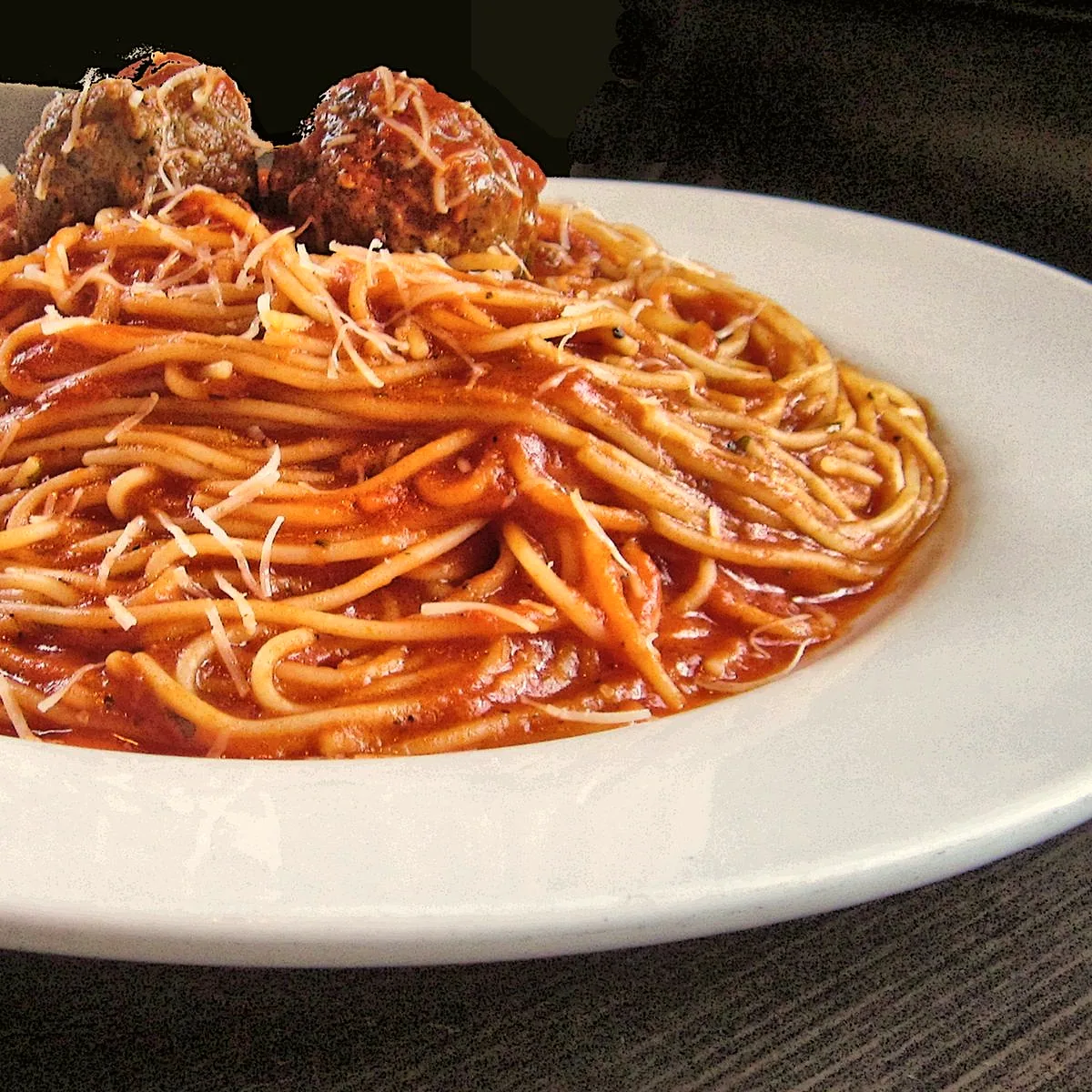

CC BY 2.0. Cropped and colour-adjusted for this site.
Method
Stir the 60 g dried breadcrumbs into the 60 ml milk and set aside to soften for 5m.
Soaking the breadcrumbs in milk before they go into the mince, rather than adding them dry, is what keeps the meatballs tender rather than dense once they are cooked through.
Combine the 500 g beef mince, the soaked breadcrumbs, the 1 egg (50 g), the 40 g Parmigiano-Reggiano, the 2 garlic cloves (10 g), the 8 g flat-leaf parsley and the 2 g ground black pepper, mixing only until combined. Shape into evenly sized balls.
Common pitfallOverworking the mince as it is mixed compacts the proteins and produces a tough, springy meatball. It is combined only until the ingredients are evenly distributed.
Heat the 20 ml extra-virgin olive oil in a wide pot over a medium-high heat and brown the meatballs on all sides for 10m. They do not need to be cooked through yet. Remove and set aside.
Add the 10 ml extra-virgin olive oil to the same pot and cook the 100 g yellow onion and the 2 garlic cloves (10 g) for 8m, until softened. Add the 800 g tinned tomatoes and the 2 g oregano.
Return the meatballs to the sauce and simmer gently, partly covered, for 25m, until the meatballs are cooked through and the sauce has thickened.
Bring the 4 L water to a rolling boil in the widest pan you have, then add the 40 g fine sea salt and let it dissolve.
Add the 360 g dried spaghetti and cook for 9m, or two minutes short of whatever the packet claims. Before draining, lift out a mugful of the cooking water: the starch it carries is what will let the sauce bind. Drain the pasta while the centre still resists a bite.
Divide the drained spaghetti among bowls, top with the meatballs and sauce, and finish with the 6 g fresh basil.
Spaghetti and meatballs was built in the United States by Italian immigrants, most of whom arrived between 1880 and 1920, rather than carried over from Italy as a finished dish [1]. Meat had been a rare, occasional food for many of these families before they left; American meat markets sold it far more cheaply and in far greater quantity, and that new abundance is what put meatballs on the table regularly enough to become a habit [1].
The combination itself would look unusual in most of Italy. Italian meals are conventionally structured around a primo, a plate of pasta treated as a starter rather than a main course, with meat or fish served separately as a secondo; the dish as served here, a large bowl of spaghetti carrying a generous helping of meatballs as the meal's centre, is not a plate that Italy itself produced [2]. It reflects an American portion size and an American idea of what a main course looks like more than it reflects Italian practice [1].
None of which makes it any less a real dish with its own history. It belongs fully to Italian-American cooking, built by people working with Italian techniques and American ingredients and quantities, and it is treated as its own dish here rather than as a corruption of something it was never trying to be.
Sources
- Spaghetti and Meatballs: History of the Italian-American Dish, Gambero Rosso InternationalOn the dish's development among Italian immigrants and its absence from Italian regional cooking.
- Is Spaghetti and Meatballs Italian?, Smithsonian MagazineOn pasta's role as a starter rather than a main course in Italian dining, and on the dish being unknown in Italy itself.