Indonesian · Main Course
Sate Ayam
Cubed chicken thigh marinated in turmeric, garlic and palm sugar, threaded onto skewers and grilled over charcoal, served with peanut sauce.
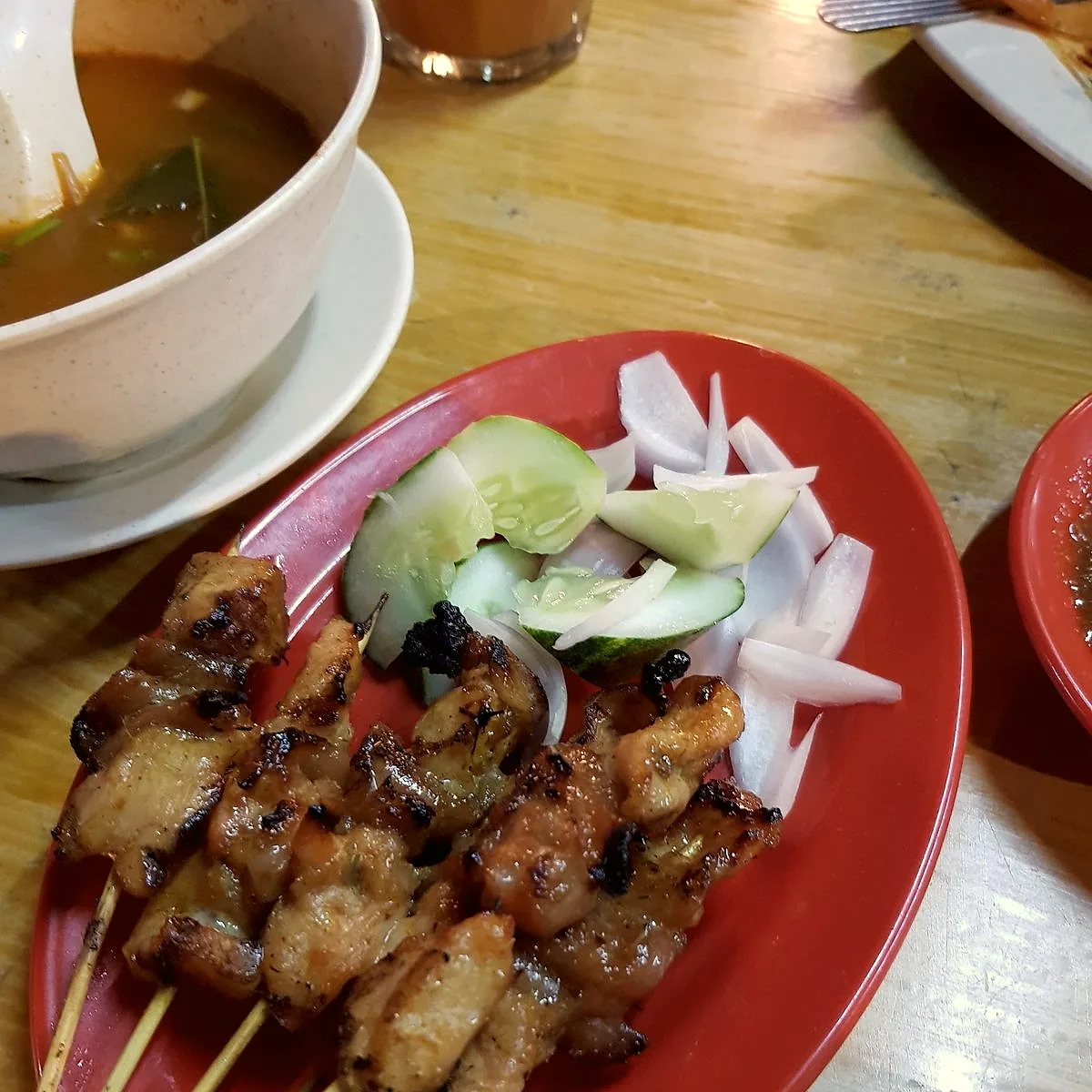

CC BY-SA 4.0. Cropped and colour-adjusted for this site.
The same dish, adapted. Every quantity, time and figure below changes with the version.
Method
Trim the 400 g chicken thigh and cut it into even cubes.
Whisk the 20 ml light soy sauce, 15 g palm sugar, 2 garlic cloves (10 g), 3 g ground turmeric, 3 g ground cumin, 15 ml peanut oil and 4 g fine sea salt together, add the chicken and turn to coat every piece. Cover and marinate, refrigerated, for 2h.
Grind the 60 g roasted peanuts to a coarse, oily meal, short of a smooth butter.
Warm the 10 ml peanut oil in a small pan and fry the 1 ½ garlic cloves (8 g) until it just turns golden.
Add the ground peanuts, 80 ml coconut milk, 50 ml water, 15 g palm sugar, 10 ml light soy sauce and 2 g chilli flakes. Simmer, stirring often so the peanuts do not catch on the bottom of the pan, for 8m, until thick enough to coat the back of a spoon. Take it off the heat and stir in the 15 ml fresh lime juice and 2 g fine sea salt.
Lift the chicken from the marinade, shaking off the excess, and thread it onto skewers.
Grill the skewers over direct charcoal heat, turning often, for 8m, until charred in places and cooked through with no pink remaining.
Common pitfallThe palm sugar in the marinade burns quickly over high heat. Keep the skewers moving rather than leaving them still over the hottest part of the coals.
Serve the skewers with the peanut sauce, 80 g cucumber and 30 g white onion.
Method
Trim the 400 g goat of any sinew and cut it into even cubes.
Whisk the 20 ml light soy sauce, 15 g palm sugar, 2 ½ garlic cloves (12 g), 3 g ground turmeric, 3 g ground cumin, 15 ml peanut oil and 4 g fine sea salt together, add the goat and turn to coat every piece. Cover and marinate, refrigerated, for 3h.
Grind the 60 g roasted peanuts to a coarse, oily meal, short of a smooth butter.
Warm the 10 ml peanut oil in a small pan and fry the 1 ½ garlic cloves (8 g) until it just turns golden.
Add the ground peanuts, 80 ml coconut milk, 50 ml water, 15 g palm sugar, 10 ml light soy sauce and 2 g chilli flakes. Simmer, stirring often so the peanuts do not catch on the bottom of the pan, for 8m, until thick enough to coat the back of a spoon. Take it off the heat and stir in the 15 ml fresh lime juice and 2 g fine sea salt.
Lift the goat from the marinade, shaking off the excess, and thread it onto skewers.
Grill the skewers over direct charcoal heat, turning often, for 10m, until charred in places and cooked through with no pink remaining.
Common pitfallGoat has less fat than chicken thigh and dries out fast over hard heat. Cut the cubes a little larger than for chicken and pull them the moment they firm up.
Serve the skewers with the peanut sauce, 80 g cucumber and 30 g white onion.
Satay is a Javanese street food, but the grilled, skewered meat it is built from is not a Javanese invention. Turkish and Arab kebab traditions travelled east along Indian Ocean trade routes, and Tamil and Gujarati Muslim traders working those same routes brought their own seasoned, grilled meats to the port cities of Java and Sumatra [1]. The word itself carries that history: satay descends from the Malay satai or saté, which in turn traces to the Tamil catai [2].
Local cooks reworked what arrived rather than copying it. Small bamboo skewers and coconut-shell charcoal replaced the larger metal skewers of a Middle Eastern kebab, cut to a size suited to a street vendor's stall rather than a spit, and the dish was seasoned with the spices already in the Javanese kitchen [1]. The dish gained ground through the 18th century alongside growing Indian and Arab immigration, and by the 19th century colonial observers were recording it as established festival and street food across the archipelago: Dutch documentation from around 1870 already shows satay vendors in Java, ketupat rice cakes hanging behind their stalls [2].
What most separates satay from the kebabs it descends from is the sauce, not the meat: a thick, ground-peanut sauce that has no real equivalent in the Arab or Tamil dishes that inspired the skewer itself. By the late 19th century the dish had crossed the Strait of Malacca into Malaysia, Singapore and Thailand, each taking the same skewered technique and giving it a different accompaniment: ketupat in Malaysia, cucumber salad and sticky rice in Thailand [2].
Sources
- Satay, WikipediaCovers the Middle Eastern and South Asian trade-route influences, the 18th–19th-century timeline, and colonial-era documentation of satay as street food.
- From Java's Street Vendors to Southeast Asian Icon: The Story of Sate or Satay, Seasia.coTraces the word's etymology through Malay to Tamil, cites Dutch documentation of Javanese vendors from around 1870, and describes the spread across the Strait of Malacca.