Central American · Main Course
Pepián
Bone-in chicken and potato in a thick, toasted sauce of guajillo chilli, squash seeds, sesame and tortilla. It is Guatemala's national dish.
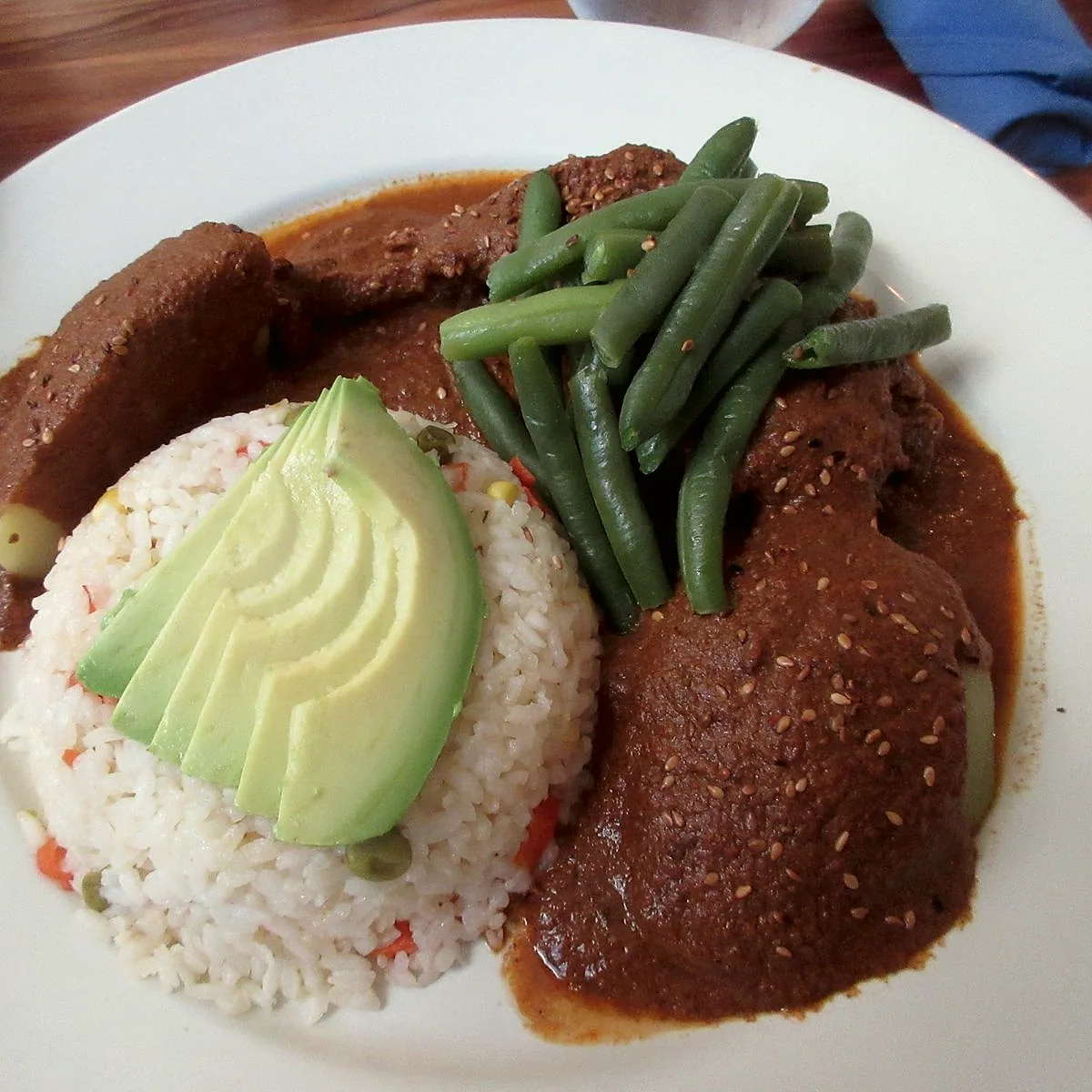

CC BY-SA 4.0. Cropped and colour-adjusted for this site.
Method
Put the 800 g chicken thigh in a pot with the 1.2 L water, half the 80 g white onion, half the 2 garlic cloves (10 g) and the 6 g fine sea salt. Bring to a simmer and cook for 40m, until the chicken is cooked through. Lift out the chicken, reserving the broth.
Meanwhile, toast the 3 dried guajillo chillies (15 g), 40 g hulled squash seeds, 15 g sesame seeds and 30 g corn tortillas separately in a dry pan for 8m, until fragrant, taking care not to scorch them.
Dry-toasting the chilli, squash seeds, sesame seeds and tortilla before blending develops a deep, nutty flavour that boiling the same ingredients would leave flat and raw-tasting.
Blend the toasted ingredients with the 200 g ripe tomatoes, the remaining 80 g white onion and 2 garlic cloves (10 g), the ½ cinnamon sticks (1 g), 1 g ground allspice, 1 g ground black pepper and enough of the reserved broth to make a smooth, thick sauce. This takes about 8m.
Heat the 20 ml vegetable oil in a pot over a medium heat and fry the blended sauce for 10m, stirring often, until it darkens slightly and smells toasted rather than raw.
Common pitfallSkipping the step of frying the blended sauce in oil before it joins the broth leaves it tasting of raw seeds and chilli rather than the toasted, rounded flavour a proper pepián has.
Stir in the remaining reserved broth, the poached chicken and the 200 g potato. Simmer for 25m, until the potato is tender and the sauce has thickened.
Pepián's base (a sauce of toasted chillies and seeds, thickened without any dairy or flour) is old enough that its origin sits with the Maya rather than with Spanish colonial cooking. Both the dish and the toasting technique behind it are traced to the Kaqchikel Maya of Guatemala's western highlands, where a version of the sauce is believed to have served a ceremonial role in pre-Columbian religious and community life [1] [2].
What Spanish colonisation added was mostly around the edges of an already established dish: garlic, onion and meat joined a base that had originally relied on indigenous chillies, tomatoes and toasted seeds [1]. The core technique (toasting the seeds and chillies before grinding and simmering them into a sauce) survived that layering more or less intact, which is part of why pepián is described as one of the oldest dishes still cooked in Guatemala in something like its original form [2].
The dish's status is now a matter of official record rather than reputation alone. In 2007, the Guatemalan government designated pepián the country's national dish and recognised it as part of the nation's intangible cultural heritage [1] [2]. That declaration formalised what was already true in practice: a dish that had been carried, largely unbroken, from a pre-Columbian kitchen to a modern one.
Sources
- UPAVIM Travel Series: Pepián, a Culinary Cultural Heritage, UPAVIM CraftsTraces pepián to the Maya-Kaqchikel people, describes its pre-Columbian ceremonial use and its later enrichment with Spanish-introduced garlic, onion and meat, and states that the Guatemalan government recognised it as a national dish and cultural heritage item in 2007.
- Guatemala's National Dish: Pepian, Latin PostIndependently corroborates the dish's origin with the Maya-Kaqchikel people, its status among Guatemala's oldest continuously prepared dishes, and its 2007 designation as the national dish.