Moroccan · Main Course
Pastilla bil Djaj
Shredded chicken in a saffron-and-cinnamon sauce, layered with fried almonds inside warqa pastry and baked, then dusted sweet with cinnamon and icing sugar over a savoury filling.
Also known asBastilla · MoroccoB'stilla · Morocco
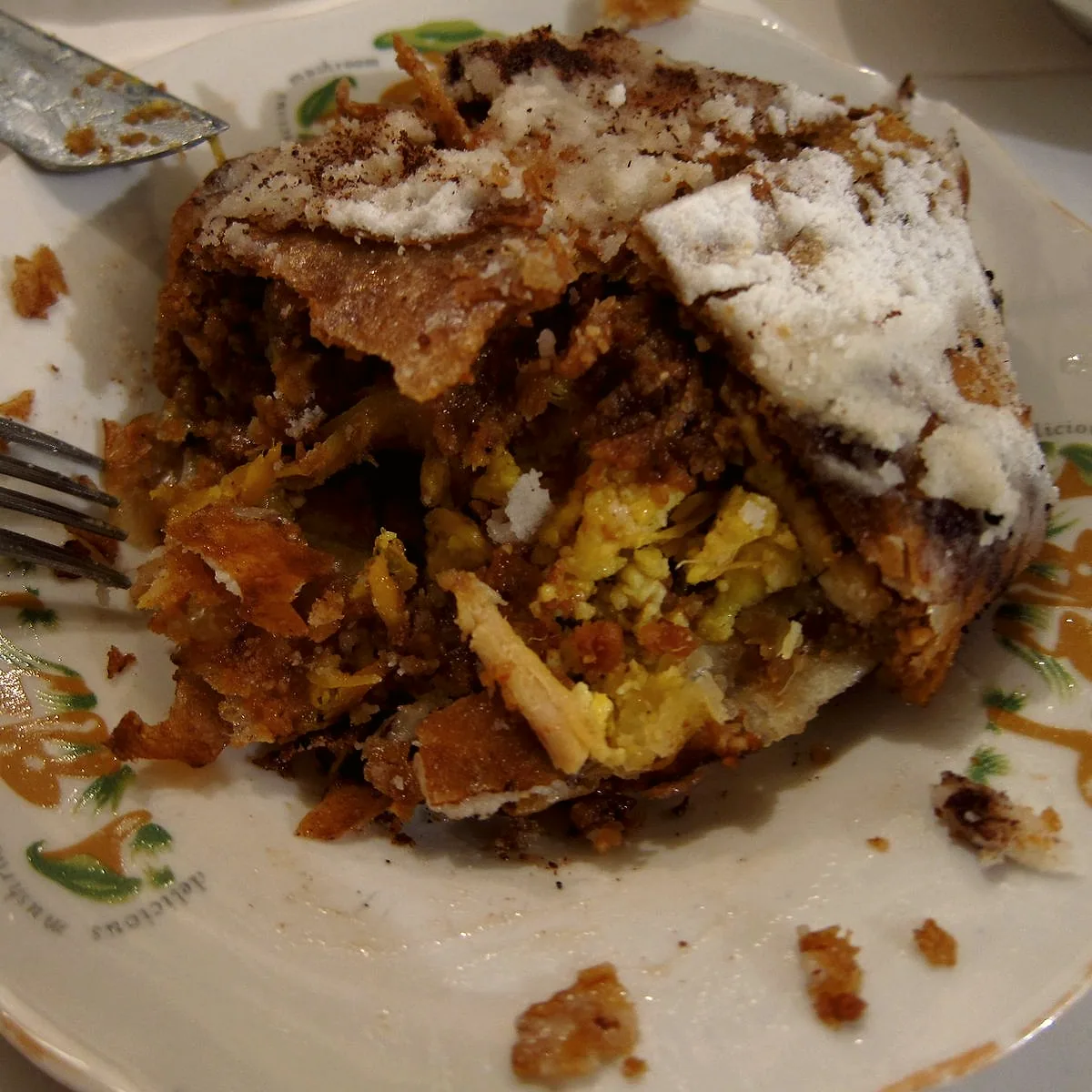

CC BY 2.0. Cropped and colour-adjusted for this site.
Method
Melt the 40 g unsalted butter in a wide pan and cook the 250 g yellow onion over a low heat until soft. Add the 700 g chicken thigh, 15 g fresh ginger, 4 g ground cinnamon, 0.2 g saffron, 6 g fine sea salt and 2 g ground black pepper, cover and cook gently for 35m, until the chicken is tender and surrounded by a reduced, well-flavoured sauce. Lift out the chicken, shred it, and set the sauce aside in the pan.
Meanwhile, fry the 200 g blanched almonds in the 20 g unsalted butter over a medium heat for 8m, until golden throughout, then crush roughly and toss with the 30 g icing sugar and 3 g ground cinnamon.
Off the heat, stir the 3 eggs (150 g) into the reserved sauce, then return the pan to a very low heat for 10m, stirring constantly, until the egg sets into a soft curd rather than a liquid. Fold this through the shredded chicken with the 10 g flat-leaf parsley and 10 g fresh coriander.
Stirring the beaten egg into the reduced cooking liquid off the heat, rather than into a simmering pan, sets it into a soft curd that binds the shredded chicken instead of scrambling into loose threads.
Brush a round baking tin with a little of the 60 g unsalted butter and line it with overlapping sheets of 320 g warqa, brushing each sheet with butter as it goes down and leaving enough overhang to fold back over the top. Spread the chicken filling evenly across the base, then the almond mixture on top of it. Fold the overhanging pastry back over the filling to enclose it completely, brushing the final layer with the last of the butter.
Common pitfallWarqa dries and cracks within minutes of being unwrapped. Keep the stack covered and work through it one sheet at a time, brushing each with butter the moment it is laid down rather than after the whole pie is built.
Bake for 30m, until the pastry is deeply golden and crisp all over.
While still warm, dust the top with the 20 g icing sugar and mark it with the 3 g ground cinnamon in a crosshatch pattern before serving.
Pastilla's name is the more settled part of its history. It comes from the Spanish pastilla, meaning pastry, itself from the Latin pastillum; carried into Moroccan Arabic, the initial p became a b, giving bastilla [1]. The dish it names is generally traced to al-Andalus, on the strength of a specific comparison rather than a continuous record: the food historian Rudolf Grewe identified judhaba, a chicken pie sealed under many thin sheets of dough in an anonymous thirteenth-century Hispano-Muslim cookbook, as a clear forerunner of the modern dish [2]. Scholar Anny Gaul has pointed to the same period, describing recipes combining pigeon with cinnamon, almonds, saffron and egg that closely resemble bastilla's filling today [1].
The pastry itself has a separate and more contested history. Warqa, the sheet the pie is built from, is sometimes assumed to have travelled to Morocco with Muslims and Jews expelled from Spain at the end of the fifteenth century, but other food historians propose a later and quite different route, arguing that paper-thin warqa dough only reached Morocco after 1830, brought by Algerian migrants during the period of Ottoman rule in Algeria, spreading out from Tétouan from there [1]. The two theories are not easily reconciled, and no source consulted here settles between them.
What is not disputed is the dish's association with Fez, where pastilla became a refined dish served at royal banquets and where a dessert variant, jowhara, later developed from it [1]. The sweet dusting of cinnamon and icing sugar over a filling of chicken, egg and saffron-spiced almonds (savoury food finished as though it were dessert) is the detail every account of the dish's Fassi refinement returns to, whichever account of its arrival in Morocco is believed.
Sources
- Pastilla, WikipediaOn the competing accounts of pastilla's origin: Anny Gaul's thirteenth-century Andalusi cookbook comparison, the Ottoman-Algeria route proposed for warqa itself, and Fez's role in the dish's development.
- Bastilla: The Crown Jewel of Moroccan Cooking, Arab AmericaOn Rudolf Grewe's identification of judhaba, a thirteenth-century Hispano-Muslim chicken pie, as a likely forerunner of bastilla, and on the Spanish etymology of the name itself.