Chilean · Main Course
Pastel de Choclo
A beef, olive and raisin filling under a thick, basil-scented sweetcorn topping, baked until the top caramelises to a pale gold.
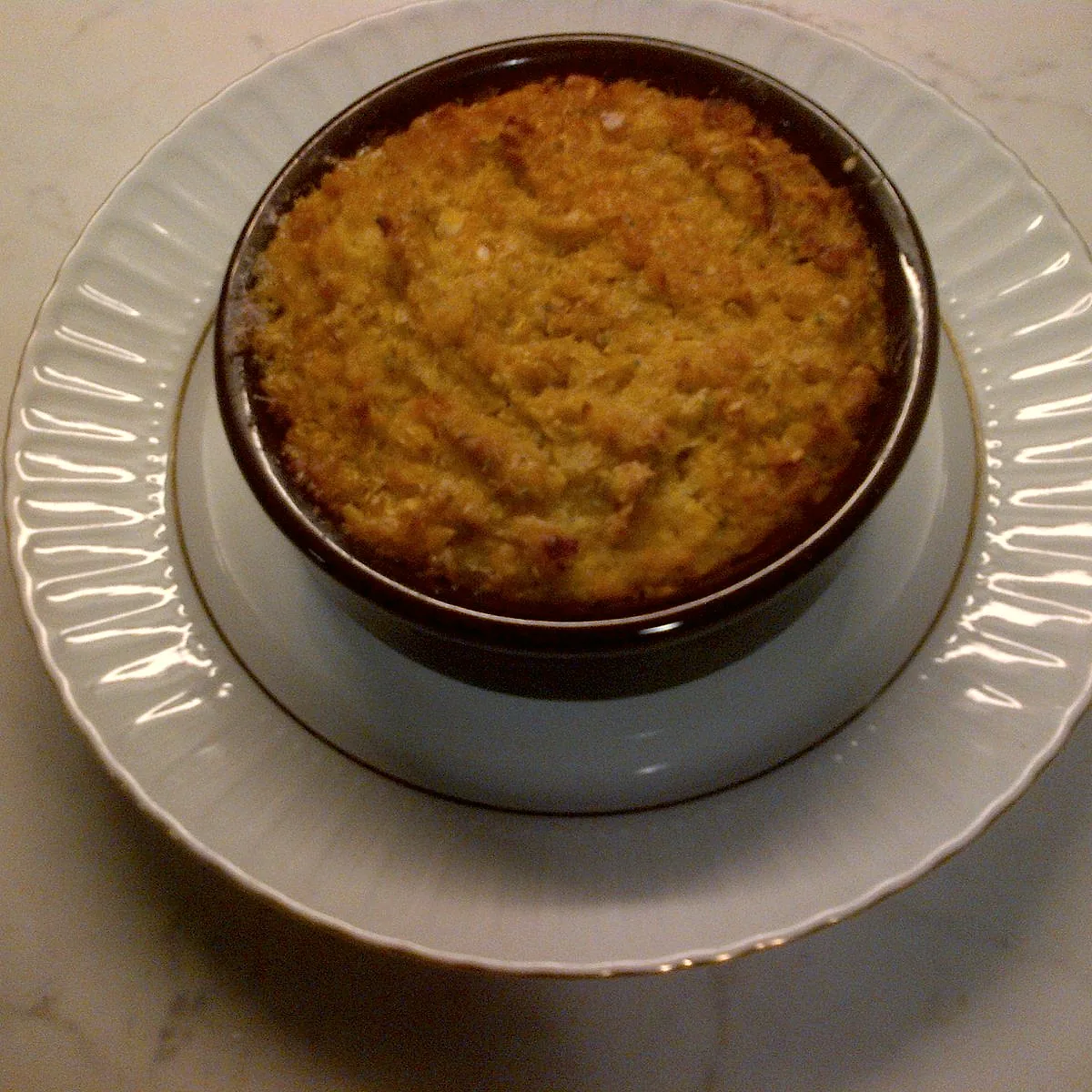

CC BY-SA 4.0. Cropped and colour-adjusted for this site.
Method
Heat the 30 g vegetable oil in a wide pan and fry the 300 g yellow onion and 2 garlic cloves (10 g) until soft. Add the 400 g beef mince, 4 g ground cumin, 3 g sweet paprika and half of the 6 g fine sea salt, and cook, breaking up the meat, for 15m, until the beef is cooked through. Stir in the 30 g raisins and set aside.
Blend the 800 g corn with the 150 ml milk and 10 g fresh basil until fairly smooth. Transfer to a pan with the 40 g unsalted butter, the 10 g caster sugar and the remaining 6 g fine sea salt, and cook over a low heat, stirring constantly, for 20m, until noticeably thickened.
The corn is blended with milk and basil, then cooked down on the stove before it ever reaches the oven, which is what thickens it into a spreadable topping rather than a wet, watery one that would sink into the filling.
Spread the beef filling over the base of a baking dish. Scatter over the 12 olives (60 g) and arrange the 3 eggs (150 g) on top. Cover evenly with the corn topping. This takes 10m.
Dust the top with the 5 g caster sugar and bake at 200 °C for 30m, until the top is set and lightly golden in patches.
Common pitfallThe sugar dusted over the top is there to caramelise into a faint golden crust, not to sweeten the dish overall. Watch it in the final minutes, since it can turn from gold to burnt quickly under a hot grill.
The standard story is a clean piece of mestizo cooking: a corn dough, made the way the indigenous tamale-like humita is made, laid over the kind of minced-meat filling used in a Spanish empanada. The anthropologist Sonia Montecino has proposed that the combination was worked out during the colonial period by Mapuche cooks put to work in the kitchens of Spanish colonists, fusing the two traditions they were made to straddle [2].
The documentary record complicates that story rather than confirming it. A dish answering to the same description appears in the Peruvian writer Ricardo Palma's nineteenth-century tradición "Agustinos y franciscanos," which sets a version of it at a colonial-era banquet in Peru, and a Peruvian recipe for the dish is separately on record from the early twentieth century [3]. The earliest known written description specifically in Chile does not appear until 1862, in the naturalist Claudio Gay's Historia física y política de Chile, which describes a filling of minced lamb, sometimes mixed with chicken, under corn seasoned with sugar, fat and chilli [1][5].
Even the dish's name sits awkwardly with the Mapuche-origin story. Choclo, the word for corn cob used across Chile and much of the Andes, comes from Quechua choccllo [4]. Quechua is the language of the Inca rather than of the Mapuche. Taken together, the evidence points less to a single Mapuche kitchen than to a dish with roots spread across the wider Andean world, reaching its familiar Chilean form only later.
None of which changes what it has become: a dish now claimed unambiguously as Chilean, eaten in high summer when corn is at its sweetest, and cooked in kitchens across the country as a byword for home cooking.
Sources
- Pastel de choclo, WikipediaGives the earliest known written description, from Claudio Gay's 1862 "Historia física y política de Chile," and notes the dish's spread across eight South American countries.
- No solo la marraqueta: Símbolos y tradiciones chilenas que otros países intentan disputar, Emol (El Mercurio)Chilean national-press report setting out anthropologist Sonia Montecino's account of the dish as a colonial-era creation of Mapuche cooks working in Spanish kitchens.
- Pastel de choclo: el manjar que se come en Sudamérica, pero que encontró su sello en Perú, InfobaeNotes that the Peruvian writer Ricardo Palma's nineteenth-century tradición "Agustinos y franciscanos" places pastel de choclo at a colonial-era banquet in Peru, and that a Peruvian recipe for the dish is on record from the early twentieth century.
- choclo, Real Academia Española, Diccionario de la lengua españolaConfirms the word "choclo" derives from Quechua "choccllo."
- Historia física y política de Chile: Agricultura, tomo I, Biblioteca Nacional Digital de Chile (Claudio Gay, 1862), 1862The primary text itself, digitised by Chile's national library, containing Gay's description of pasteles "compuestos de picadillo o pino de cordero, mezclado a veces con carne de pollo y cubierto con una capa de maíz."