Turkish · Main Course
Mantı
Tiny lamb dumplings folded small enough to fit dozens on a spoon, boiled and served under garlic yoghurt and paprika butter.
Not the same asCentral Asian manti (The large, hand-sized steamed dumpling found across Central Asia. Kayseri mantı is boiled rather than steamed, folded closed rather than left open, and a fraction of the size.)
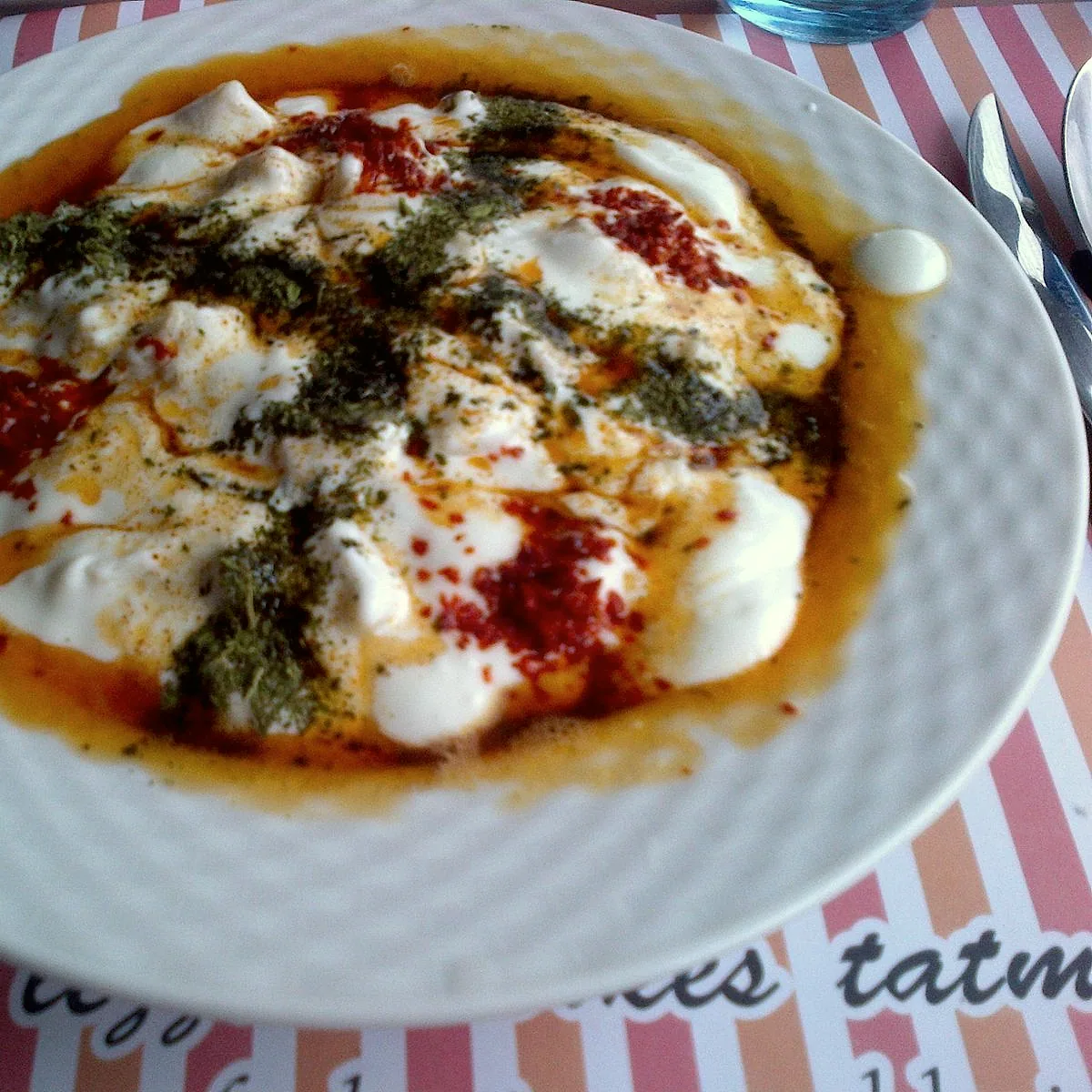

CC BY-SA 4.0. Cropped and colour-adjusted for this site.
Method
Combine the 280 g plain flour, 1 egg (50 g), 60 ml water and 3 g fine sea salt in a bowl and bring together into a firm dough, then turn it out and knead for 10m until smooth.
Cover the dough and rest it for 30m at room temperature, until it has relaxed and no longer springs back when pressed.
Meanwhile, combine the 250 g lamb mince, 80 g white onion, 2 g ground black pepper, 10 g flat-leaf parsley and 3 g fine sea salt in a bowl and mix until evenly combined.
Whisk the 300 g yoghurt, 1 ½ garlic cloves (8 g) and 1 g fine sea salt together and set aside at room temperature.
Roll the rested dough out on a surface dusted with the 20 g plain flour until paper-thin, and cut it into small squares no larger than a fingernail, about 2 cm across. Place a speck of filling in the centre of each square and pinch all four corners up to seal, forming a small closed pouch. Set the shaped mantı close together on a floured tray as you go.
Kayseri mantı is judged on scale as much as flavour: folding it this small is slower, but it is what lets a single spoonful hold dozens of dumplings under the sauce rather than two or three.
Drop the mantı into a large pot of gently boiling water and cook for 10m, until they float and the dough is cooked through.
Common pitfallA hard, rolling boil knocks the tiny dumplings against each other and against the pot, splitting the thin corners open. It wants a gentle, steady simmer instead.
Meanwhile, melt the 60 g unsalted butter in a small pan and stir in the 3 g sweet paprika. Cook for 4m, until it foams and smells toasted, then take off the heat.
Spread the yoghurt sauce over warmed plates. Lift the mantı straight from the pot on top, drizzle the paprika butter over, and scatter with the 1 g dried mint.
The dominant account of mantı's history puts its origin well outside Turkey. Most food historians agree that the dish travelled across Central Asia along the Silk Road, carried west by Turkic and Mongol peoples before it ever reached Anatolia [1]. Under that account, the small boiled or steamed dumpling belongs to a much wider family that also produced Chinese jiaozi and mantou, rather than being a dish Anatolia invented on its own. Not every historian accepts the direction of travel, though: a minority view holds the sequence may run the other way, with a Middle Eastern dumpling spreading eastward toward China and Korea instead [1]. Neither claim rests on the kind of single decisive document that would settle the question, and both remain live positions rather than a resolved debate.
Whichever way the dish first moved, its documented presence in Ottoman kitchens is much firmer. A fifteenth-century cookbook by Muhammed bin Mahmud Şirvani records a version of it: a steamed dumpling filled with minced lamb and crushed chickpeas, seasoned with cinnamon and finished with vinegar [1], recognisably the same idea as today's dish, though built differently in almost every particular of filling and sauce.
What is not in dispute is that Kayseri, in central Anatolia, has become the form's most famous address. Kayseri mantısı is distinguished chiefly by scale: folded small enough that dozens fit a single spoon, then served under yoghurt and butter melted with mint or Aleppo pepper, with more of the same dried herb and pepper scattered over the top [1]. The size is treated locally as a matter of skill as much as taste (a smaller mantı is read as a more accomplished one), and it is this exacting, miniature style that most people outside Turkey now mean when they say the name. The standard is stated as a proverb rather than a measurement: the best mantı is the kind small enough that forty of them fit on one spoon [2]. Kayseri mantısı now carries an official geographical indication, and the transmission account it rests on (dough parcels of meat carried west along the trade routes and remade with local ingredients) is the same one the Turkish tourism authority sets out [2].
Sources
- Manti (food), WikipediaSets out the Silk Road transmission theory, the fifteenth-century Şirvani recipe, the competing Middle Eastern origin theory, and Kayseri's particular style.
- Mantı: Traditions, Rituals, and Regional Variations, Go TürkiyeTürkiye's official tourism publication, corroborating the Central Asian transmission account and recording Kayseri mantısı's geographical indication and the forty-to-a-spoon standard.