Turkish · Main Course
Lahmacun
A thin round of yeasted dough spread edge to edge with minced lamb, tomato and pepper and baked until crisp; one disc is a single serving, rolled up with parsley, onion and lemon.
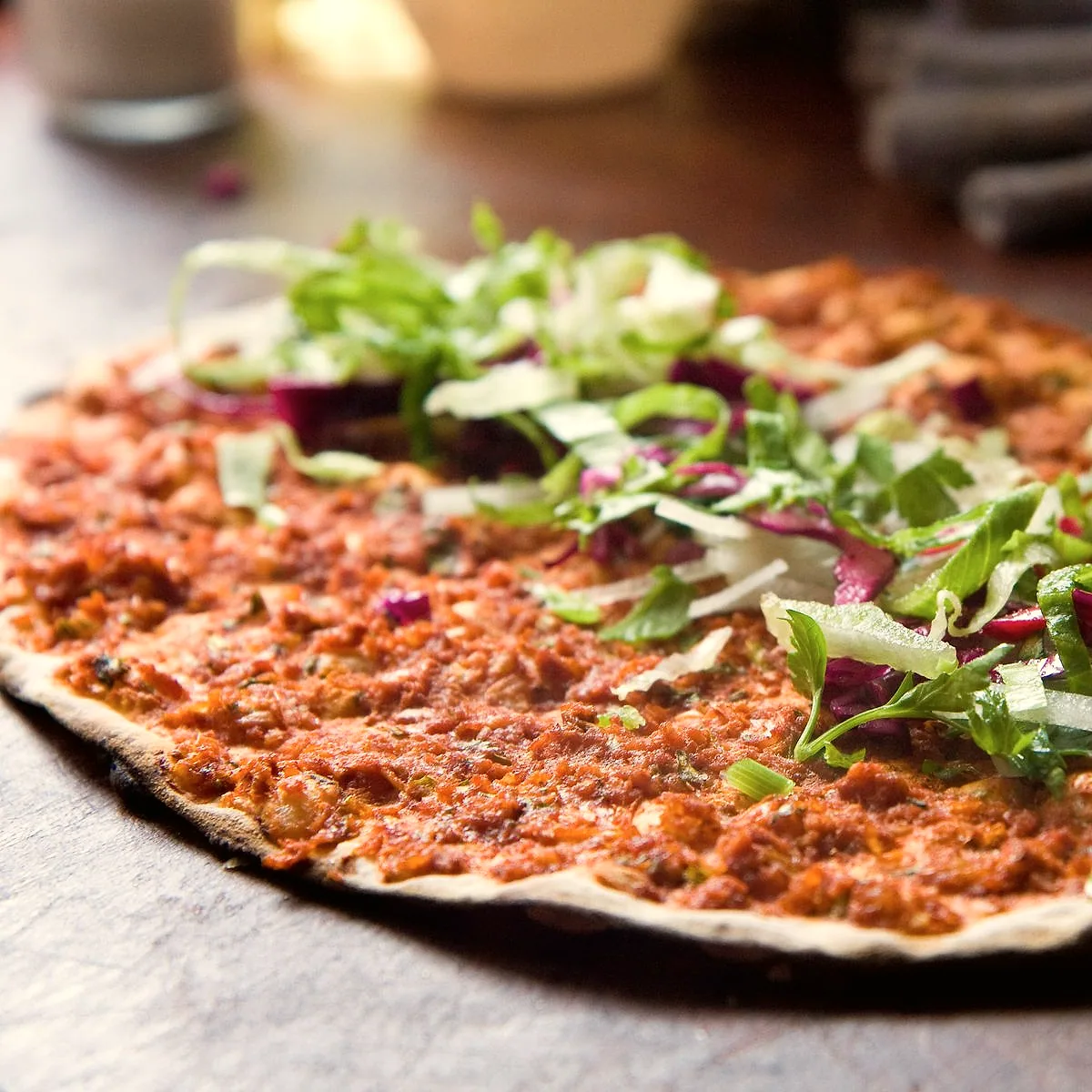

CC BY-SA 4.0. Cropped and colour-adjusted for this site.
Method
Dissolve the 3 g dried yeast in the 170 ml water, then work in the 300 g bread flour until no dry flour remains. Add the 6 g fine sea salt and 10 ml extra-virgin olive oil and knead until smooth.
Cover the dough and leave it to rest at room temperature for 45m.
Meanwhile bring the oven to its absolute maximum, with a stone or steel in place, and give it 30m to saturate.
Combine the 250 g lamb mince, 100 g ripe tomatoes, 60 g red pepper, 60 g white onion, 1 ½ garlic cloves (8 g), 10 g flat-leaf parsley, 3 g sweet paprika, 2 g Maraş pepper, 2 g ground cumin, 2 g ground black pepper, 5 g fine sea salt and 10 ml extra-virgin olive oil to a loose, spreadable paste.
Divide the rested dough into even pieces and roll each out paper-thin into a round.
Spread the topping over each round in a thin, even layer, right to the edge.
The topping goes on raw and paper-thin, right to the edge of the dough, because it is meant to cook in the same brief blast of heat that crisps the base rather than steaming the dough underneath it.
Bake on the stone for 8m, until the base is crisp and the topping has set and coloured at the edges.
Common pitfallA topping spread too thick never cooks through in the time the base needs to crisp, leaving a raw centre under a burnt edge.
Scatter the 10 g flat-leaf parsley over the hot lahmacun, roll each one up and serve with the 20 ml freshly squeezed lemon juice for squeezing over.
The earliest written trace of lahmacun is a 13th-century Aleppo cookbook, Kitab al-Wusla ila al-Habib, which instructs a cook to "cut up meat small, then spread it on a round piece of dough and bake it in the oven", recognisably the dish eaten today [1]. The Ottoman traveller Evliya Çelebi later recorded a dish called lahm-ı acîn among the foods of Damascus in his 17th-century Seyahatname, which the linguist Sevan Nişanyan identifies as the earliest known use of the word in Turkish [1]. The name itself is Arabic: laḥm bi ʿajīn, "meat with dough."
Who cooked it in Aleppo is where the record runs out and the dispute begins. Turkey's claim centres on Gaziantep and Şanlıurfa, cities in the country's southeast, and Gaziantep lahmacun was registered as a protected EU geographical indication in 2025 [1]. But Urfa and Gaziantep both held substantial Armenian communities until the end of the 19th century, and Urfa's Armenian quarter was destroyed, along with the people who lived there, in 1915, which makes any claim about who was cooking what there before that date very hard to settle either way [2]. What is documented is that lahmajoun reached present-day Armenia only in the 1960s, brought by Aleppo-Armenian repatriates, which argues for a shared Aleppo-region dish carried onward by both communities rather than an invention either can claim outright [2].
Within Turkey itself, the dish stayed regional for centuries: it was essentially unknown in Istanbul until the middle of the 20th century, remaining a specialty of Arab-influenced southern cities before spreading nationwide after the 1950s [1].
Sources
- Lahmacun, WikipediaCites the 13th-century Aleppo cookbook "Kitab al-Wusla ila al-Habib", Evliya Çelebi's 17th-century Seyahatname, and the dish's slow spread to Istanbul.
- Who created Lahmajoun?, The Armenian KitchenDiscusses the Armenian claim to the dish via Aleppo and Urfa, citing "Armenian Food: Fact, Fiction and Folk Lore" and the scholar Vartan Matiossian.