Levantine · Main Course
Falafel
A Levantine fritter of soaked, uncooked chickpeas ground with herbs and spices to a coarse paste and deep-fried until dark and crisp outside, green and fluffy within.
Not the same asTa'ameya (The Egyptian version made from dried broad beans rather than chickpeas, usually coated in sesame seeds before frying. It is a related but different fritter, not a regional name for this one.)
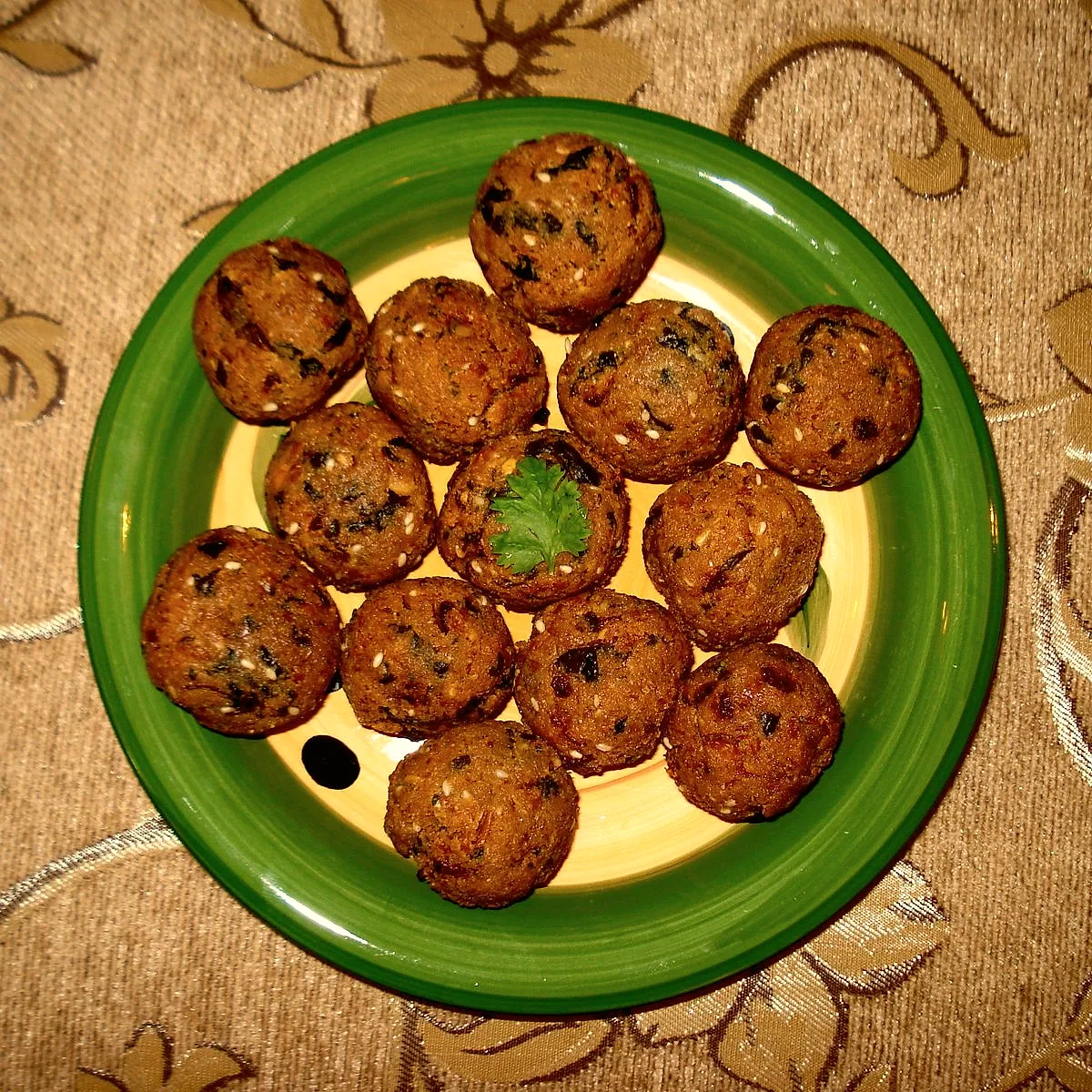

CC0. Cropped and colour-adjusted for this site.
The same dish, adapted. Every quantity, time and figure below changes with the version.
Method
Cover the 300 g dried chickpeas with the 900 ml water and leave to soak for 12h. The chickpeas should roughly double in size and still be raw and firm, not softened.
The chickpeas are never cooked before grinding. A raw, soaked chickpea grinds into a paste that holds together and fries firm; a cooked one turns to mush and falls apart in the oil.
Drain the chickpeas and pulse them in a food processor with the 60 g white onion, 2 ½ garlic cloves (12 g), 20 g flat-leaf parsley, 15 g fresh coriander, 4 g ground cumin, 2 g ground black pepper and 8 g fine sea salt for 10m, stopping while the mixture is still coarse and slightly grainy rather than smooth.
Common pitfallOver-processing to a smooth paste, closer to hummus, gives falafel that is dense and can disintegrate when fried. Pulsing to a coarse, slightly grainy texture is what lets it hold together while staying light.
Stir in the 3 g bicarbonate of soda and rest the mixture for 20m before shaping.
Heat the 1 L peanut oil in a deep pan to a steady, gentle bubble. Shape the mixture into small patties and lower them in without crowding the pan. Fry for 20m, turning once, until deeply browned and firm to the touch. Lift out and drain.
Method
Cover the 300 g dried broad beans with the 900 ml water and leave to soak for 12h. The beans should roughly double in size and still be raw and firm, not softened.
Rub the soaked beans between your hands in their soaking water to loosen the skins, then skim off and discard the skins as they float free. Drain the peeled beans, working for 20m.
Skinning the soaked beans gives a paste fine and pale green enough to hold together without turning grey or fibrous; the skins left in would make it coarse and dull the colour.
Pulse the peeled beans in a food processor with the 2 ½ spring onions (40 g), 2 garlic cloves (10 g), 25 g flat-leaf parsley, 15 g dill, 15 g fresh coriander, 2 g ground black pepper and 8 g fine sea salt for 15m, stopping while the mixture is still coarse and slightly grainy rather than smooth.
Common pitfallOver-processing to a smooth paste gives a patty that is dense and can fall apart when fried. Pulsing to a coarse, slightly grainy texture is what lets it hold together while staying light.
Stir in the 3 g bicarbonate of soda and rest the mixture for 15m before shaping.
Heat the 1 L peanut oil in a deep pan to a steady, gentle bubble. Shape the mixture into small flattened patties, pressing both sides into the 40 g sesame seeds to coat, and lower them in without crowding the pan. Fry for 20m, turning once, until deeply browned and firm to the touch. Lift out and drain.
The most repeated origin story for falafel holds that it was invented in Egypt by Coptic Christians as a meatless dish for Lent, sometimes said to be a thousand years old. It is a tidy story and a widely told one, but it rests on essentially no documentary evidence: no source ties the dish to Coptic fasting practice at any specific date, and the claim functions more as folklore than as a traceable history [1].
The textual record instead points somewhere much more recent: the word falafel does not appear in Egyptian writing until after the British occupation began in 1882, which has led some historians to a more prosaic theory: that British officers stationed in Alexandria, having developed a taste for fried vegetable croquettes while serving in India, had their Egyptian cooks adapt the idea with local ingredients [1]. Whether or not that specific account is right, the documentary silence before the late nineteenth century argues against any claim of great antiquity for the dish under this name.
What is not in dispute is that Egypt and the Levant make genuinely different things under related names. Egyptian ta'ameya is built on dried, skinned broad beans, herb-heavy and often coated in sesame seed before frying, while the Levantine version this page treats as the default is built on dried chickpeas alone [2]. The modern argument over falafel is mostly not about which of these came first, but about national ownership of the Levantine chickpea version specifically; it has been claimed at various points as Lebanese, Palestinian and Israeli, a dispute bound up with questions of national identity that this page has no basis to settle and does not attempt to.
Sources
- Debating the Levantine Origins of the Falafel, AGBIOn the Coptic Lent legend, the British-occupation theory for Egypt, and the modern national dispute over the dish.
- Falafel or Taameya? Celebrating the Popular Dish's Many Disguises, Egyptian StreetsOn the Egyptian broad-bean version, ta'ameya, and its relationship to the Levantine chickpea version.