Chilean · Main Course
Empanada de Pino
A large Chilean pastry of butter-rich dough filled with onion-heavy minced beef, a wedge of hard-boiled egg, a whole black olive and raisins.
Also known asEmpanada chilena · Chile
Not the same asEmpanadas Argentinas (Smaller, thinner-doughed and usually made without raisins; the Argentine styles favour a decorative crimped repulgue over the deep, folded seal typical of the Chilean pastry.)
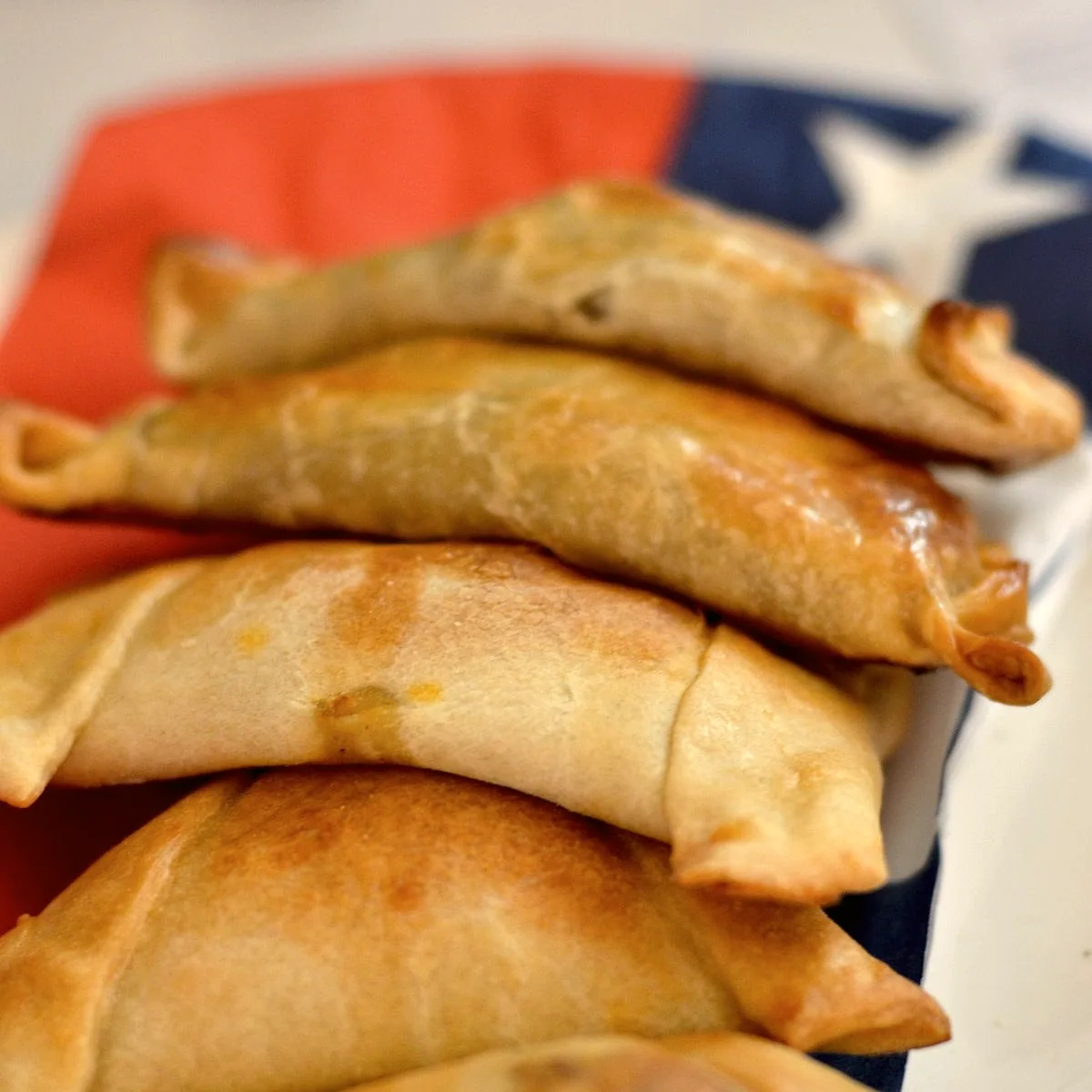

CC BY-SA 4.0. Cropped and colour-adjusted for this site.
Method
Combine the 500 g plain flour and 6 g fine sea salt in a bowl. Add the 90 g unsalted butter, 1 egg (50 g) and the 170 ml water, mixing until a smooth, pliable dough comes together.
Wrap the dough and rest it for 20m.
While the dough rests, melt the 30 g unsalted butter in a wide pan and cook the 500 g yellow onion over a low heat, stirring often, until fully soft and collapsing rather than crisp. Add the 450 g beef mince, 3 g ground cumin, 4 g smoked paprika and 2 g chilli flakes and cook until the meat is no longer pink. Stir the 15 g plain flour through, then add the 100 ml water and the 5 g fine sea salt and 2 g ground black pepper. Simmer for 30m, until thickened and glossy rather than wet.
Chilean pino is built on far more onion than meat, cooked down slowly until it collapses into the mince rather than staying distinct. That long, gentle cooking is what gives the filling its characteristic sweetness and body, not the beef alone.
Spread the filling on a tray and cool completely, for 30m.
Roll the dough and cut into large rounds. Spoon the cooled pino onto one half of each round, then top with the 60 g raisins, a wedge of the 4 eggs (200 g) and a whole 8 olives (40 g). Fold the dough over, press the edges firmly together and fold the sealed edge over on itself along its length. Brush with the ½ eggs (25 g).
Common pitfallThe egg wedge, olive and raisins go in last, on top of the cooled meat, so they keep their own texture rather than being stirred through and crushed. Mixing them into the pino loses the point of including them at all.
Bake at 200 °C for 30m, until deep golden.
The empanada is older than Chile's version of it by centuries. Its distant ancestor is usually traced to the Persian sambusak of the ninth and tenth centuries, a wheat pastry wrapped around seasoned meat and prized by merchants precisely because the crust kept the filling clean on a journey [2]. The idea travelled both east into South Asia and west into the Iberian peninsula, where it is on record by the thirteenth century: the Cantigas de Santa María, compiled under Alfonso X of Castile around 1282, includes in its fifty-seventh song an anecdote about a thief choking on a stolen chicken empanada [1][3].
Spanish colonists carried the pastry to Chile, where the earliest known local reference comes from Francisco Núñez de Pineda y Bascuñán's captivity narrative, describing a Mapuche cacique sharing empanadas among other foods during his six months as a prisoner in the seventeenth century [2]. The historian Eugenio Pereira Salas documented how the dish became fully embedded in Chilean life by the early nineteenth century: a 1807 food tariff set by the Cabildo of Concepción lists empanadas alongside bread and cooked hominy as staple, regulated foods [2].
The filling's name is where Iberian and Mapuche threads meet. Pino is usually traced to the Mapudungun word for a minced mixture of meat and onion, adopted into Chilean Spanish as the dish took its modern shape, though accounts of the exact word differ enough between sources that the precise etymology should be treated as reasonably well established rather than settled to the letter [2]. What is not in question is the result: an empanada built on far more onion than meat, sweetened by the long, slow cooking of that onion, and finished with raisins, a wedge of hard-boiled egg and a whole black olive, a combination distinct enough from any other country's empanada that it functions as a mark of Chilean identity on its own.
Sources
- Empanada, WikipediaDocuments the empanada's medieval Iberian record, including the Cantigas de Santa María (c. 1282) and the 1520 cookbook Llibre del Coch.
- Su majestad, la empanada: cómo una preparación para comerciantes persas terminó convertida en el plato insignia de la comida chilena, El DínamoChilean news feature citing the historian Eugenio Pereira Salas, the first Chilean documentary reference in Núñez de Pineda y Bascuñán's captivity account, and the 1807 Cabildo of Concepción food tariff.
- La empanada románica, La Región (Xavier Castro)Galician newspaper column corroborating the Cantigas de Santa María's cantiga 57 reference to an empanada, citing the historians J. M. Andrade and Serafín Moralejo.