Caribbean · Main Course
Cuban Sandwich
Ham, mojo-roasted pork, Swiss cheese, pickles and mustard pressed inside Cuban bread until the cheese melts and the crust turns crisp and flat.
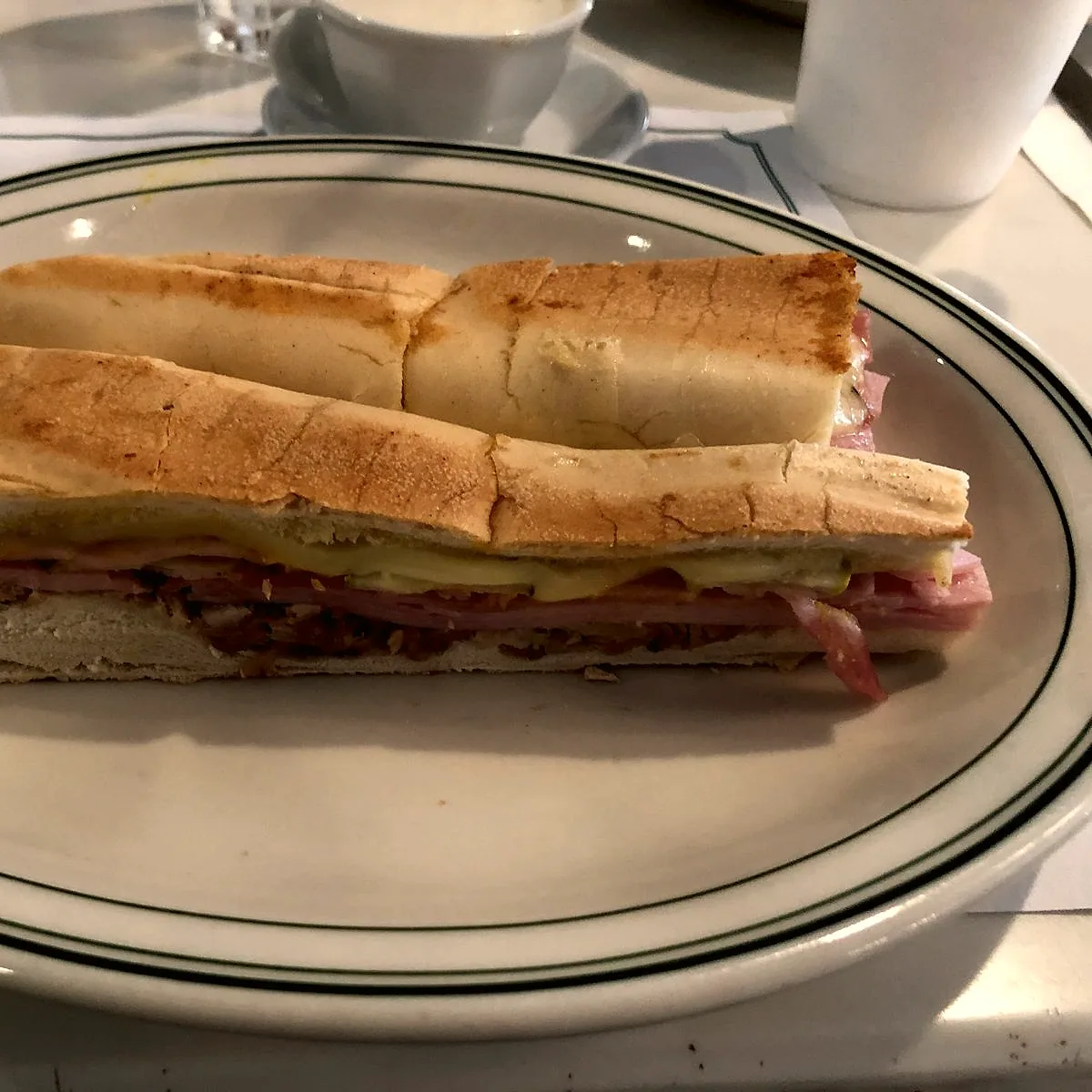

CC BY-SA 2.0. Cropped and colour-adjusted for this site.
Method
Combine the 60 ml sour orange, 2 garlic cloves (10 g), 2 g ground cumin, 1 g oregano, 10 ml extra-virgin olive oil, 4 g fine sea salt and 1 g ground black pepper, rub over the 400 g pork shoulder and refrigerate for 12h.
Roast the pork with its marinade at 160 °C for 3h, until completely tender and cooked through.
Rest the pork, then slice it thinly. This takes about 10m.
Split the 480 g Cuban bread lengthwise and spread the cut sides with the 30 g yellow mustard. Layer the 200 g sliced ham, sliced roast pork, 160 g Swiss cheese and 80 g dill pickles onto the bottom half and close each sandwich. This takes about 10m.
Common pitfallLayering the pickles directly against the bread rather than between the meats lets their liquid soak in before pressing, leaving the crust soggy instead of crisp.
Spread the outside of each sandwich with the 30 g unsalted butter and cook in a sandwich press or under a heavy pan over a medium heat for 8m, until the bread is flattened and deeply golden and the cheese has melted.
Pressing the sandwich under weight while it cooks flattens the layers into the bread and melts the cheese into a binder, which is what holds the whole sandwich together when it is cut and eaten by hand.
The Cuban sandwich did not begin as an American invention, whatever the Tampa–Miami rivalry over it might suggest. Researchers at the University of South Florida traced its origin to Havana, where it appeared on menus by the 1800s under the name mixto ("mixed") rather than as a Cuban sandwich at all [1].
What turned the mixto into the sandwich known today happened in Florida, not Cuba, once the cigar industry and its largely Cuban workforce relocated from Key West to Tampa's Ybor City in the mid-1880s [2] [1]. Tampa held the largest Cuban population in the United States for decades before Miami took on that role after 1959, and it was Tampa, not Havana, that gave the sandwich the form most identified with it in the United States today [1].
That form still carries a genuine regional disagreement, not a settled standard: a 1934 description of Tampa's version lists ham, lean pork, Swiss cheese, soft salami and dill pickle on Cuban bread, and Tampa kitchens have kept the salami ever since [2] [1]. Miami's version, which spread widely after the wave of Cuban exiles who arrived from 1959 onward, drops the salami entirely, a difference the two cities have argued over for decades without resolving [2] [1].
Sources
- The Cuban Sandwich Story, University of South FloridaReports USF researchers Andrew Huse, Bárbara Cruz and Jeff Houck's finding that the sandwich, known in Cuba as a mixto, appeared on Havana menus in the 1800s before reaching Tampa, and traces Tampa's later dominance of the dish in the United States.
- Cuban sandwich, WikipediaCites historian Loy Glenn Westfall's description of the sandwich as "born in Cuba and educated in Key West," documents its appearance in Ybor City workers' cafés around 1900, and describes the Tampa-versus-Miami salami distinction, including a 1934 description of the Tampa version.